de.sci.genealogie
Genealogie im deutschsprachigen Raum (German-language).
The German-language genealogy group: church-book (Kirchenbuch) research, Sütterlin and Kurrent script deciphering, emigration records to the Americas, and archive-access advice across Germany, Austria and Switzerland.
Posts ran in German; its transcription-help threads preserved skills that family researchers still hunt for.
On this page
- The group's own paperwork
- Why the science branch
- Reading the old hand
- 1941, and what a decree does to an archive
- The parish registers
- The registry offices, and three countries' dates
- Archives, borders and losses
- The Ahnenpass and the descent bureaucracy
- After 1945: where the films went
- Files, programs and shared databases
- Microfilm, and the way research actually worked
- Data protection, and the people who are still alive
- What the group carried
- What the record does not show
- Scope and limits
The group's own paperwork
de.sci.genealogie has a birth certificate, and it is an unusually complete one. The German-language hierarchy keeps its group creations on the public record, and the control message that brought this group into existence survives in the Usenet control archive with the whole ballot printed inside it. It was issued by the moderation of de.admin.news.announce, carries an Approved header and a PGP signature, and is dated 6 March 2000; its message identifier, newgroup-de.sci.genealogie-05.03.2000, dates the decision to the previous day.
The references in that message trace the procedure backwards, step by step. A first Request for Discussion was published on 18 December 1999, a second on 5 January 2000; a first Call for Votes followed on 23 January and a second on 13 February, and the result was published on 26 February. All five identifiers carry the working title the proposal had begun under — the creation of de.soc.genealogie, a genealogy group in the social branch. By the time the ballot was drawn up, the argument had moved the group to the sciences, and none of the names actually voted on sat under de.soc at all.
The vote was in two parts, which is how de.* handles a proposal whose name is contested. The first question was whether a group on the subject should exist; it drew 196 yes votes against 18 no. The second offered three names, and the result table prints each against the two tests named in its own column headings, a two-thirds majority and a floor of sixty yes votes: de.sci.ahnenforschung took 121 to 60, de.sci.familienkunde 19 to 168, and de.sci.genealogie 132 to 59. Two of the three passed both tests; the name the table records as accepted is de.sci.genealogie, which had drawn both the most yes votes and the better ratio of yes to no. Two hundred and thirty-nine valid votes were counted, with one invalid.
Three German words for one discipline were on that ballot, and the electorate's preference is worth a moment. Ahnenforschung is ancestor research, the plain compound a hobbyist would use; Familienkunde is family lore or family studies, the word carried in the names of many of the older genealogical societies and the one the voters rejected outright; Genealogie is the learned Greek-derived term that a university faculty would recognise. The group chose the academic word and then filed itself under the sciences, and both decisions point the same way.
The result posting supplied the line for the world's newsgroups files, and this is it, verbatim, tab and all:
de.sci.genealogie Familienforschung und verwandte Themen.
Family research and related subjects: four words of German officialese, and the hierarchy's own one-line description of the group. The status line beneath it was equally short. The group was unmoderated.
The charter was not short. It runs to four paragraphs and reads, in translation:
This group serves the discussion of genealogy (family and ancestor research) and related subjects. By way of example may be mentioned the exchange of experience about research on the spot, about German-language genealogy software and information about archives, or announcements of (genealogically relevant) events. Also welcome are discussions of social-historical and genetic genealogy, questions of jurisprudence in so far as they concern the genealogist and come into contact with the law in force, genealogical forms of presentation (ancestor tables, family trees), migrations, and the literature relevant to genealogy. Subjects related to genealogy such as heraldry, palaeography, chronology, sphragistics and onomastics may likewise be discussed in the group, in so far as it is connected with genealogy and provided there are no better suited groups for those discussions. Research into descendants is indeed a subject of this group, but search notices for people still living are unwanted. Other groups exist for that.
Almost everything this article goes on to describe is anticipated somewhere in those four paragraphs: the archives, the software, the scripts, the law, the migrations, and the one thing the group would not do.
The machinery that produced them belongs to the hierarchy rather than to this group. Its published rules require a proposal to be mailed to the moderation rather than posted, direct the discussion into de.admin.news.groups, allow at least a fortnight for that discussion and then a ballot of at least three weeks and at most a month, take votes by e-mail only, and have the vote-taker publish a list showing every voter's name and address against their vote. Under the rules as they now stand a proposal carries if it draws at least twice as many valid yes votes as no votes and at least fifteen yes votes in all; a Call for Votes may add rules of its own, as the 2000 ballot did when it set a floor of sixty. Only de.alt.* stands outside the procedure. The whole of it is set out on the de.* hierarchy page.
Why the science branch
Filing a hobby practised almost entirely by amateurs under de.sci looks, to an English-speaking reader, like a category error. It is not. German scholarship counts genealogy among the historische Hilfswissenschaften, the auxiliary sciences of history — the technical disciplines a historian needs in order to read and date evidence at all. The charter names five of its neighbours in that family by their proper names: heraldry, palaeography, chronology, sphragistics and onomastics. The charter did not have to explain what sphragistics is, which tells you something about the readership it expected.
The consequence is a standard of evidence rather than a matter of manners. A discipline that thinks of itself as an auxiliary science works from sources, and the source is a named register, in a named parish, for a named year. Family legend is admissible in it as a hypothesis to be tested against a document, and a stated relationship is worth what the document behind it is worth.
The English-language hierarchies sorted the same subject differently. There, family history went into soc.*, among the social subjects, where soc.roots and the soc.genealogy.* groups that replaced it in 1994 handled it; the taxonomy of the soc.* hierarchy put genealogy with the communities rather than with the methods. Neither placement is wrong. They record two traditions, one that treats the family tree as belonging with the people who care about it, and one that treats it as belonging with the archive.
The group's active life is easy to date at both ends and was shorter than the discipline it served: created in March 2000, retired in 2026. The years this directory documents, when the news2mail gateway carried the group to subscribers' mailboxes, fall at the very beginning of that span — which means the pages here catch de.sci.genealogie in its first years rather than at its peak. Genealogy suited Usenet unusually well while it lasted. It is a slow discipline conducted largely by correspondence, and a plain-text medium with a long memory suited it better than most: a question about an obscure parish could find its answer from a stranger years later, and the accumulated threads became a reference work of a kind.
Reading the old hand
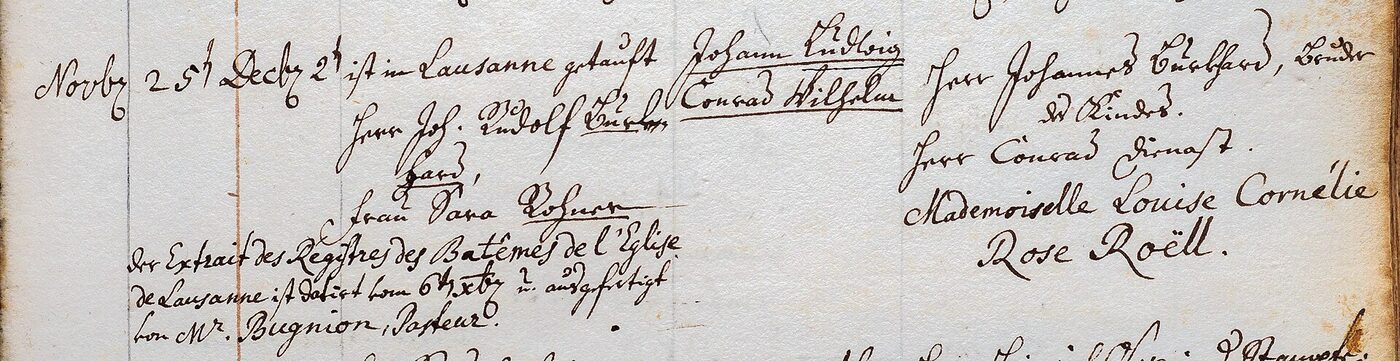
Before a German record can be weighed it has to be read, and for most of the period genealogy is concerned with that means a script that has not been the ordinary school hand anywhere in German-speaking Europe since 1941. Kurrent, the German cursive, developed in the early sixteenth century out of the chancery bastarda, and from then until the middle of the twentieth it was the ordinary handwriting of the entire German-speaking area. Palaeographically it belongs with the broken scripts: it is a pointed hand, angular where Latin cursive is round, and its letters are not variants of the Latin forms but a separate alphabet. The small n and u are drawn identically and are told apart only by a bow written over the u; a straight line over an n or an m is not a flourish but a mark of doubling; and the small e has a form of its own that looks to a modern eye like another n.
What makes it harder is that German writers kept two hands at once. The convention that printed German was set in Fraktur while Latin and foreign words were set in Antiqua had a handwritten twin: German text in Kurrent, and Latin cursive for headings, proper names, foreign words and letters written to foreigners. An educated writer commanded both and switched between them mid-sentence, so a single register page can carry two alphabets, and the switch itself carries information about how the writer classified what he was writing.


Kurrent was not only German. With small changes it was used in Denmark and Norway, where it was called gotisk skrift and remained in use until 1875, and in Czech; in Austria it became the ordinary hand of office and record as well as of correspondence, and in Switzerland it served all three purposes until the early twentieth century. The group's charter covered the German-speaking world rather than any state, and the script followed the same map.
In 1911 the Prussian ministry responsible for culture and schools commissioned the graphic artist Ludwig Sütterlin to design a teaching hand that beginners could actually manage. Sütterlin simplified the letter forms, brought the ascenders and descenders into equal proportion with the body of the letter, stood the relatively broad letters upright, and had children write with a ball-point nib that produced an even stroke instead of the swelling line of the pointed pen. He designed a Latin companion hand in the same style at the same time. The German one was introduced in Prussia from 1915, began during the 1920s to displace the older form of Kurrent, and in 1935 was adopted in a modified version — slightly sloped, with fewer round forms — as the Deutsche Volksschrift and made part of the official curriculum. In Austria it was never introduced at all; Austrian schools went on teaching traditional Kurrent, which is why an Austrian parish entry of the 1930s can look older than a Prussian one of the same year.
1941, and what a decree does to an archive
The end came by decree, in two stages, and both are dated. On 3 January 1941 Martin Bormann circulated a decision of Hitler's, in a non-public circular, that the broken types were to be abandoned and Antiqua designated in future as the Normal-Schrift, printing to be converted to it by degrees and school teaching to follow as soon as textbooks allowed. The circular's stated reason was a fabrication about the origins of the Schwabacher type, and it contradicted every argument advanced on either side during sixty years of the German script quarrel; the reasons offered inside the administration were different again. Hans Heinrich Lammers passed the decision to the supreme Reich authorities on 13 January with the explanation that the script damaged German interests at home and abroad because foreigners who knew the language mostly could not read it.
The second stage is the one that matters to genealogy. On 1 September 1941 the Reich ministry for science, education and popular education issued a decree regulating writing instruction in schools. The Deutsche Volksschrift was given up; from the school year 1941/42 only a Latin cursive, the new Deutsche Normalschrift, was to be taught. A companion decree of the same date settled reading: Fraktur type was still to be taught in the second and third school years so that the existing books and papers could go on being read fluently, but the reading of German cursive handwriting was to be dropped.
That distinction, made in an office in Berlin in September 1941, is a large part of the reason German family history is difficult in a way that English or French family history is not. Printed Fraktur survived in the curriculum and then in habit; the handwriting did not. The Normalschrifterlass lost its force in 1945, and after that Kurrent was taught in some West and East German schools as an additional hand alongside the Latin one, in places into the 1970s and 1980s, but it was hardly used in practice; the practice ended in the 1980s, once the older generations who had still commanded the script and used it from habit had left working life. Every parish register, every registry entry, every letter and land record and court file in German before the middle of the twentieth century is written in a hand that no ordinary schooling since has taught anybody to read.
Hence the steadiest genre of traffic a group with this charter could carry. The pattern is constant wherever the work is done: an entry that will not yield, a description or a scan put where others can see it, then replies offering a reading, disputing a letter, or — more often than the outsider expects — recognising a formula rather than deciphering it, since register entries are largely boilerplate and boilerplate can be learned. This is palaeography, one of the auxiliary sciences the charter listed, done by amateurs.
The parish registers
The backbone of German research before the registry offices is the Kirchenbuch, the parish register — Matriken in Austria, Rodel in Switzerland. The oldest instructions to keep such books in the German-speaking area came from Friedrich III of Zollern, bishop of Constance, in 1435; the fact that the order had to be repeated constantly shows how slowly it was obeyed. The oldest surviving example from the German-speaking area is a baptism book from Basel begun in 1490, now in the British Museum in London.
Two dates then set the pattern. In the regions where the Reformation prevailed, registers were kept from the beginning, which makes Protestant series roughly fifty years older than Catholic ones. For the Catholic Church the requirement came from the Council of Trent, whose twenty-fourth session promulgated the marriage decree Tametsi on 11 November 1563, ordering marriage registers and, with them, the introduction of baptism books. Forms for burial registers and confirmation registers appeared only in the Rituale Romanum of 1614, and even that had no binding force, so the quality of entries continued to vary with the diligence of the individual priest.
What the books contain is therefore uneven by nature. A baptism entry records the child, the date of baptism, the parents and the godparents, and often the dwelling place and the occupation as well; but because the books were kept in the first place to record a church act, entries made before printed forms became usual in the seventeenth century often give only the place and date of the baptism or the burial, not of the birth or the death. Mothers' names are frequently missing from old baptism entries, sometimes both parents'. Catholic registers were kept almost exclusively in Latin until about 1800 and in the vernacular thereafter, following the Protestant registers, and until that point surnames are spelled as the priest heard them, since he was writing down what was said rather than copying a document.

The registers were also, from early on, quietly conscripted by the state. Duplicate copies, first introduced in France under Louis XIV, had to be delivered annually to state offices so that a central authority could track population movement; in Austria Joseph II and in Prussia the Allgemeines Landrecht obliged priests or sextons to make and hand over second copies for state purposes. Those duplicates are frequently the only survival where the original has been lost, and where and whether they survive is precisely the kind of local knowledge a newsgroup could carry and a search engine could not.
Survival is the recurring problem. Continuous large-scale survival begins only after the Thirty Years' War, in which registers were destroyed on a considerable scale; the Napoleonic coalition wars between 1797 and 1809 took more, and the Second World War took more again. For the generations they do cover, these books are often the only written evidence that a person existed at all, because entries were made for every member of the parish regardless of rank, sex or property.
The registry offices, and three countries' dates
Civil registration is the other great record class, and its introduction is the single most useful date in German genealogy because it divides the sources in two. Civil registry offices first appeared on German soil under French occupation: they were introduced in the Rhineland between 1792 and 1808, the oldest surviving registry books date from 1792, and the rest followed under the Code civil. That is a local exception the better part of a century ahead of the rest.
For Germany as a whole there are three dates rather than one. Baden introduced the Standesamt on 1 February 1870; Prussia on 1 October 1874; and the Reich law on the registration of civil status and on marriage of 6 February 1875 established registry offices uniformly across the German Empire from 1 January 1876. From that moment births, marriages and deaths were recorded by state officials in dedicated registers, and a marriage was valid in civil law only if concluded before a registrar. Roughly speaking: after 1876 the researcher works from the civil registers and turns to the church books for confirmation; before 1876 there are no civil sources at all, only the parishes.
The other two countries in the group's remit ran to different clocks. In Austria the registry offices were at first competent only for people belonging to no legally recognised church or religious society, under a law of 9 April 1870; their competence extended to Burgenland from 1 October 1895 and to the rest of Austria only on 1 January 1939, following the introduction of compulsory civil marriage on 1 August 1938. Before those dates the religious communities kept the Austrian civil-status books, and the originals largely remain in the parishes to this day, with copies at the diocesan administrations — the opposite of the German arrangement, where older volumes were gathered into central church archives. Switzerland introduced the Zivilstandsamt in 1876, the same year as the German Empire. The circumstances in which Austria's registers changed hands belong to that country's own history and are told on the Austria page; here they are a records question, and the records question is simply that an Austrian civil-status search before 1939 goes to a parish.
Which is why a useful query in German genealogy has three parts rather than one. It names a place, a period and a confession. The place decides which parish and which registry district; the period decides whether there is a civil register at all; and the confession decides which of two or three parallel sets of books in the same village will contain the entry. Leave one of the three out and the question cannot be answered even in principle.
Archives, borders and losses
The structural difficulty of German genealogy is not that the records were badly kept. It is that the state whose officials kept them no longer exists, and that its territory is now divided among several. Records for places that are today in Poland, Russia, Lithuania and the Czech Republic sit in the archives of those countries, in central German archives, or nowhere; a single family that moved twice in the nineteenth century can require correspondence in three languages with three archive administrations under three different access regimes.
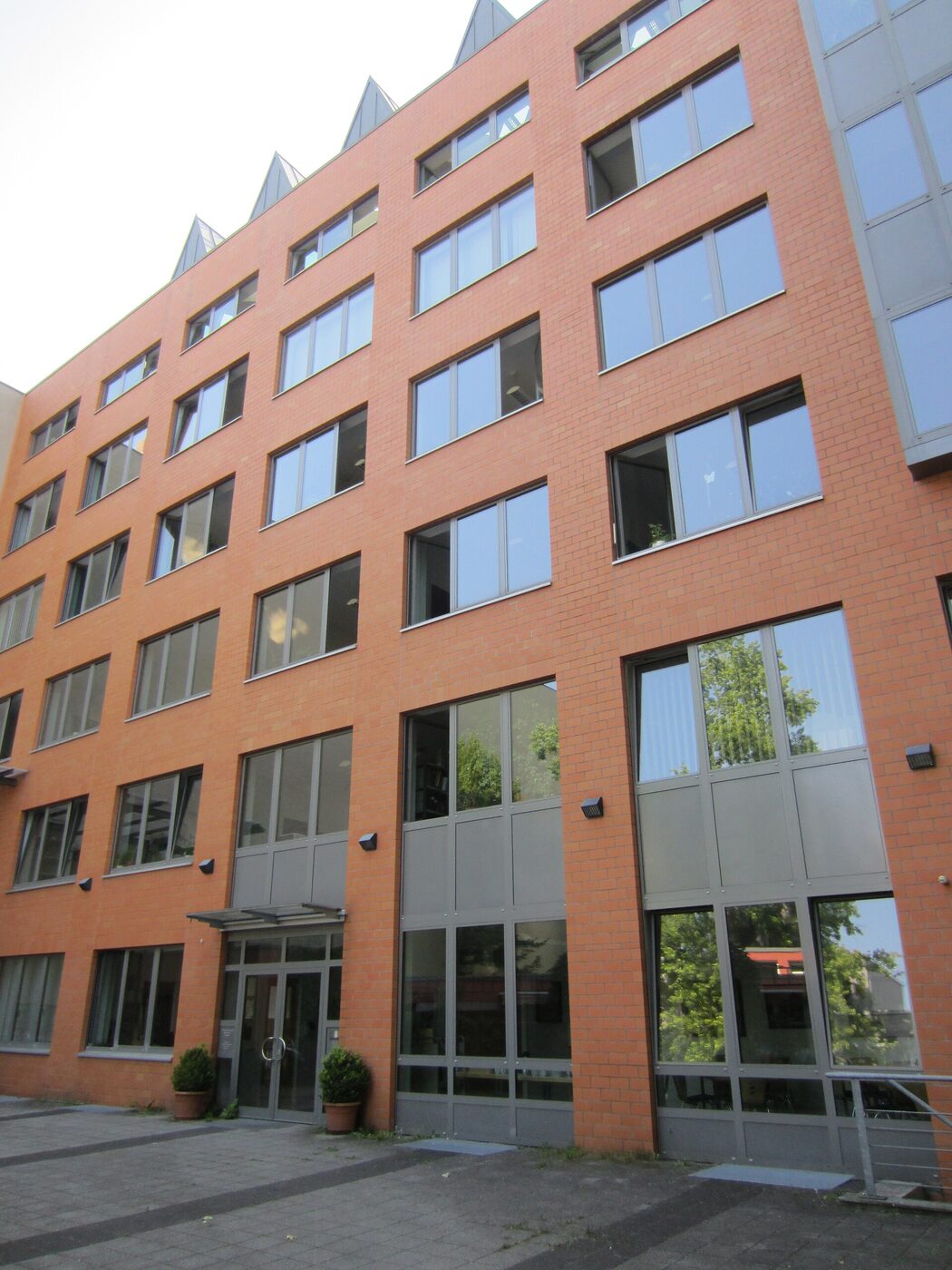
The best-documented instance of what survived is the church-book office of the Evangelisches Zentralarchiv in Berlin, which is responsible for the records of the former Protestant congregations of the Prussian church provinces east of the Oder and Neisse and for congregations abroad. Its holdings are countable: about 6,000 church books from congregations of the Evangelical Church of the Old Prussian Union in East Prussia, West Prussia, Brandenburg east of the Oder, Pomerania, Posen and Silesia — territories that have belonged since 1945 to Poland, Russia and Lithuania and where no German Protestant congregations remain; about 750 military church books of the Prussian army and the Wehrmacht; about seventy from German-speaking congregations abroad; and civil-status records from Danish refugee camps. For conservation reasons the volumes themselves are no longer produced, and readers work from microfiche.
The archive's own account of that office states the practical position plainly: because of the sheer number of enquiries, genealogical search requests can be dealt with only in exceptional cases, and anyone interested is free to do the research themselves in the reading room. The institution holding the records does not answer questions about them at the rate the questions arrive. What is left is to travel, or to ask somebody who has already been.
The other great German-language collection is in Leipzig, and its story is told below, because it cannot be separated from the 1930s. Alongside them stand the Prussian records proper: the Geheimes Staatsarchiv Preussischer Kulturbesitz in Berlin, which holds roughly 38,000 shelf-metres of Brandenburg-Prussian material and was made responsible, under the winding-up legislation of 6 September 1965, for certain archive and registry holdings from the local authorities of the former Prussian eastern provinces.

Loss is documented too, and not only from the war. The most precisely recorded German archival catastrophe of recent times happened long after this group was founded: on 3 March 2009 the building of the historical archive of the city of Cologne collapsed, together with two neighbouring houses, because of a fault in the construction of a slurry wall for an underground railway tunnel. Two people were killed. Around ninety per cent of an archive of some thirty shelf-kilometres was buried, much of it in groundwater. Recovery work was declared finished on 9 August 2011 with about ninety-five per cent retrieved, a proportion that had until then been described as the optimistic case; cataloguing the recovered material took until 2021, a large part of it still needs restoration, and the replacement building opened on 3 September 2021. Not all German archival loss belongs to the war years.
The Ahnenpass and the descent bureaucracy
Between 1933 and 1945 German genealogy was not only a hobby. It was, for millions of people, compulsory paperwork, and the documentary trail it produced is part of the archival record a researcher meets today. It is set out here with dates, because the sources described above cannot be described accurately without it.
The legal basis was paragraph 3 of the Law for the Restoration of the Professional Civil Service of 7 April 1933, the first racially grounded law of the German Reich and one of the best-known instances of the so-called Aryan paragraph, which provided that officials not of Aryan descent were to be retired. Its first implementing ordinance of 11 April 1933 defined non-Aryan descent by reference to parents or grandparents, and, in the absence of any racial marker, fell back on the religion of the ancestors: it was to be assumed in particular where a parent or a grandparent had belonged to the Jewish religion. The proof required was documentary — seven birth or baptism certificates and three marriage certificates, for the subject, the parents and the four grandparents — and only certified extracts from civil registers or church books were accepted. The Reich Hereditary Farm Law of 29 September 1933 extended a far longer proof to farmers, back to 1 January 1800; the Nuremberg Laws of 15 September 1935 widened the requirement further; and party, SS and professional bodies imposed the long form on their own members.
The Ahnenpass was the container for all this: a bound booklet of printed forms for certified copies of the birth, baptism and marriage records of one's ancestors, filled in by a registrar or a church-book keeper. The first blanks were produced from the spring of 1933 by the Reich association of German registrars, founded in 1920; a circular of the Reich and Prussian interior minister of 26 January 1935 authorised registrars to certify entries in them; at least seventeen publishers printed and sold them between 1933 and 1945. Possession was never legally compulsory even after 1935 — a 1936 encyclopaedia entry called it not prescribed by law but advisable — but a complete certified Ahnenpass replaced the sheaf of separate certificates otherwise demanded, and it was pressed on everybody.
The demand fell on the parish registers, because before 1876 there was nothing else. Catholic dioceses and Protestant parish offices supplied information from their books to the state authorities from April 1933, reaching back before the eighteenth century, and the church administrations had their own forms printed for the purpose; a report of May 1935 states that 12.5 million church-book extracts were issued in the first two years alone. A count of May 1939 put the number of citizens obliged to produce proof of descent under the 1933 law at 4,737,962. Whatever else that is, it is a bureaucracy running on baptism registers.
Doubtful cases went to a central office. A post of expert for racial research was set up in the Reich interior ministry in 1933 with around sixty staff; it was renamed the Reichsstelle für Sippenforschung in March 1935, and again, on 12 November 1940, the Reichssippenamt. It employed up to 125 people and had issued more than 112,000 descent rulings by the time of the renaming, commissioning several thousand hereditary and racial-biological reports from university institutes to decide individual cases. Among its tasks were the securing of old church books, the promotion of descent research, and the evaluation of Jewish civil-status registers — the birth, marriage and death registers of the synagogue communities, together with circumcision books, cemetery registers and membership lists — gathered, in forced collaboration with the Reich Association of Jews in Germany, into a central office established in the rooms of the former General Archive of German Jews in Berlin. Those documents were moved to Rathsfeld castle in the Kyffhäuser for protection against air raids and filmed there between 1943 and 1945 by a Duisburg firm.
The filming programme is where the period reaches directly into present-day research. Systematic microfilming of church books began in November 1933 with the holdings of the old Berlin church-book office; in 1934 filming moved to the eastern provinces of West and East Prussia, Pomerania, Posen and Silesia, and then to parts of the rest of the Reich and to German settlement areas abroad. The closing year chosen for the filming was 1875, the year the registry offices were set up in Prussia, so the films stop where the civil registers begin; only for the German communities abroad do they run later, to 1940 and in Transylvania to 1944. A great deal that no longer exists in the original exists because it was filmed for this purpose. That is a statement of provenance, and German archives make it themselves in their finding aids.
After 1945: where the films went
The office was gone by 1945; its records were not. Parts of the Reichssippenamt's holdings had been evacuated from Berlin to castles in Thuringia and salt mines near Magdeburg, which left the bulk of them, in 1945, in the Soviet occupation zone. Paul Langheinrich, a genealogist familiar with the collections from before the war, gathered them from 1946 at Wolfsgrün and Eibenstock in the Erzgebirge as a German archive for genealogy; the collection moved in 1948 to the public scientific library in Berlin, in 1952 to Potsdam, and in July 1965 — some 250 shelf-metres of it — to the state archive in Leipzig.
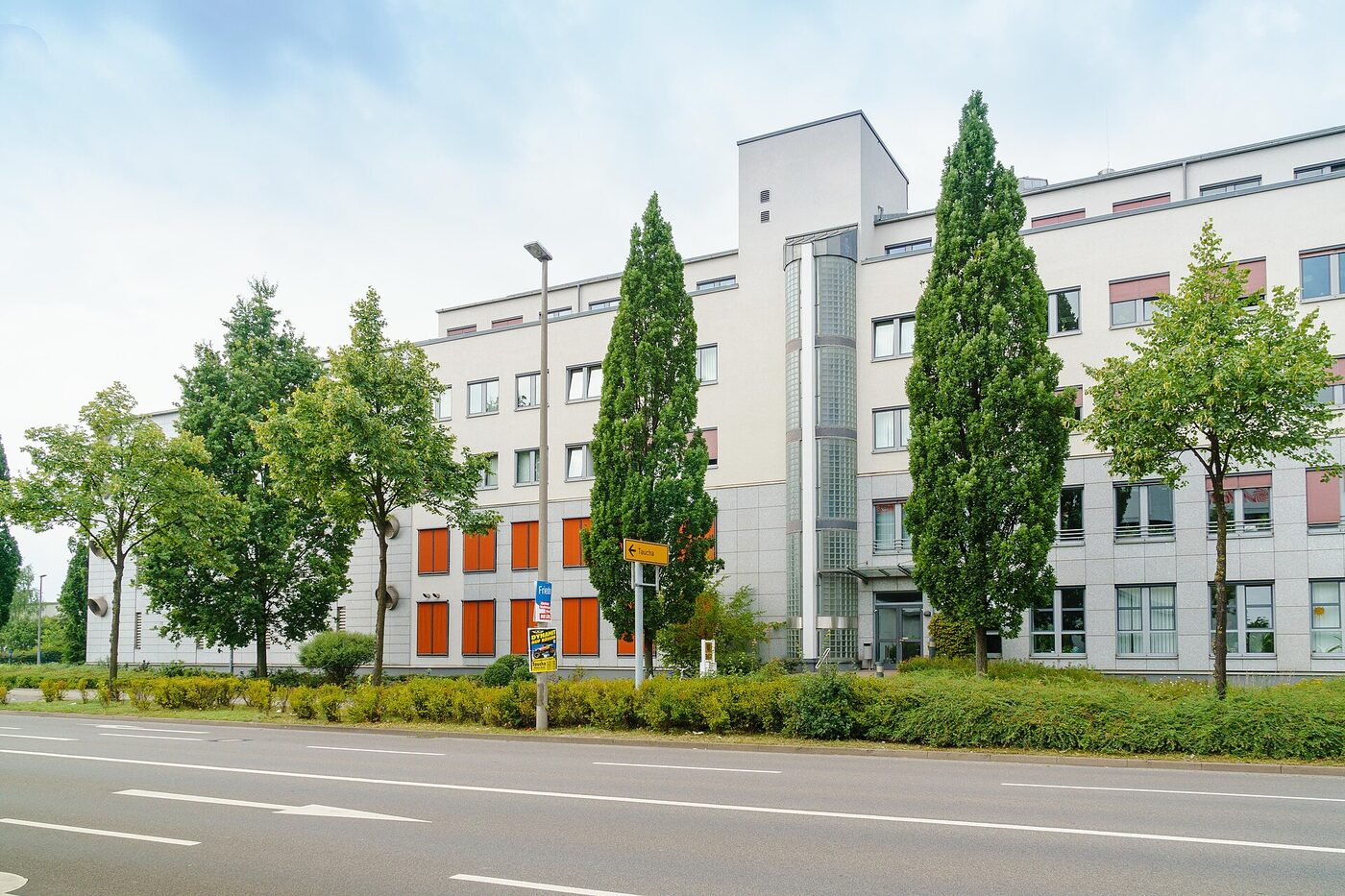
In 1967 that archive, the collections of the old Leipzig Zentralstelle für Deutsche Personen- und Familiengeschichte (founded in 1904 and wound up in the same year) and the holdings of various dissolved societies were combined into a newly founded Zentralstelle für Genealogie in der DDR and made publicly usable again in the former Reich Court building; part of the Reichssippenamt material reached Leipzig in 1968. On 3 October 1990 the Leipzig institution passed to the Free State of Saxony as the Deutsche Zentralstelle für Genealogie, and in 1995 it was incorporated as a department into the Staatsarchiv Leipzig, where it is now section 33 of the Saxon State Archive. Saxony's archive law of 17 May 1993 names it explicitly as the special archive for personal and family history.
Its published lists of holdings are the fullest description of what the period left behind, and they run to four parts: the church-book material of the eastern provinces of Posen, East and West Prussia, Pomerania and Silesia; the archival and church-book material of German settlement areas abroad, from Bessarabia and Bukovina through the Baltic states, Transylvania, the Sudetenland, Slovenia and South Tyrol; the church books of the German states and provinces; and the local family books held at Leipzig. Alongside them sit the other genealogical collections of the Reichssippenamt: military church books, Jewish civil-status documents, Huguenot records, and genealogical, seal and armorial collections.
The archive is equally candid about the material's defects, and they are the defects of the programme that produced it. There is no local or chronological completeness. Name indexes are rare. Legibility is often impaired by the condition the books were in when they were filmed. And, in a detail that has cost researchers whole afternoons, the church books were filmed as separate left and right pages, so that a single opening has to be reassembled from two images; evaluation as a rule requires working in Leipzig itself.
The Ahnenpass itself was disposed of quietly. After 1945 there was no longer any occasion to continue one; the provisions on certifying entries in them were struck from the service instructions for registrars during the 1950s, in North Rhine-Westphalia on 12 January 1955, and German civil law records that an Ahnenpass does not carry the evidential force of a civil-status certificate. The family record book that replaced it corresponded to the one used in the Weimar period. Ahnenpässe were handed back to their holders after being produced and were never centrally archived, so they are to be looked for in family papers rather than in public collections; and a researcher does meet them, because a certified transcript made in 1938 from a parish register destroyed in 1944 is, whatever it was made for, sometimes the only copy of the entry that exists.
One German genre carries the same double history. The Ortsfamilienbuch, or local family book, reconstitutes every family of a single place from its registers and whatever else survives, so that a parish is worked through once and for all instead of one ancestor at a time. The printed genre is much older than the period: the oldest known example anywhere is the family statistic of the parish of St Niklaus in Valais, published in 1861 by its priest, with family entries reaching back to the turn of the sixteenth and seventeenth centuries, and Württemberg had made a family register compulsory in every municipality in 1807. During the Nazi years the Reichsnährstand pressed, as part of its blood-and-soil policy, for a Dorfsippenbuch for every village and organised the card-indexing of church books to that end. From the 1950s family and local historians resumed the work free of those aims, the registers of more than two thousand communities have now been worked up in this form and printed, and a growing number are published online through the genealogy.net site described below.

Files, programs and shared databases
German computer genealogy had the same two problems as everyone else's: getting a family into a machine, and getting it out again in a form another machine would accept. The first genealogy program, still DOS-based, was written around 1980 for the Genealogical Society of Utah; Personal Ancestral File was developed onwards from there, was last updated in 2002 and was withdrawn from download and support on 15 July 2013. GEDCOM, the exchange format devised alongside it and first released by the Church of Jesus Christ of Latter-day Saints in 1984, did the second job well enough to become the de facto standard and loosely enough to keep every genealogy forum in the world busy.
The version history explains the complaints. Version 5.5 carries the date 11 December 1995, with a corrected version issued on 10 January 1996, and it is the release most of the software of this group's years wrote and read. A 5.5.1 draft followed on 2 October 1999, introducing nine new attributes and tags and adding UTF-8 as an approved character encoding; it was never formally approved, its provisions were adopted in part by a number of programs, and it was released as 5.5.1 final only on 15 November 2019, twenty years later. Version 7.0, which requires UTF-8 throughout, appeared in 2021. In other words, for the entire life of this newsgroup the industry's exchange standard was a document in draft.
The character-set question was not academic for German users. The header of a GEDCOM 5.5 file conventionally declared ANSEL, a bibliographic character set that adds sixty-three graphic characters to ASCII, twenty-nine of them combining diacritics — so an umlaut is not a character but a letter with a mark attached to it. Many suppliers never fully implemented the multilingual Unicode support the specification offered instead. A file that survived one program's export and another's import with every a-umlaut and every eszett intact was not something to take for granted, and neither was one that kept its notes: in 2001 the GEDCOM TestBook Project tested how well four popular genealogy programs conformed to 5.5 and reported that the commonest fault leading to data loss was the failure to read the note tag at all the levels at which it can appear.
The programs themselves were frequently German and frequently small. Ahnenblatt is the characteristic case: begun in 1992 on the Atari ST and for Windows 3.1, published as version 1.0 on the Internet in February 2001, distributed as freeware, storing its data in its own format and importing and exporting GEDCOM. It stayed monolingual German until version 2.50 in 2008 and free until version 3 in May 2019, and in the reader surveys the association's own magazine ran in 2018 and 2021 it came out as by far the most-used genealogy program in the German-speaking world. What such a program could hold, what it printed and what it silently dropped were proper subjects for a group with this charter, alongside the commercial German packages and the translated American ones.
The durable work, though, was collective, and most of it ran through one association. The Verein für Computergenealogie was founded in Dortmund on 26 October 1989, originally under the cumbersome name of an association for the promotion of computer-supported family research; it is seated in Lünen, has more than 4,200 individual members besides numerous member societies, is the largest genealogical association in Germany, and publishes the quarterly magazine Computergenealogie. Its web services gathered the volunteer projects: GenWiki, a genealogical wiki conceived in 2003 and started in the summer of 2004, carrying regional articles, glossaries of occupations and diseases and long source bibliographies, and grown by the end of 2017 to more than 413,000 articles; the Geschichtliches Ortsverzeichnis or GOV, a gazetteer of historical places recording each one's shifting political and ecclesiastical affiliations, interlocked with the wiki from the start; and a data entry system for structured transcription directly from a scan, whose first project captured some eight million person records from the casualty lists of the First World War. The online local family books are published through the same site.
Microfilm, and the way research actually worked
For most of the group's life the practical route to a distant parish register was not a website. It was a roll of film. The Genealogical Society of Utah, founded on 13 November 1894, began microfilming genealogically relevant originals in the United States in 1938 and in Europe in 1948; the negatives are kept near Salt Lake City in six climate-controlled tunnels under two hundred metres of granite. By 2004 filming had taken place in about 160 countries, the collection stood at some 2.3 million rolls, and more than 250 filming projects were running in more than forty-five countries. Copies could be ordered into any of the society's local research centres — the first branch opened in 1964, there were about 200 by 1976, 400 by 1982, 1,200 by 1988 and about 2,250 by 1994 — and had to be read there, on a reader, without taking them home.
The German order figures for exactly the years this directory covers are on record: about 29,800 film orders in 2000, 32,600 in 2001, 38,500 in 2002 and 37,600 in 2003. That is what German family history looked like while de.sci.genealogie was young. Somebody worked out which parish, which years and which confession; somebody ordered a film; somebody sat in front of a reader in a suburban centre and read Kurrent off a screen. A newsgroup was of use mainly at the first of those three steps, because the second and third were slow and the cost of aiming at the wrong parish was measured in weeks.
The alternative arrived during the group's own first year. FamilySearch opened to the public in May 1999 after a beta release on 1 April that went offline almost immediately under the load; within days of the official launch the site had taken an estimated hundred million hits and visitors were being limited to fifteen minutes at a time. In November 1999 another 240 million names were added, bringing the total to 640 million. The society stopped making microfilm around 2016 and now captures documents as digital images.
The church archives followed, later and on their own terms. The Protestant church-book portal Archion, run by a company founded in Stuttgart in May 2013 by the Evangelical Church in Germany and eleven regional churches, opened a beta at the 66th German Genealogists' Day in Kassel on 13 September 2014 and went live on 20 March 2015 with about 40,000 church books and some 2.5 million pages digitised; the figure passed 120,000 books and 19 million images in 2021 and more than 175,000 books with nearly 30 million pages by its tenth anniversary in March 2025. That is the machinery that eventually took over the work — a decade and more after the group was founded, and not before.
Data protection, and the people who are still alive
Genealogy in Germany runs into privacy law earlier and harder than in most countries, and the constraint is a real one rather than a rhetorical worry. It has three layers, and all three are written down.
The first is the civil-status law. Under the reformed Personenstandsgesetz, in force since 1 January 2009, a registry office keeps each register for a fixed period before it goes to an archive: eighty years for marriage and civil-partnership registers, a hundred and ten years for birth registers, thirty years for death registers, and eighty years for the death registers of the special registry office at Bad Arolsen. Until those periods expire, the register is not an archival source at all. Certificates, information and inspection are available to the person the entry concerns and to their spouse, civil partner, ancestors and descendants; anybody else must make out a legal interest, with a lesser standard for a sibling asking about a birth or death entry, and applicants must be over sixteen. There is one relief for researchers: before the period expires, a legitimate interest suffices once thirty years have passed since the death of the last of the people the entry concerns. Once the period does expire, archive law takes over.
The second layer is that archive law. For federal records the general protective period is thirty years from the creation of the document. Records that relate by purpose or substance to named individuals may be used, after that, at the earliest ten years after the person's death; where the year of death cannot be established without disproportionate effort, the period ends a hundred years after birth, and where the date of birth cannot be established either, sixty years after the document was created. The federal states and the church archives have their own comparable rules. The practical effect is that a German researcher can usually reach a great-grandparent's civil-status entry and often cannot reach a grandparent's, and that the answer to almost any archive question of the form may I see this depends on arithmetic performed on somebody's death date.
The third layer is data protection proper. The General Data Protection Regulation was published in the Official Journal on 4 May 2016, entered into force on 24 May 2016 and has applied since 25 May 2018; it governs information relating to an identified or identifiable natural person. A family tree is mostly a document about the dead, but its youngest branches are not, and the ordinary consequence for the hobby is the one already built into the software: genealogy programs conventionally let the user restrict what is passed on, typically by excluding information about living persons from an export.
What is striking, reading the group's founding charter a quarter of a century later, is that it had already drawn the same line by hand. Research into descendants was a subject of the group; search notices for people still living were not wanted, and the charter said other groups existed for that. That sentence was written in 2000, eighteen years before the Regulation applied. It was a piece of scope-setting rather than a piece of law, and it happened to point the same way.
What the group carried
No archive of de.sci.genealogie's traffic is presented here, and no thread, poster or posting count is described below. What can be stated honestly are the classes of traffic that a group with this charter, in this hierarchy, necessarily carried, each of them anticipated in the charter itself or entailed by the state of the sources described above:
- Transcription help. An entry that will not yield, put where others can see it, and the collaborative reading of it. The single most characteristic genre, and the one the charter covers under palaeography.
- Archive questions. Which office holds which register after a century of boundary changes; what a given archive's access rules permit; what to do when the registry district one needs has not existed since 1945. The charter names information about archives explicitly.
- Software questions. German-language genealogy software is named in the charter's first paragraph. In practice that means program comparisons, GEDCOM import and export, character sets and what a given program does to data it does not understand.
- Construing the record. Latin formulae in Catholic registers, obsolete occupational terms, old disease names in death entries, calendar and dating puzzles of the kind that appear to put a baptism before a birth.
- Names. Origin, meaning and regional distribution of surnames — onomastics, again named in the charter, and the subject on which the gap between rigour and folk etymology is widest in any language.
- Migration. Also named in the charter: movement within the German-speaking lands, the settlements to the east and south-east, and emigration overseas — more than five million European emigrants left through Hamburg alone between 1850 and 1939.
- Method, argued at length. What counts as a source, how a source should be cited, when a hypothesis may be written down as a fact, and how much of a family tree should be published. These are the standing arguments of the discipline rather than of the group, and they are not settled anywhere.
The group also sat in a landscape of neighbours rather than alone. On the English-language side, soc.genealogy.german served the mirror-image audience — descendants of German emigrants working back towards Europe, often without much German — and it is one of nineteen soc.genealogy.* groups still carried in the current international active file, whose mailing-list gateways are described on the soc.* hierarchy page. German-language family history also ran on the mailbox networks: MausNet still lists maus.wissenschaft.genealogie, filed, like this group, under the sciences rather than the social subjects. And the association's own mailing lists and forums drew on much the same pool of researchers as the newsgroup did.
The working language was German throughout, and that boundary followed none of the ones on the map. The subject reached across Germany, Austria and Switzerland, back into parishes now in Poland, the Czech Republic, Lithuania and Russia, out to the German-speaking settlements of eastern and south-eastern Europe, and on to the emigrant communities of the Americas. The records themselves are in German and, in Catholic parishes, in Latin, with other languages appearing as one moves east.
What the record does not show
The administrative record for this group is excellent and the discursive record is almost entirely absent, and it is worth being explicit about which is which.
What is documented, and quoted above, is the creation procedure with its dates and tallies, the charter, the official one-line description, the unmoderated status, and the deletion. What is not documented anywhere consulted for this page is the group itself: no subscriber figure, no traffic measurement, no list of regular participants, no famous thread, no surviving frequently-asked-questions posting under this group's name. Nothing here should be read as implying otherwise. The classes of traffic listed in the previous section are inferences from the charter and from the state of the sources, not summaries of counted postings.
Two further gaps are worth naming. First, the relationship between the newsgroup and the association's mailing lists and forums is not documented in any source read here; the two overlapped in subject and probably in people, and how traffic moved between them is not recorded. Second, the reasons the group's traffic declined are not recorded for this group specifically. The general pattern — German-language Usenet losing participants and postings from the middle of 2001, web forums and searchable databases taking over the work — is documented for the hierarchy as a whole, and the digitisation dates above show what the alternative looked like as it arrived; but no source read here connects those developments to this group's own traffic, and the connection is asserted here only as the general one.
Scope and limits
de.sci.genealogie was retired in 2026, by the same procedure that created it and with the same paperwork. The control message that removed it names the four postings that preceded it: a Request for Discussion on deletion published on 4 March 2026, a first Call for Votes on 19 March, a second on 2 April, and the result on 19 April. The tallies of that ballot are not reproduced here, because the result posting was not available for this page; what is on the record is the outcome. The rmgroup control message went out on 1 May 2026, signed like the newgroup message twenty-six years before, and reads, in its entirety, as a request: please remove de.sci.genealogie. The group's name is absent from the current de.sci block of the international active file, which now lists twenty groups from astronomy to theology. What the hierarchy's own housekeeping did in 2026, and to which of this directory's other groups, is recorded on the de.* page.
This page describes the group as the news2mail gateway carried it, in the first years after its creation, and the description above is drawn from the group's own administrative record and from the documented history of its subject. It is not drawn from the group's postings, which are not archived here. Where the world outside the group is described — the scripts, the registers, the archives, the law — the dates are those of the published record; where the group's internal life is described, the account stays at the level of classes of traffic, because that is as far as the evidence goes.
The remaining German-language material about the discipline outlives the medium comfortably. Advice about where a class of record survives ages far better than the interfaces built on top of it, and the underlying facts have hardly moved: the registers still begin where they begin, the border of 1876 still divides the sources, the eastern books are still in Berlin and Leipzig and Warsaw, and the hand is still unreadable to anyone who has not learned it. What changed is that the questions are now typed into search boxes. What has not changed is that somebody, somewhere, still has to sit down and read the entry. For the branch of the English-language namespace this group's German equivalent was filed under, see the sci.* hierarchy.
Reading de.sci.genealogie today
- Historical archive: Google Groups — de.sci.genealogie (coverage varies by group and era).
- Open in a newsreader:
news:de.sci.genealogie— the original site offered exactly this link, and it still works if your system has a newsreader registered for thenews:scheme. - Live access: point an NNTP newsreader at a modern server — see accessing Usenet today.
- The original news2mail e-mail subscription service ended in the mid-2000s and no longer operates.