The de.* hierarchy — German-language Usenet
de.* is the German-language hierarchy, with its own governance, its own proposal-and-vote procedure and its own announcement groups, run separately from the Big-8. Its groups are written in German; the descriptions here are in English, the language of this directory.
On this page
Before de.*: news over UUCP from Dortmund
German-language Usenet began as a university operation. EUnet, the European Unix network, was founded in 1982 and grew out of the European Unix Systems User Group; its German end started in 1983 on a machine called unido in the Informatikrechner-Betriebsgruppe (IRB) at the Universität Dortmund. That machine, a DEC VAX-11/750, became the German backbone site. Traffic moved by UUCP, the store-and-forward protocol, and the two services on offer were mail and news.
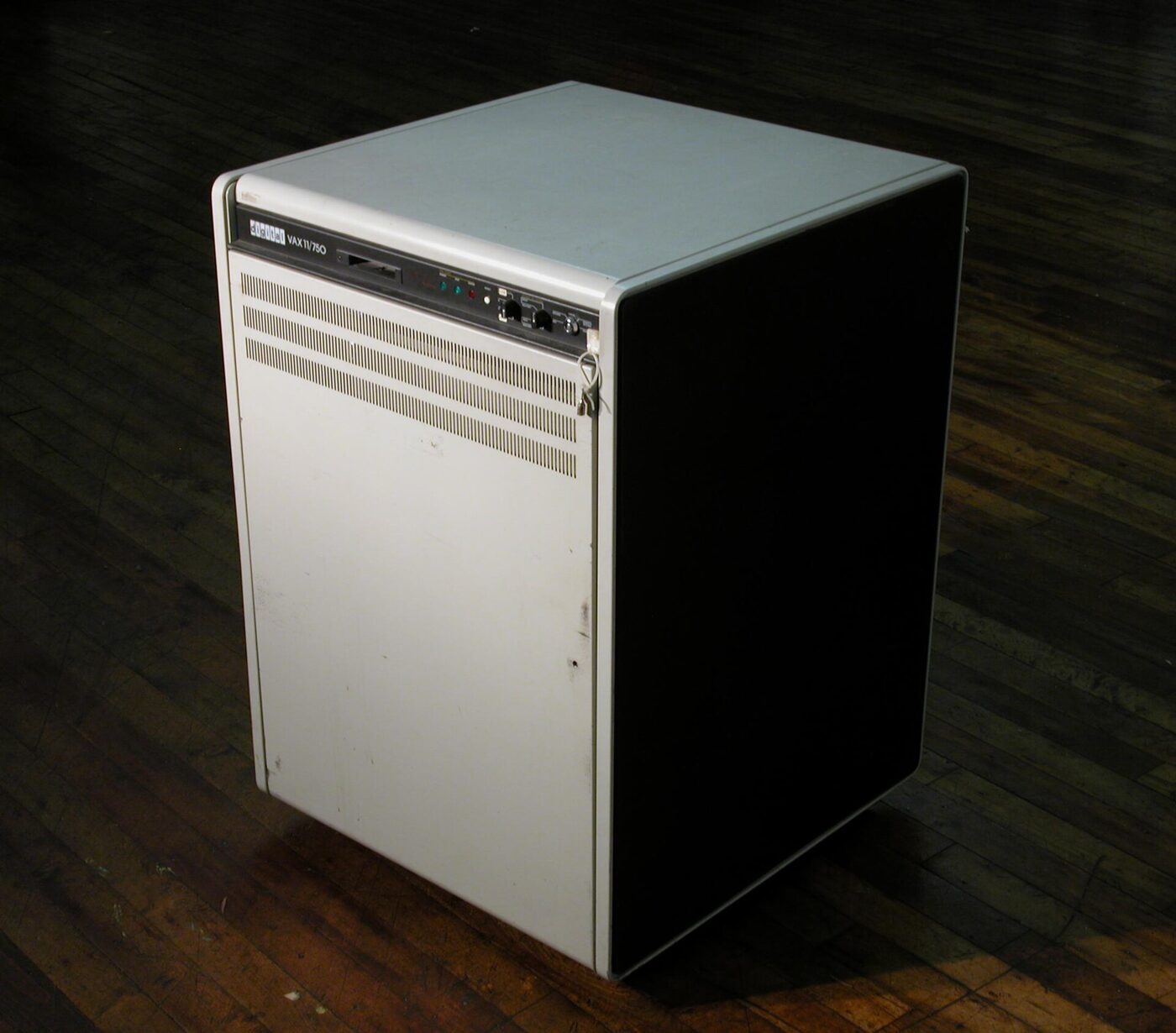

Store and forward meant what it says: a machine dialled its neighbour, handed over whatever had accumulated since the last call, took whatever was waiting for it and hung up. The German end of EUnet was one of the first German internet-provider projects, and mail and news were the two services it offered from the start.
The Internet arrived in Germany on a separate track. On 3 August 1984 at 10:14, Michael Rotert received the first internet e-mail addressed to Germany at the Institut für Telematik of the Universität Karlsruhe — a greeting sent the previous day, at 12:21 on 2 August, by Laura Breeden of the CSNET coordination centre in Cambridge, Massachusetts. For much of the 1980s the two strands ran beside one another: UUCP news out of Dortmund, CSNET mail into Karlsruhe. Both institutions reappear further down this page, in the history of the .de domain.
Two hierarchies become one, 1992
What this directory lists as de.* was assembled in 1992 out of two older German-language hierarchies. dnet.* came from the German part of EUnet; sub.* was distributed mainly in the SubNet. The reference text on the hierarchy that is still posted weekly to de.newusers.infos records the merger in its opening section, and the German Wikipedia article on Usenet dates it to January 1992, describing de.* as the answer to a demand for newsgroups in languages other than English as Usenet spread beyond the United States.
Usenet was not the only place German was being written at the time. The Z-Netz — first called the Zerberus network, after the mailbox program of the mid-1980s on which it ran — was the first democratically organised German-language mailbox network, and it deliberately put non-computing subjects such as environmental protection, politics and literature in the foreground. From 1992 it exchanged mail and news using its own protocol, ZConnect, and networks including the T-Netz, the trade-union-oriented Solinet and the left-leaning CL-Netz grew out of its structures. These were boards reached by dialling in rather than Usenet groups, and they are a different lineage from de.*; but they are part of why German-language network culture of the early 1990s was already organised and used to voting on its own affairs.
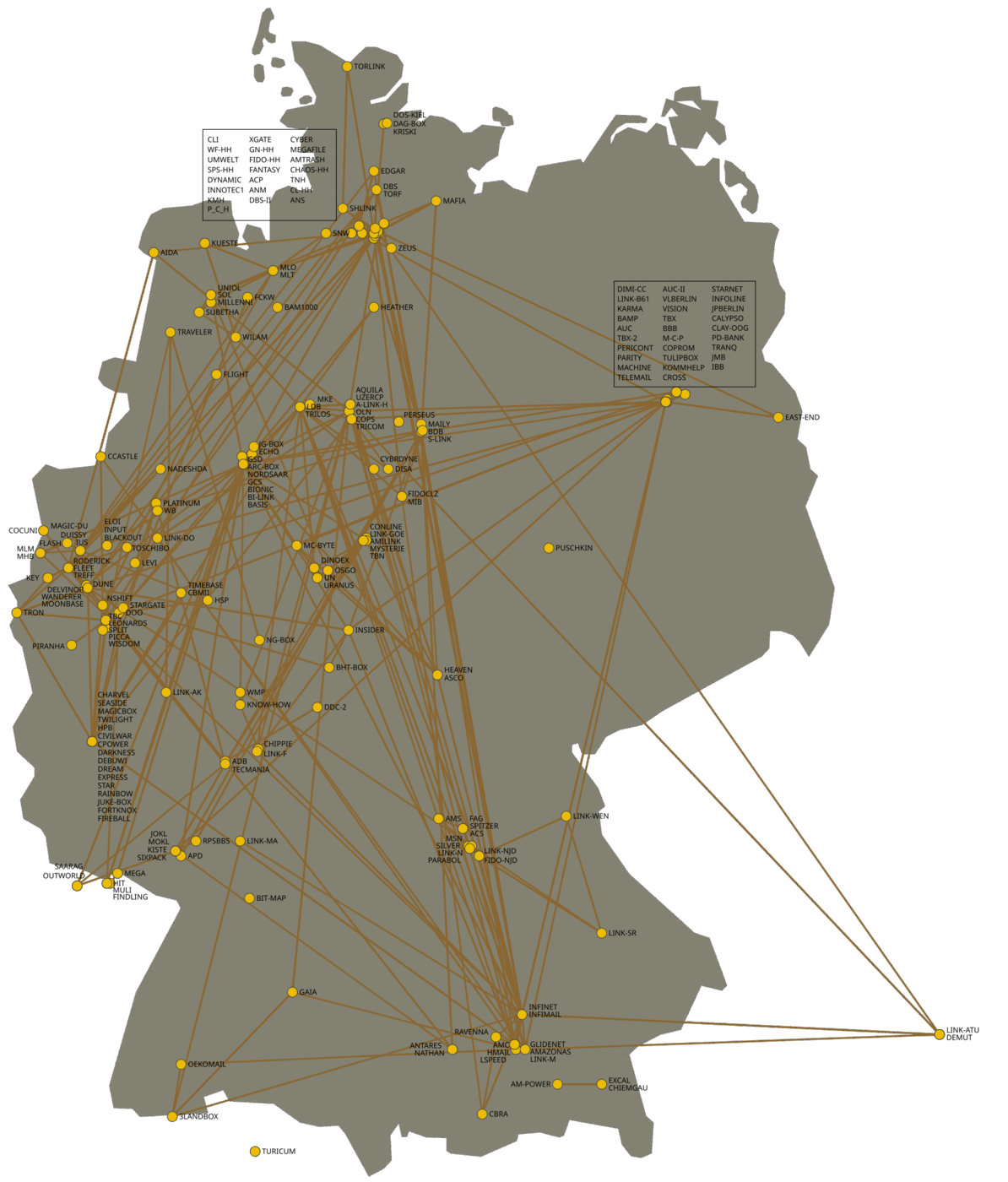
The bridge between the two worlds, for private users, was the Individual Network e. V. Founded in 1992 and wound up in 2000, it was a non-profit umbrella for regional operator associations and for mailbox networks such as MausNet and the CL-Netz; it held contracts with EUnet and Xlink, then the leading German providers, and as a member of the Deutsches Forschungsnetz it could use university infrastructure in many towns. At times some 300,000 users reached the net through it. In the years when de.* was settling its procedures, a large share of its readers were getting their feed from a club rather than from a company.

de.admin.news.announce and the written rules
The hierarchy governs itself through one moderated announcement group, de.admin.news.announce, universally shortened to dana. Its charter was decided by the participants in a vote whose result was published on 8 April 1997, and it defines the group narrowly. In translation it reads:
In this group are posted calls for discussion (RfD, Request for Discussion) and calls for votes (CfV, Call for Votes), voting results and lists of procedures under way concerning the creation, removal and alteration of groups under de.* (excluding de.alt), the associated control messages, and articles concerning administration, the rules and the moderation.
The rulebook itself is a document, not a custom. It is titled Regeln für die Einrichtung, Änderung und Entfernung von Usenet-Gruppen — rules for the creation, alteration and removal of Usenet groups — and is known as the Einrichtungsregeln. Its current text carries a last-modified date of 13 December 2021 and is posted weekly to de.admin.infos and de.alt.admin. A companion text, the Netiquette for de.*, last modified on 8 August 2006, goes out weekly to de.newusers.infos, de.answers and the international news.answers.
Around dana sit the groups that do the arguing and the explaining. de.admin.news.groups is where discussion of a proposal is directed; de.admin.news.misc takes the rest of the news-administration traffic; de.admin.infos is a moderated group whose only content is the periodic reference texts about the hierarchy and its administration; de.newusers.infos does the same job for newcomers, and de.newusers.questions answers them.
The rules are unusually frank about the limits of their own authority. They state that no participant and no system administrator is bound in any way by the net's decisions — whether a group is carried, created or removed locally is the local news administrator's business — and that Usenet has no executive, or rather voluntarily does without one. What the procedure produces is a documented consensus that server operators are willing to act on.
The procedure: RfD, CfV and the count
Creating, renaming, moderating or deleting a group in de.* follows one published route, and a proposal is not posted by its author: it is mailed to the moderation, which checks it against the rules, corrects small errors or returns a list of disputed points, and publishes it if it passes.
- A formal RfD (Request for Discussion) must say plainly what is being proposed, and for a new group must give the name, the intended status — moderated or unmoderated — a charter of normally one or two paragraphs, and a short description that should if possible fit, with the group name and an eight-column tabulator, into fewer than eighty characters.
- The discussion is directed by Followup-To into de.admin.news.groups and should be given at least two weeks, and longer if no consensus has formed. If the discussion changes the proposal, a further RfD is issued.
- A CfV (Call for Votes) may then be submitted. It must match the last RfD in substance, state the address votes go to and the exact period in which they are accepted — at least three weeks and at most one month — and it cannot be published while the name, short description, charter, status or (for a moderated group) the moderator is still unsettled.
- Voting is by e-mail only; articles, telephone calls and letters do not count. Anyone able to cast an otherwise valid vote may vote, once, as a natural person, and each vote must carry a real name with at least one written-out given name and surname.
- The count is published: name, address and vote of every participant, with omissions only in justified individual cases. The rules describe the ballot as general, equal and free, but expressly not secret. A proposal passes if at least twice as many valid yes votes as no votes arrive, and at least fifteen yes votes in absolute terms.
- After the result there is a week in which anyone may lodge an objection with the moderation, which decides on it and may correct the result or annul the vote. Once objections are settled, the moderation sends the control messages and updates the official group list.
Two side routes exist. A vereinfachtes Verfahren, or simplified procedure, handles small changes such as a rewording of a charter: it is published like an RfD, allows at least two weeks for objections and takes effect if nobody objects — a single objection is enough to make it fail, after which it can be restarted as an ordinary RfD. A combined voting offers several mutually exclusive proposals in one CfV, with a run-off block that picks the one with the best ratio of approval to rejection if more than one passes. When a new sub-hierarchy is created, its .misc group comes into being with it, without a separate ballot.
de.alt.* is deliberately outside all of this. Its appendix in the same rulebook is four sentences long and its stated principle is fairness: ask in de.alt.admin whether anyone objects to the proposed group, wait long enough for objections to arrive — seven days is the customary period — and if the protest was not too fierce, simply send the newgroup message yourself.
An elected moderation
The dana moderation is a team of elected office-holders with named jobs, not an anonymous address. Four Verfahrensbetreuer each shepherd individual procedures from allocation through to the result and keep in contact with proponents and votetakers. One Umsetzungsbeauftragter carries decisions out by sending the newgroup, rmgroup and checkgroups control messages, and also maintains the list of de.alt.* groups folded into the checkgroups message — while the published concept is careful to add that de.alt.* remains independent and that the message claims no authority over it. One Statusverwalter distributes the work, watches deadlines and posts a list of running procedures, the dana status, about once a week.
Every member posts under their own name and PGP signature, so that responsibility is legible from the article header. Two points carry a four-eyes rule: every first CfV and every result is read by a second team member before publication, and any proposed decision on an objection must be released by the moderation as a whole. Each post is filled for a fixed term and re-advertised once a year, at one of three fixed dates in January, May or September, and anyone on Usenet may stand. Members can be voted out individually rather than as a team, though a motion to remove someone must name an alternative candidate.
The technical counterpart of all this is the news server configuration published for de.*. The recommended control.ctl entry tells a server to verify every newgroup, rmgroup and checkgroups message for de.* against a PGP key whose fingerprint is printed on the same page, and to act only on messages that verify; de.alt.* is exempted, its control messages being accepted from any sender and merely mailed to the local news administrator. The recommended moderators entry routes postings for any moderated group in the hierarchy to a single address pattern at moderators.dana.de. Because operators choose to install those lines the moderation's authority is real, and because they can remove them it is conditional — the position the rules themselves describe. Many ballots and elections are run by the German Volunteer Votetakers and counted with the Usevote software.
The shape of the hierarchy
de.* is designed to be themenvollständig — topic-complete — so that every possible subject has somewhere to go, with de.etc.misc as the catch-all of last resort. Almost all of it is text; de.alt.dateien.* is the exception where non-text files are allowed. Within a sub-hierarchy, a group ending in .misc takes what the specific groups do not cover, and one ending in .d exists to discuss the articles in the group of the same name.
- de.admin.* — the administrative groups described above, addressed chiefly to system administrators.
- de.alt.* — the branch with the simplified creation rules and unsigned control messages: de.alt.folklore.usenet for old cabals and new anecdotes, de.alt.sysadmin.recovery for whatever cheers up a system operator, and de.alt.augenoptik on eyes, spectacles and contact lenses.
- de.comm.* — communication and communication technology: amateur and CB radio, mobile devices, TCP/IP, voice over IP, providers and newsreader software.
- de.comp.* — computers and what people do with them, the largest branch in the current list alongside de.comm.
- de.etc.* — everything that fits nowhere else, including a whole railway sub-hierarchy under de.etc.bahn.*.
- de.markt — offers and wants, in a single group.
- de.newusers.* — the information and question groups for newcomers.
- de.org.* — organisations and discussion about them, among them de.org.ccc for the Chaos Computer Club.
- de.rec.* — recreation: books, cycling, gardening, cooking and eating, classical music, Perry Rhodan, cats, sailing, and de.rec.motorroller for motor scooters.
- de.sci.* — the sciences: astronomy, biology, chemistry, electronics, history, mathematics, medicine, philosophy, physics, psychology, spaceflight and theology.
- de.soc.* — social questions: data protection, unemployment, law in half a dozen specialised groups, the environment, religion and world views, and de.soc.usenet on how people treat one another in the medium itself.
- de.talk.* — talk rather than exchange of information: jokes and a separate group for discussing the jokes, current affairs, and de.talk.bizarre, chartered as a German counterpart to talk.bizarre where participants are expected to ignore the subject line on principle.
- de.test, de.answers — testing, and the collection of German-language periodic postings, the latter moderated through the international news.answers address at MIT.
Three of the groups this directory documents belong to these branches: de.sci.genealogie under the sciences, de.talk.liebesakt under talk and de.alt.motorroller under de.alt; what became of all three is at the end of this page. The naming convention is worth noting on its own: names follow the English-language groups in places, so the labels are not consistently German even where the articles are.
The list of groups is not a museum piece but a maintained file. The checkgroups list published by the dana moderation and fetched for this page in August 2026 contains 233 groups, nine of them moderated; German Wikipedia gives the hierarchy 378 groups as of October 2019 and calls it the largest German-language Usenet hierarchy. The distribution across branches in the current file runs roughly forty groups each in de.comp and de.comm, thirty-eight in de.alt, thirty-four in de.rec, twenty-two in de.soc, and twenty each in de.sci and de.etc.
Umlauts, eszett and the wire
A German-language hierarchy on a medium built for seven-bit ASCII has an obvious problem, and de.* solved the easiest part of it by legislation. The published rules for group names in the hierarchy allow only lower-case letters, digits and the two characters plus and minus; a name may be at most 71 characters including the separating dots, each component at most 30 characters, and each component must differ from its siblings before the fifteenth character. Umlauts are simply not available, so the hierarchy transliterates: de.rec.buecher for books, de.soc.recht.steuern+buchfuehrung for tax law and accounting. The same discipline runs through the official short descriptions, which are written in plain ASCII with ae, oe and ue for the umlauts — Fuer Statistiken, Ueber den Wolken, Aussagekraeftige Themen bitte! — so that they survive any transport.
Article bodies were the harder case. ISO/IEC 8859-1, published in its first edition in 1987 and generally called Latin-1, gave the German alphabet everything it needed for ordinary prose: ä, ö, ü and ß all have code points, and IANA registered the character map for internet use in 1992, the year de.* was formed. Its gaps are instructive. There is no capital ß in Latin-1, because German had no capital ß when the standard was drafted; the slot where an upper-case Ÿ would belong is occupied by the lower-case ß instead. There is no euro sign either — the currency was not designed yet in 1987, and the symbol was first shown publicly in December 1996 — which is why ISO/IEC 8859-15 was issued in 1999 as an update carrying the euro.
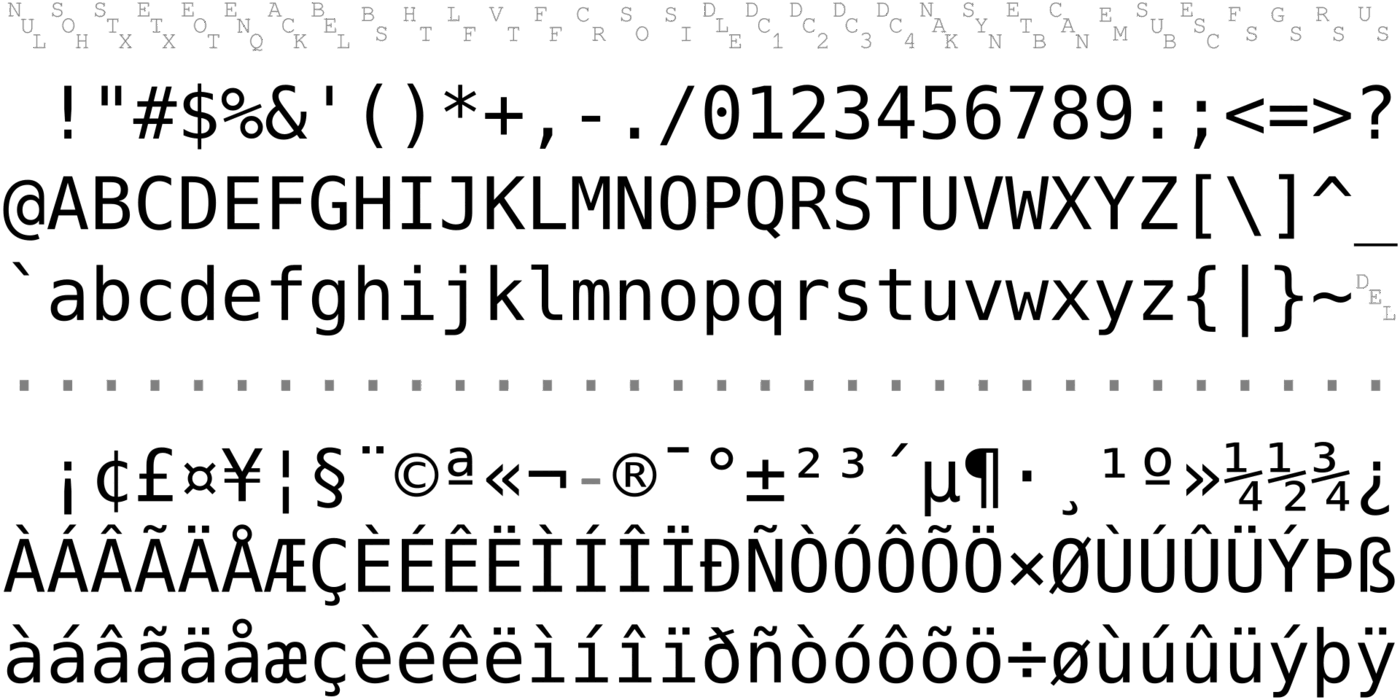

The second complication was Windows. Windows-1252 began as ISO 8859-1 and diverged from Windows 2.0 onwards by filling the range 0x80 to 0x9F, which the ISO standard reserves for C1 control codes, with typographic characters — among them the curly quotation marks and the low double quote that German typography uses to open a quotation. Text written in that set but labelled ISO-8859-1, which happened constantly, arrived on other systems with its quotation marks and apostrophes replaced by question marks or boxes; the behaviour was eventually standardised the other way round, with browsers and later HTML5 treating a document declared as ISO-8859-1 as Windows-1252.
Headers were a third case again, and the rule there has not moved. The reference text on header lines, maintained for de.newusers.infos and last revised in December 2024, states that header lines may contain only seven-bit ASCII characters: umlauts and other special characters have to be encoded as MIME encoded words, which is unreadable by eye and is therefore the newsreader's job. Its worked example shows a Subject line encoded in UTF-8 being displayed as ordinary German. That is the current settlement — bodies increasingly in UTF-8, headers still ASCII with MIME encoding — though the transition is visibly unfinished: the reference texts themselves are still issued with a Content-Type of text/plain and charset ISO-8859-1.
The letter that caused most of the trouble finally got its capital form long after the hierarchy was founded. A capital ẞ was accepted into Unicode version 5.1 in April 2008 at U+1E9E, with ISO/IEC 10646 updated to match on 24 June 2008; the Council for German Orthography adopted it as a permitted variant in 2017, and since 2024 it is the preferred form when setting ß in capitals. None of that is expressible in the character set most of de.* was written in.
The .de domain and the German internet
The country's domain has a longer history than its hierarchy. .de was introduced on 5 November 1986, which puts it among the first national domains anywhere, and from 1988 it was administered by Rüdiger Volk and colleagues at the Informatikrechner-Betriebsgruppe of the Universität Dortmund — the same group whose VAX had been carrying German Usenet since 1983. Volk introduced the name DE-NIC, and the foundations of the later organisation were laid there.
Administration moved to the Universität Karlsruhe in 1994, under a contract with the Interessenverbund Deutsches Network Information Center, an association of just under two dozen German internet providers. In December 1996 a registered cooperative was founded to give the operation a durable legal basis: DENIC eG, dated 17 December 1996, seated in Frankfurt am Main, and designed from the outset as a non-profit body — unlike the commercial registries that ran .com and .net. An office was set up in Frankfurt by July 1997 and the tasks were transferred step by step, the name servers following from Karlsruhe.
The scale the domain reached is worth stating beside the size of the hierarchy. At the end of March 2025, 17,639,014 .de domains were registered, making it the second most-registered country-code domain in the world.
What lasted, and what did not
The decline is documented as carefully as the growth. German Wikipedia's article on Usenet records participant and posting numbers falling from the middle of 2001, notes that the fall was especially marked in the German-language part, and reports the reason most often given at the time: a lack of flexibility and an excess of bureaucracy in how the hierarchy was shaped.
The infrastructure went next. Duke University, one of the two universities where Usenet began in 1979, closed its server in May 2010. Microsoft announced in May 2010 that it would replace its support newsgroups with web forums, and shut its news server that autumn; some new groups were created in the German-language Usenet to give the displaced discussions a home. Deutsche Telekom switched off news.t-online.de on 1 April 2011, explaining that the medium had lost importance, and many of its users moved to free servers run by volunteers and associations. Google Groups stopped accepting or displaying new Usenet content on 22 February 2024, leaving its archive readable but no longer part of the network.
What did not stop is the administration. The rules text and the Netiquette are still posted weekly, and the copies consulted for this page carried message identifiers from August 2026. The dana status page, read for this page in August 2026, listed five open discussions, among them reorganisation procedures for de.comp.security, de.admin.net-abuse and de.comp.lang, each with a named proponent, procedure supervisors from the moderation team and a votetaker, and first RfDs published between 20 and 26 April 2026. The change log of the group-list reference text records creations and deletions through May and June 2026, including a new group for mass storage and the removal of a long list of dormant computing groups.
That housekeeping has reached this directory's own subjects. The reference text's change log records de.talk.liebesakt among the groups deleted in its revision of 24 April 2026, and de.sci.genealogie among those deleted in the revision of 25 May 2026; neither appears in the current checkgroups file, and nor does de.alt.motorroller, while de.alt.augenoptik and de.rec.motorroller both still do. The pages here describe those groups as the gateway carried them, between 2000 and 2004. For a comparable national hierarchy with its own governance, see the nl.* hierarchy.