soc.culture.cuba
Cuban culture, society and politics.
soc.culture.cuba carried the culture, music and history of the island alongside the politics of the embargo years, argued between readers on the island, in the United States and across the wider diaspora.
This address originally listed the group’s recent messages; the live feed ended with the gateway, and the message archive is not preserved here.
On this page
- The proposal, in two languages
- The charter the group actually voted on
- The vote: 308 to 25
- Who cast the ballots
- Clause 4: the group and the mailing list
- Creation, and four control messages
- A group split by more than distance
- What the connectivity record does and does not establish
- The Special Period
- August 1994: created in July, tested in August
- Two American statutes, and the aircraft
- January 1998: the papal visit
- 1999 to 2000: the custody case
- Music, which was the other half of the charter
- Books, ballgames and the rest of the furniture
- Spanish on a seven-bit wire
- The neighbourhood
- What the record does not show
- Scope and limits
The proposal, in two languages
The paperwork for this group survives in full, which for a soc.culture.* group of the mid-1990s is not to be taken for granted. The Internet Systems Consortium's mirror of news.announce.newgroups holds four documents for soc.culture.cuba — a Request for Discussion, a first Call for Votes, a second and last Call for Votes, and the result — and the separate control archive holds four more messages besides. Between them they date the group precisely, name the people who proposed it, and preserve its charter in the wording its voters actually saw.
The Request for Discussion was posted on 16 May 1994 by Omar Galloso, from an account at a commercial Internet provider whose name appears in the message's Organization header as Cybergate, Inc. Three names stand under the heading Support by: Simon Lopez, Omar Fernandez and Galloso himself. It was crossposted to news.announce.newgroups, news.groups, soc.culture.caribbean and soc.culture.latin-america, and — the detail that distinguishes it from most of its neighbours — it was also sent to a mailing list: CUBA-L, on BITNET. Discussion, as the guidelines required, was directed to news.groups.
The document is bilingual. An English text runs first, then a line reading [Version en castellano], and the whole proposal repeats in Spanish: purpose, charter, topic list, background, discussion venue, discussion period. The RFD says in as many words which readership it has in mind — under the heading Languages it answers “Primarily Spanish”, with English posts welcome to widen the audience — and the doubled text is that answer carried out in practice. The Spanish version also carries a slip that has now been preserved for three decades in a public archive, announcing a discussion on the creation of the unmoderated group news.culture.cuba. Nobody appears to have minded.
The RFD gave its own reasons for wanting the group, and they are worth taking at face value because they are the only contemporaneous statement of intent that exists. Cuban exiles, it said, had spread around the world over thirty-four years; Cuba was “one of the countries where networking is limited but growing”; the BITNET list CUBA-L already carried heavy traffic and its subscribers would benefit from a group in the mainstream Usenet hierarchy; and several other countries in the Americas — it named Argentina, Brazil, Peru, Uruguay and Venezuela, with Chile added in the Spanish version — had already created or were creating similar groups. The proposal, in other words, presented itself as a piece of catching up.
The charter the group actually voted on
Two charter texts survive, and they are not identical. The RFD's Proposed Charter opens with a statement of purpose and, immediately after it, a request:
The purpose of the soc.culture.cuba newsgroup is to provide a common meeting place for the discussion of issues and events that concern Cubans both at home and abroad. Based on the principle that each opinion is a valid one and should be respected. The creation of this newsgroup will enhance the communication among Cubans from all over the world with access to the internet.
The RFD then listed the admitted topics without hedging: all kinds of news from Cuba; international news and their relation to Cuba; Cuban history; Cuban politics; travel information; literature, music, folklore and all kinds of artistic expression from Cuba; food, customs, traditions. It closed the list with a line set off on its own — Everyone is welcome. A proposal that puts “Cuban politics” fourth on a seven-item topic list, and a plea for mutual respect in its opening paragraph, has understood what it is proposing.
By the time of the Call for Votes the charter had been rewritten into four numbered clauses. Clause 1 defined the scope:
Soc.culture.cuba will be a newsgroup dedicated solely to the discussion of issues related to the life, culture, and politics affecting all Cubans living in the island, in the mainland USA and around the world.
Clause 2 confirmed that the group would be unmoderated and left relevance to contributors' own judgement, asking that discussions of interest to very few individuals be moved to e-mail. Clause 3 addressed language, and did so at greater length than most charters devote to anything: Spanish was Cuba's principal language and was expected to dominate, but a large part of Cubans and other Spanish speakers with access to Usenet used English as a second language, and therefore “articles written in English will be as welcomed as those written in Spanish”. Clause 4 dealt with the mailing-list gateway, and is set out below.
One small discrepancy is worth recording for the sake of anyone comparing documents. The charter's own Description field reads “Cuban culture, politics, and society”; the newsgroups-file line published in the same message, and still carried in the Big-8 newsgroups file today, puts the same three nouns in a different order. Usenet's administrative record is full of this kind of thing, and it is one of the reasons the primary documents are worth reading rather than paraphrasing.
The vote: 308 to 25
The Call for Votes went out on 21 June 1994, issued by Ron Dippold under the banner of the Usenet Volunteer Votetakers — the standing pool of neutral third parties who ran Big-Seven ballots in this period. The general machinery of that process, and what the two-thirds-and-a-hundred rule required, belongs to the soc.culture.* page; what matters here is the local detail.
The CFV was crossposted more widely than the RFD had been, and along noticeably linguistic rather than geographic lines: besides news.announce.newgroups and news.groups, it went to soc.culture.latin-america, soc.culture.mexican, soc.culture.spain, soc.culture.venezuela, soc.culture.chile, soc.culture.colombia and soc.culture.argentina. It was then posted to CUBA-L as well. Like the RFD, it carried a full Spanish section, including the instruction that questions about the voting process should be sent to the votetaker en ingles solamente. Ballots were cast by e-mail to an address at Qualcomm, in one of three prescribed English sentences, and voters were warned that their addresses and votes would all be published.
A second and last Call for Votes followed on 27 June, superseding the first and repeating the charter in full; the voting deadline in both was 23:59:59 UTC on 12 July 1994. The result was posted on 20 July 1994 — late enough in the evening, at 20:26 Eastern, that the Universal Time date had already rolled over, which is why the subsequent control messages report it as 21 July. Its subject line records the tally without ornament: RESULT: soc.culture.cuba passes 308:25.
The body gives the arithmetic. There were 308 YES votes and 25 NO votes, for a total of 333 valid votes, and there was one abstention. Both conditions for passage were met by a wide margin: yes votes were well above two-thirds of the valid total, and the yes-minus-no margin of 283 was nearly three times the required hundred. The result also set out the mandatory five-day period in which allegations of voting irregularity could be raised. None appear in the archive, and the group was created five days later.
Who cast the ballots
Because the votetakers published the full roll, the electorate of this particular group creation can be examined directly rather than guessed at — and it is one of the few quantitative things about soc.culture.cuba that can be. The published list gives 334 entries: 308 in favour, 25 against, one abstention.
Sorted by the top-level domain of the voting address, the roll is dominated by academic and corporate hosts: 123 addresses under .edu and 69 under .com, with fifteen more under .org and .net and four each under .gov and the Cuban .cu. After that the list is emphatically international. Canada supplied 21 addresses, Germany 20, Australia 13, the United Kingdom and Spain 10 each, Venezuela five, the Netherlands and Finland four each, and then a long tail of ones, twos and threes from Sweden, Italy, France, Switzerland, New Zealand, Norway, Ireland, Ecuador, Denmark, Belgium, Brazil, Mexico, Chile, Austria and Hungary. Free-net accounts in Cleveland and Carleton appear alongside research institutes and corporate mail hosts. This was a 1994 Usenet electorate, with all that implies: whoever had an account and cared enough to send a correctly formatted line of e-mail.
Four ballots came from the .cu domain, all of them yes votes, and all four at hosts under cigb.edu.cu — the domain of Cuba's Center for Genetic Engineering and Biotechnology, the Havana research institute founded in July 1985. That is a fact of some weight, and it needs stating carefully. It establishes that in the summer of 1994, more than two years before the island had an Internet connection in the ordinary sense, e-mail addressed from a Cuban academic host could reach a votetaker's mailbox in California and be counted. It does not establish where the four people sat when they wrote, how many other readers those hosts served, or anything at all about who posted to the group afterwards. It is one clean data point in a record that otherwise offers almost none.
Clause 4: the group and the mailing list
The fourth clause of the charter is the most technically interesting thing in the group's paperwork, and it points at a piece of network history that has largely evaporated. It provided that soc.culture.cuba would be “initially gatewayed” to the CUBA-L list server, with the qualification that the link would remain open only so long as the members or owner of that list wished it to.
CUBA-L was a BITNET LISTSERV list, and the address the charter gives for it — CUBA-L%UNMVMA.BITNET, reached through a gateway host at the University of Arizona — shows both halves of the arrangement in one string: a list living on a BITNET node, addressed from the Internet side through an academic relay. BITNET was a co-operative university network founded in 1981, and it differed from the Internet in kind: a point-to-point store-and-forward system in which mail and files were passed whole from one mainframe to the next over leased lines. It reached its zenith around 1991 with roughly 500 organisations and 3,000 nodes; the organisation that supported it wound that support up in 1996, so the group was chartered as BITNET was going into decline and its traffic was increasingly reaching the Internet through gateways of exactly the sort named in the charter. For a subject whose readership included people at the far end of thin, intermittent, mail-only links, a list-to-newsgroup gateway was not a nicety. It was the difference between taking part and not.
The same logic runs through the whole proposal. The RFD was mailed to CUBA-L; both Calls for Votes were mailed to CUBA-L; the ballots themselves were e-mail. A reader who could receive and send mail but could not read news could nonetheless discuss the group, vote on it, and afterwards follow it. This directory exists because of a later application of the same idea — news2mail carried Usenet to e-mail from 2000 to 2004 — and the pattern is worth noticing wherever it appears: for a large part of the world in the 1990s, e-mail was the network, and everything else was reached through it.
Whether the gateway was ever actually established, how long it ran, and on what terms, the surviving record does not say. The charter's own wording is conditional, and no follow-up notice appears in the group's administrative file.
Creation, and four control messages
The control archive holds four messages for this group. The first three are newgroup messages, all issued by David C. Lawrence — tale, then the moderator of news.announce.newgroups — and all carrying the same body: a statement that soc.culture.cuba is an unmoderated newsgroup which passed its vote for creation by 308:25 as reported on 21 July 1994, the line for administrators' newsgroups files, and the charter culled from the Call for Votes. They are dated 26 July 1994, 11 August 1994 and 19 August 1994. Repeat newgroup messages of this kind were routine housekeeping; Usenet propagation was best-effort, servers came and went, and a control message reissued weeks later caught the sites that had missed the first one.
The fourth message is of an entirely different character. Dated 4 November 2001 and reading in its entirety “please remove the bogus newsgroup soc.culture.cuba”, it is an rmgroup control message purporting to come from Urs Janßen, the developer of the newsreader tin. It did not come from the Big-8 group-creation authority whose control messages administrators of that hierarchy conventionally honoured; its Message-ID imitates a German university host while its Path and complaints headers show it entering the network through a service provider in Quebec; and in place of a signature it ends with a machine-generated nonsense sentence of the kind that accompanied the bulk forged-control-message runs of that period. Whatever it was, the group survived it: soc.culture.cuba still appears in the Big-8 active and newsgroups files today, with the same one-line description tale published in 1994.
That is the entire administrative life of the group in eight documents. There is no moderator-vacancy notice, because there was no moderator; no charter amendment; no removal proposal that went anywhere. For a group whose subject was as contested as this one, the paperwork is remarkably quiet.
A group split by more than distance
Every soc.culture group has a home-and-away problem: some of its readers live in the place under discussion and most usually do not. In soc.culture.cuba that ordinary asymmetry was multiplied by a specific one. For essentially the whole of the group's active life, readers on the island and readers abroad had radically unequal access to the network, and the politics the group existed to discuss was among the reasons why.
The dates are on the public record and they are worth laying out in order. The .cu country-code top-level domain was delegated on 3 June 1992 — two years before the newsgroup existed — and IANA's delegation record still names its manager as CENIAInternet in Havana, at an address given as Industria y San José, Capitolio Nacional. A national slot in the root zone, in other words, predated the newsgroup, the vote and the World Wide Web's popular arrival.
Four months later, on 23 October 1992, the United States enacted the Cuban Democracy Act, which tightened the embargo in most respects and loosened it in one. Its telecommunications section, now codified at 22 U.S.C. § 6004(e), states flatly that “Telecommunications services between the United States and Cuba shall be permitted”, and authorises telecommunications facilities “in such quantity and of such quality as may be necessary to provide efficient and adequate telecommunications services” between the two countries. The statute that Cuban officials denounced as an intensification of the blockade also contained the clause under which the island's first commercial connection to the American network would later be built.
That connection is conventionally dated to September 1996: a 64 kilobit-per-second link to Sprint in the United States. Sixty-four kilobits is a single ISDN channel. It was, for a time, the whole country's road to the Internet, and it arrived twenty-six months after the newsgroup named for the country had been created.
Before that link there was no Internet connection in the ordinary sense at all, and what electronic mail reached the island did so by other means: relayed in batches, arriving hours or days after it was sent, with no interactive session at any point. The four cigb.edu.cu ballots in the 1994 vote are the group's own small proof that such traffic existed and worked. Whether the same links carried news articles, and to how many people, the record does not say.
What the connectivity record does and does not establish
After 1996, expansion was slow, and the documented reasons are several and disputed in their weighting: cost and scarce bandwidth, United States embargo restrictions, and the Cuban government's own regulation of who could connect. Some of the specific restrictions are matters of published record. Private ownership of a computer or a mobile telephone required a government permit that was difficult to obtain until 2008; when buying computers was legalised that year, the number on the island reached about 630,000, some 23 per cent more than the year before. Bandwidth being scarce, the authorities gave preference to places where access was collective — workplaces, schools, research centres — over individual accounts. Public navigation rooms under the ETECSA brand Nauta opened at 118 sites from June 2013; the first public wireless hotspots, in 35 locations, followed in 2015; mobile Internet at 3G speeds was rolled out in December 2018. Until the ALBA-1 undersea cable to Venezuela came into public service in January 2013, the island's international traffic ran over satellite and ageing telephone circuits, with total bandwidth to the global Internet reported at 209 megabits per second upstream and 379 downstream for the country as a whole.
The temptation at this point is to conclude that soc.culture.cuba was therefore written from Miami. The honest position is that the surviving record does not support that conclusion, or its opposite, because the evidence that would settle it — the messages — is not preserved here and has not been examined for this article. What can be stated is structural, and it is enough to be going on with: for most of the group's life, a reader in Havana faced obstacles to participation that a reader in Madrid, Toronto, Caracas or Hialeah did not, and those obstacles were themselves among the subjects the charter admitted for discussion.
It is also worth resisting a second, subtler assumption. “Abroad” in the group's own charter language meant the island, the mainland United States, and the rest of the world, in that order — and the voter roll bears the third category out. The ballots cast from Germany, Australia, Sweden and Ecuador are a reminder that a Spanish-language group about Cuba on 1994 Usenet was not a two-city conversation. Groups named for countries whose people were widely dispersed recur across this branch of the hierarchy — soc.culture.yugoslavia is another — and the reasons differed group by group.
The wider Caribbean, and how its territories came online at different dates and on very different terms, belongs to soc.culture.caribbean and is not retold here.
The Special Period
The group was created in the middle of a severe and prolonged economic crisis, and every subject in its charter passed through that fact. The Special Period — officially the Special Period in the Time of Peace — began in 1991 with the dissolution of the Soviet Union and Comecon, and its worst years were precisely the group's first ones.
The scale is best given in the plainest available figures. Cuban gross domestic product shrank by around 35 per cent; imports and exports each fell by more than 80 per cent; oil imports, on which transport, industry and mechanised agriculture all depended, fell to roughly a tenth of pre-1990 volumes. Estimates of daily dietary energy intake compiled by the United States Department of Agriculture put the fall at 3,052 calories per person in 1989 to 2,099 in 1993, with other reports giving lower figures still; the FAO's series for the same country gives 2,720 calories per person per day for 1990–92 and 2,440 for 1995–97. Power cuts of many hours were routine. Some 1.2 million bicycles were bought from China and distributed, with a further half million made domestically; articulated bus-trailers nicknamed camellos, for their two humps, appeared on Havana's streets; Australian permaculture specialists were invited in 1993 to teach urban food-growing, and organopónicos took over vacant lots. After the disturbances of August 1994, farmers' markets were reinstated.
These are the conditions under which a national newsgroup acquired a charter promising discussion of food, customs, traditions and travel information alongside politics and news. The mundane half of a soc.culture charter is never mundane when the country in question has lost a third of its economy in three years, and the ordinary business of such a group — where to find a recipe ingredient, whether a journey is advisable, what a relative reports — carries a different weight in 1994 than in 2004.
The crisis eased slowly. Accounts date the improvement to the late 1990s, as Venezuela emerged as Cuba's principal trading partner, and to the years after 2000; average caloric intake is given as 3,280 by 2003. The Special Period is generally dated 1991 to 2000, which is to say that it covers the group's creation, its growth, and most of its busiest years, and ends at about the moment the news2mail gateway that produced this directory began carrying it to e-mail.
August 1994: created in July, tested in August
Ten days after the newgroup control message went out, the subject matter arrived. On 5 August 1994 thousands of people took to the streets around the Malecón in Havana in a protest that has been known ever since as the Maleconazo. It followed a summer of attempts to leave the island by sea — among them the hijacking of a tugboat on 13 July, which sank with the loss of dozens of lives — and the authorities' efforts to stop them; it is described as the largest public defiance of the government since Fidel Castro came to power. It was dispersed within hours.
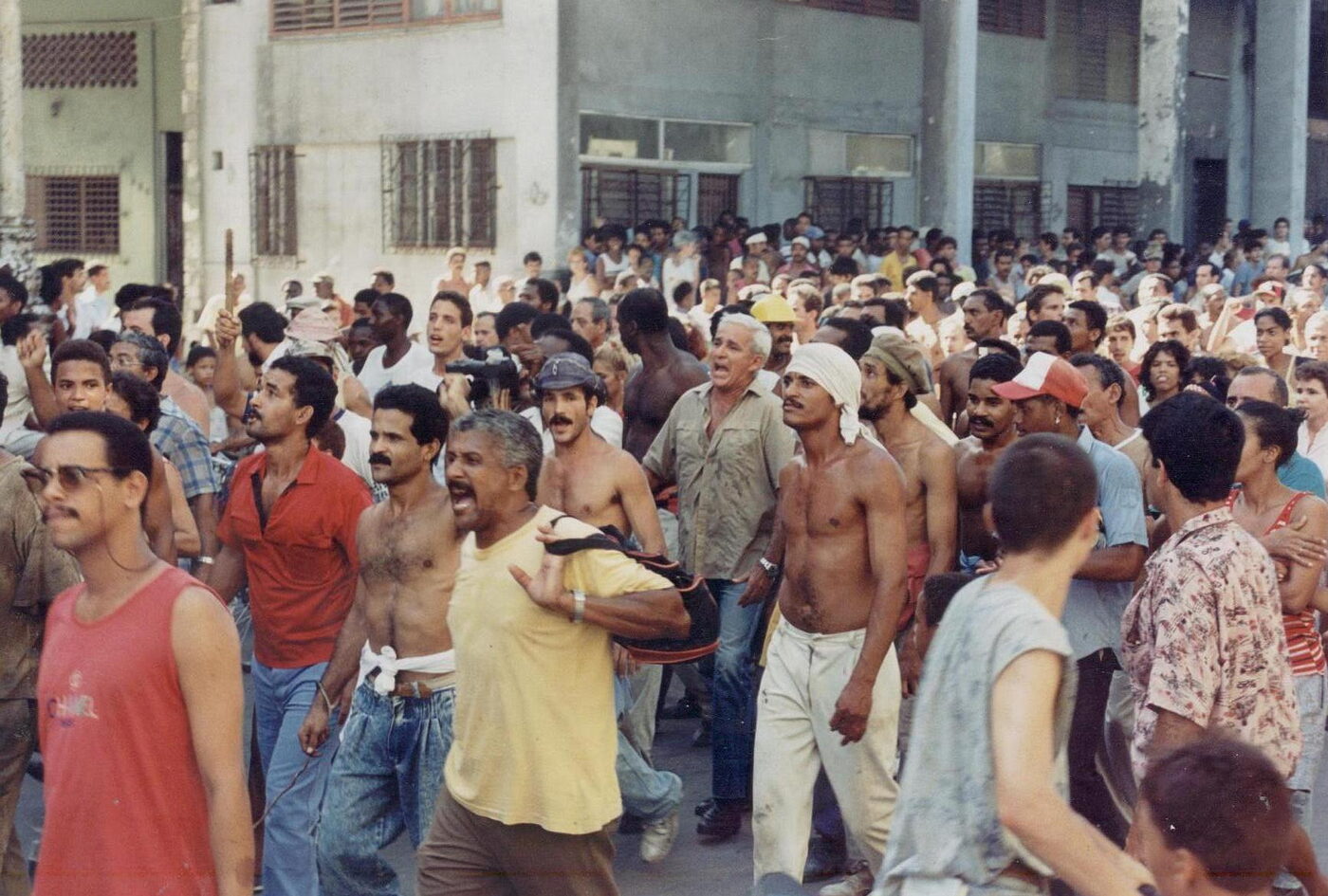

In response, Castro announced that those who wished to leave could do so. The rafter crisis — the crisis de los balseros — followed over roughly five weeks: around 33,000 people left the island on rafts and improvised craft after the announcement, on top of some 5,000 who had gone earlier in the year, more than 35,000 in all. The Clinton administration announced that rafters intercepted at sea would be taken to the United States naval base at Guantánamo Bay rather than to Florida, and many thousands were held there in tent camps while their status was litigated — published accounts put the number variously at around 20,000 and at some 33,000. Detainees organised gyms, art galleries, newspapers, a radio station and poetry readings while they waited.
Two agreements closed the episode. On 9 September 1994 the United States and Cuba concluded a migration agreement under which the United States undertook to admit no fewer than 20,000 Cuban immigrants a year outside the immediate-relative categories, implemented in part through a visa lottery whose qualifying registrants rose from 189,000 in 1994 to 433,000 in 1996 and 541,000 in 1998. In early May 1995 a further agreement resolved the position of those still at Guantánamo, most of whom were paroled into the United States, and established the interdiction policy that became known as wet feet, dry feet: those intercepted at sea were returned, those who reached dry land could stay. It was applied until January 2017.
No group whose charter admitted “all kinds of news from Cuba” and “Cuban politics”, unmoderated, in the summer of 1994, could have carried anything else. That the group's creation and the exodus fell within a fortnight of each other is coincidence; that the coincidence shaped what the group became in its first months is not a claim this page can test, and it is not made.
Two American statutes, and the aircraft
Two pieces of United States legislation frame the group's whole existence, and both are worth stating in the exact form the statute books give them, because both are habitually summarised in the terms of whichever side is doing the summarising.
The Cuban Democracy Act of 1992, sponsored by Congressman Robert Torricelli and effective 23 October 1992, reimposed the prohibition on trade with Cuba by foreign subsidiaries of United States companies — trade valued at some 700 million dollars in 1991 alone — and restricted the movement of ships that had called at Cuban ports. It also contained the telecommunications provisions quoted above, and provisions for humanitarian shipments. Britain invoked its Protection of Trading Interests Act 1980 against the subsidiary provisions; the European Commission protested within days of the signing; Canada and several Latin American states objected; a Cuban-sponsored United Nations resolution against the embargo followed shortly after the bill was signed, and the General Assembly has voted on such a resolution every year since.
The Cuban Liberty and Democratic Solidarity (LIBERTAD) Act of 1996 — Helms–Burton — passed Congress on 6 March 1996 and was signed on 12 March. Its Title III created a private right of action allowing United States nationals with claims to property confiscated after the revolution to sue those “trafficking” in it, subject to a presidential waiver renewable for periods of up to six months; Title IV required visa denial and exclusion for persons trafficking in such property. Successive presidents waived Title III until the waivers were revoked in 2019. The European Union responded in November 1996 with Council Regulation 2271/96, declaring the extraterritorial provisions unenforceable within the Union and permitting recovery of damages imposed under them.
The bill had passed each chamber in late 1995 without becoming law, and it was an incident in the following February that carried it through. On 24 February 1996 two Cessna Skymasters operated by the Miami exile organisation Brothers to the Rescue were shot down by a Cuban Air Force MiG-29UB; the four men aboard — Carlos Costa, Armando Alejandre Jr, Mario de la Peña and Pablo Morales — were killed. Whether the aircraft were in Cuban or international airspace was disputed at the time and remains so; the International Civil Aviation Organization reported on the incident that June and the United Nations Security Council addressed it in July. The shootdown, the legislation it accelerated, and the arguments over both are recorded here as events. This page does not adjudicate them, and readers who came looking for a verdict on the embargo will not find one.
January 1998: the papal visit
From 21 to 25 January 1998 John Paul II travelled to Cuba, the first visit to the island by a reigning pope. He was received at José Martí International Airport by Fidel Castro; he celebrated Mass at Santa Clara on 22 January, led a gathering centred on young people at Camagüey on the 23rd, crowned the image of Our Lady of Charity of El Cobre — the patroness of Cuba — at Santiago de Cuba on the 24th, and closed with a Mass in the Plaza de la Revolución in Havana on the 25th, attended by hundreds of thousands and by Castro. The events were broadcast at length on Cuban state media, which was itself without recent precedent.
The visit's most quoted sentence — Que Cuba se abra al mundo con todas sus magníficas posibilidades y que el mundo se abra a Cuba, that Cuba open itself to the world and the world open itself to Cuba — was read by the Cuban government, by opposition and exile circles and by religious observers in quite different ways. The pope criticised the effects of the United States embargo and argued for wider religious and social freedom on the island; commentators of every persuasion found something in the trip to cite.
Its documented consequences include the restoration of 25 December as a public holiday, suspended since the late 1960s, and a greater public visibility for the Catholic Church in Cuban life. The groundwork had been laid in November 1996, when Castro visited the Vatican and met the pope in person. Later papal visits followed in 2012 and 2015.
For a newsgroup whose charter listed customs and traditions alongside politics, an event of this kind sits awkwardly across the categories, and that awkwardness is the point. The visit was simultaneously a religious occasion, a diplomatic one and a domestic political one, and it fell squarely in the middle of the years when the group's subject was busiest.
1999 to 2000: the custody case
The case that dominated the period in which such groups were most used began at sea. On 21 November 1999 a small aluminium boat left Cuba with fourteen people aboard, including Elián González, then five years old, and his mother, Elizabeth Brotons Rodríguez. The engine failed and the boat sank; the mother and ten others died. The boy was found on an inner tube, was picked up by two fishermen, was handed to the United States Coast Guard in late November, and was released by the Immigration and Naturalization Service to his great-uncle Lázaro González in Miami. His father, Juan Miguel González Quintana, in Cárdenas, demanded his return.
The sequence that followed is unusually well dated. On 10 January 2000 a Florida state court held that the state family court could rule on temporary custody; the Attorney General, Janet Reno, maintained that the matter was federal and that the father spoke for the child. On 21 January the boy's two grandmothers flew from Havana to press for his return, meeting congressmen and the Attorney General over nine days. On 21 March a federal district judge dismissed the asylum petition the Miami relatives had filed on the boy's behalf. On 29 March the mayor of Miami-Dade County, with twenty-two other civic leaders, stated that the county would not assist federal authorities in any repatriation. On 13 April Reno set a deadline for the boy's transfer, which the relatives did not meet. In the pre-dawn hours of Saturday 22 April 2000, agents of the Border Patrol's BORTAC unit, part of an operation involving more than 130 INS personnel, entered the house and removed the child; the photograph taken inside won the 2001 Pulitzer Prize for Breaking News Photography. On 1 June the Eleventh Circuit held that the boy was too young to file for asylum and that only his father could speak for him; on 28 June the Supreme Court declined to review that decision, and the family flew from Dulles to Havana the same afternoon, seven months and a week after leaving Cuba.
Contemporaneous opinion polling in the United States showed majorities favouring the boy's return to his father; opinion in Miami's Cuban-American community was reported very differently, and the case is widely described as a factor in the 2000 presidential election in Florida, where polling afterwards put the Cuban-American vote for the Republican candidate at about 80 per cent, against 65 per cent four years earlier. Every element of it — the sea crossing, the immigration policy that made the crossing consequential, the custody law, the raid, the photograph — sat inside the charter of soc.culture.cuba. The group was unmoderated, and it was at its busiest.
This page records the chronology and takes no position on any of the questions the case raised. That is not squeamishness; it is the register the subject requires, and it is the register the group's own founding document asked for.
Music, which was the other half of the charter
The RFD listed literature, music and folklore before it listed food, and any account of soc.culture.cuba that treats the music as light relief has the proportions wrong. Cuban popular music is among the most widely exported bodies of work of the twentieth century, and the group existed during the decade in which the pre-revolutionary catalogue was rediscovered by an international audience.
Son cubano took shape in the highlands of eastern Cuba in the late nineteenth century: a syncretic form whose vocal style, lyric metre and lead instrument — the tres, a three-course guitar strung with six strings in doubled pairs — descend from Spanish practice, and whose clave rhythm, call-and-response structure and percussion section come out of Bantu traditions. Son reached Havana around 1909 and was first recorded in 1917; from it and the other Cuban dance forms around it came the repertoire that Puerto Rican and Nuyorican musicians in New York remade from the 1960s as salsa — a story that carries over to soc.culture.puerto-rico. In Cuba itself, son developed instead into songo and later timba.
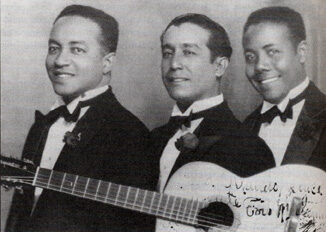

The revolution split the catalogue geographically. Celia Cruz, who had risen to fame in Havana in the 1950s as a singer of guarachas and was known as La Guarachera de Cuba, made the rest of her career in the United States and sold more than thirty million records as the Queen of Salsa. On the island, nueva trova emerged around 1967–68 — literary, formal, politically engaged, with Silvio Rodríguez, Pablo Milanés and Noel Nicola as its principal figures — while dance music kept developing: Los Van Van, founded in 1969 by the bassist Juan Formell, was central to songo and to the Havana dance styles that followed it. Two catalogues, two audiences, and for decades very little traffic between them except on records carried by hand.
Then came the revival that the group lived through. In March 1996, at the EGREM studios in Havana, the American guitarist Ry Cooder and the Cuban bandleader Juan de Marcos González recorded an album of son, bolero and related repertoire with a cast of veteran musicians, several of them long out of the business: Compay Segundo, Ibrahim Ferrer — who had retired from music in 1991 — the pianist Rubén González, Omara Portuondo, Eliades Ochoa and the laúd player Barbarito Torres among them. Buena Vista Social Club was released internationally by World Circuit on 23 June 1997 and in the United States by Nonesuch that September. It won the 1998 Grammy for Best Traditional Tropical Latin Album; the ensemble played Amsterdam and Carnegie Hall in 1998; Wim Wenders's documentary of the sessions and concerts premiered at the Berlin festival on 17 February 1999, opened in the United States on 4 June, and was nominated for an Academy Award. The album had sold more than eight million copies by 2020 and was added to the United States National Recording Registry in 2022.
The dates are the point. A group created in 1994 to discuss Cuban culture found, within three years, that the most visible Cuban cultural export in a generation was a record of pre-revolutionary repertoire made in Havana by an American producer and sold in Miami, London and Tokyo. It would be hard to design an object better calculated to be claimed by everyone and agreed on by no one.
Books, ballgames and the rest of the furniture
Literature divided along the same fault line as music, and rather more bitterly. Guillermo Cabrera Infante, born in Gibara in 1929 to founding members of the Cuban Communist Party, supported the revolution, then went into exile in London in 1965; his novel Tres tristes tigres, published in 1966, set out to do for Cuban Spanish what Mark Twain had done for American English, and he received the Cervantes Prize in 1997. Reinaldo Arenas left in the Mariel boatlift of 1980, dictated the memoir published posthumously as Before Night Falls, and died in New York in 1990. The Padilla affair of 1971 — the poet Heberto Padilla arrested on 20 March, released thirty-seven days later, and only after delivering a statement of self-criticism to the writers' union in which he denounced himself and others, his wife among them — drew international criticism and has been argued about ever since. A newsgroup covering Cuban literature in the 1990s therefore covered a canon whose authors were distributed across at least three countries and several mutually unforgiving accounts of the same events.
Baseball was less fraught only in the sense that everyone agreed it mattered. The Cuban League, which had operated since 1878, ended when the Cuban government abolished professional baseball in March 1961, and was replaced by the Cuban National Series, an amateur competition that began that year with four charter teams and reached eighteen from the late 1970s; Industriales of Havana became its dominant club. During the group's lifetime the National Series became a supplier to Major League Baseball by way of defection. Liván Hernández, then twenty, defected in 1995 and was named Most Valuable Player of the 1997 World Series for the Florida Marlins — a Miami team, two years after he left the island. His half-brother Orlando Hernández, El Duque, formerly of Industriales and a gold medallist with Cuba at the 1992 Olympics, defected on Christmas Day 1997 and won World Series with the New York Yankees in 1998, 1999 and 2000.
In 1999 the two systems met on the field. After three years of lobbying by the Orioles' owner Peter Angelos and against congressional opposition, the Baltimore Orioles played the Cuban national team at the Estadio Latinoamericano in Havana on 28 March 1999 — the first appearance by a major-league club in Cuba since March 1959 — winning 3–2 in extra innings, and lost the return at Camden Yards 12–6 on 3 May. The games were televised by ESPN and introduced José Contreras, who defected in 2002, to an American audience. Few events of the period were as precisely calculated to be read as a political statement by people who disagreed about which statement it was.
Food and language rounded out the charter's list. Cuban Spanish, for the record, derives substantially from the speech of the Canary Islands and Andalusia, the product of heavy Canarian migration between the late seventeenth and early twentieth centuries, with Galician, Asturian, Catalan and Castilian settlement leaving lighter traces; a good deal of characteristic Cuban vocabulary is Canarian, guagua for a bus being the standard example. It also brought a specific technical problem to a network that had not been built with it in mind.
Spanish on a seven-bit wire
Spanish needs very little beyond the twenty-six letters of English: the tilde on ñ, acute accents on the five vowels, the diaeresis on ü, and the inverted marks that open questions and exclamations. Fourteen characters or so, in upper and lower case. On 1990s Usenet, that was fourteen too many.
The reason is architectural. RFC 822, dated 13 August 1982, defined a message body as “simply a sequence of lines containing ASCII characters”, and defined a character as any of the 128 values from 0 to 127. RFC 1036, the December 1987 standard for Usenet message format, built directly on RFC 822 and inherited the constraint. ASCII, in the revision shown below, has no ñ, no á, no ¿. Eight-bit character sets that did — ISO 8859-1, Latin-1, first published in 1987 — existed, and the first MIME specification named it as a usable character set in 1992, but a Usenet article travelled through an unknown number of intermediate machines, any one of which might be running software that stripped the eighth bit or mangled what it did not recognise. MIME, which defined content-transfer encodings such as quoted-printable to carry non-ASCII bytes safely through seven-bit paths, appeared as RFC 1341 in June 1992 and was rewritten as RFC 2045 and its companions in November 1996; adoption across news software was gradual, and for years the safe assumption was that anything above 127 might not survive the journey.
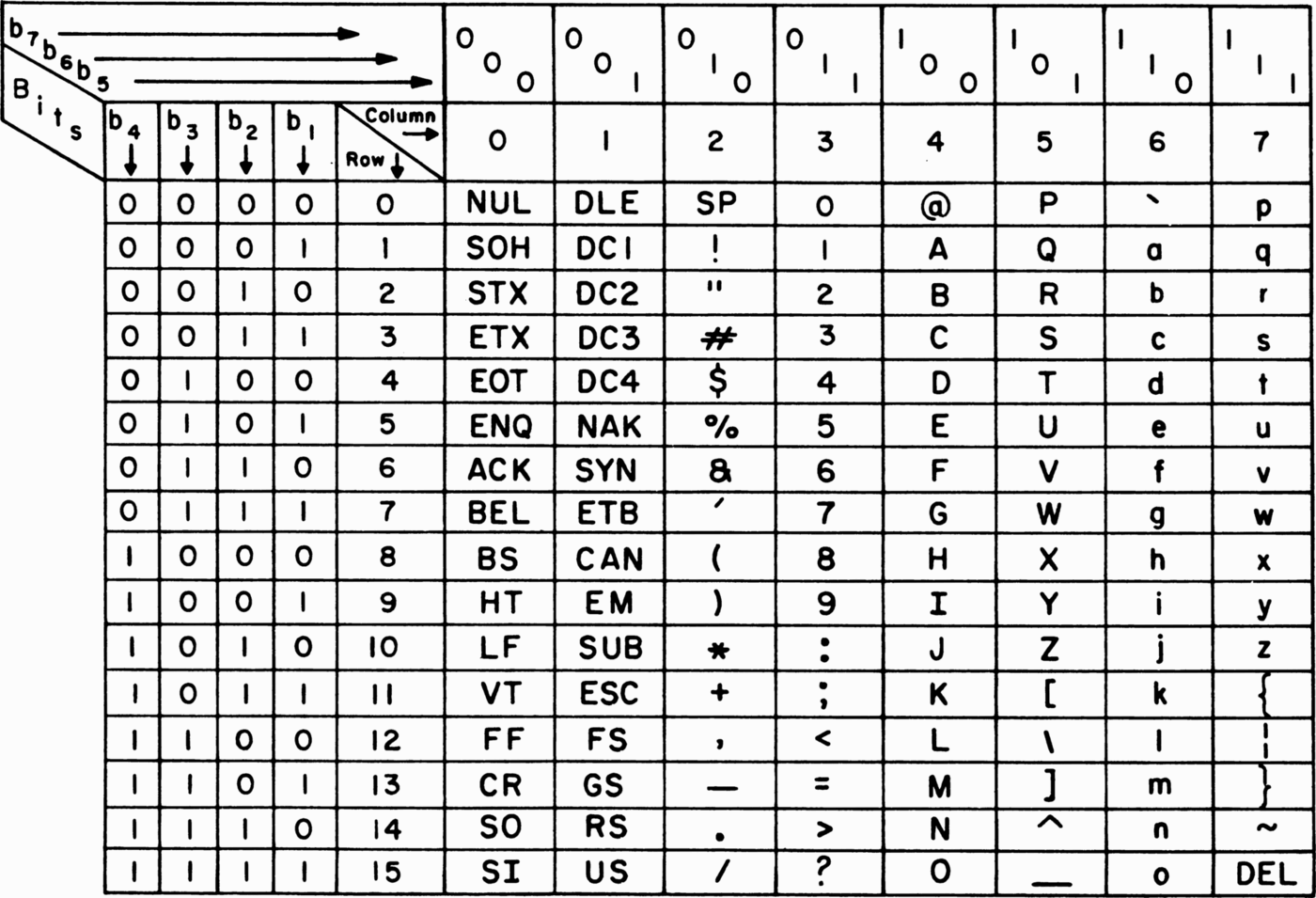

What Spanish-language posters did about it is visible in the group's own founding documents, which is a rare piece of luck. Every accent in the Spanish text of the RFD and the Calls for Votes is simply absent: discusion, creacion, politica, informacion, musica, expresion. Where the missing character was the tilde, and dropping it would have changed the word, the writers used a two-character workaround that anyone who read Spanish text on a seven-bit network in the 1990s will recognise instantly: an~os for años, espan~ol for español. The convention is not a typographical error and it is not carelessness; it is a language being written through a pipe that was not sized for it.
The cost was real but modest, and it should not be overstated. Spanish is legible without accents in a way that some languages are not; the ambiguity introduced is small, and the tilde workaround handled the one genuinely lexical case. French, which uses more diacritics and more of them lexically distinctive, met the same seven-bit wall on harder terms; that story belongs to the soc.culture.quebec page and is not repeated here. The point for this group is narrower: its own paperwork is written in stripped Spanish, and that is documentary evidence of the medium, preserved by the archive that preserved the paperwork.
The neighbourhood
A group's neighbours can be read off its crosspost headers, and this group's are unusually informative. The RFD went to soc.culture.caribbean and soc.culture.latin-america — the two general rooms whose subject matter the new group would be carving into. The Calls for Votes went instead to a set defined by language: soc.culture.latin-america, soc.culture.mexican, soc.culture.spain, soc.culture.venezuela, soc.culture.chile, soc.culture.colombia and soc.culture.argentina. The proposers looked for their electorate among Spanish speakers rather than among Caribbean readers, and on the evidence of the roll they found it.
Within this directory, the regional room is soc.culture.caribbean and the neighbouring island whose music history overlaps with this one is soc.culture.puerto-rico. The mechanics of the branch itself — how a soc.culture group was proposed, argued over and voted into existence — are on the soc.culture.* page, and the governance of the hierarchy above it on the soc.* page.
Outside the Big Eight there were alt.* groups touching the subject, as there were for every country: the newsgroups file still lists alt.fan.countries.cuba, against which it records no description at all, and alt.smokers.cigars.cuban. They were created without votes, left no comparable paperwork, and are not documented here on the strength of a name in a newsgroups file.
What the record does not show
It is worth being explicit about the size of the hole in the middle of this article, because it is characteristic of the whole directory and not a failure peculiar to this page.
The administrative record for soc.culture.cuba is complete and precise: proposers, dates, charter, tally, voter roll, control messages. Everything after 26 July 1994 is not recorded there at all. There is no surviving readership estimate for this group, no traffic count, no list of frequent posters, no FAQ preserved in the news.answers collection, and no contemporaneous description of the group written by anyone who read it. No figure for it has been located in the network-wide readership surveys of the era. What proportion of the traffic was in Spanish, whether the CUBA-L gateway ever operated, when the group peaked and when it thinned — none of that is established by any source consulted for this article.
Nor is the geography of the readership established, and the temptation to fill it in from the politics should be resisted in both directions. The voter roll of July 1994 is a snapshot of one week's self-selected electorate, not a census of the group that followed; it shows a heavily academic, heavily North American but genuinely international electorate with four ballots from a Cuban institute, and it shows nothing about 1998 or 2002.
What can be said with confidence is what this article has tried to say: what the group was chartered to do, in its own words; when and how it came into existence, with the documents cited; what the world it described was doing during its lifetime, with dates; and where the evidence stops. On a subject where a great deal of confident description circulates, the boundary between the two is the useful part.
Scope and limits
This page is a reference article about a newsgroup, written from the surviving administrative record and from published accounts of the events its charter admitted for discussion. It is not an archive of the group.
No copy of the group's articles is held on this site. Nothing in this article quotes, counts, characterises or summarises any message posted to soc.culture.cuba, because no such message has been examined in writing it. Where the text quotes documents, they are the Request for Discussion, the two Calls for Votes, the result and the control messages, all of which are administrative postings held in the Internet Systems Consortium's public mirrors and cited as such. Where an archive of the group's own traffic can be consulted, the box above this article points to it; coverage there varies by group and by era, and this site makes no claim about what it contains.
Every date, name and figure above was checked against a published source in the course of writing. Where sources disagree — the exact day in September 1996 on which Cuba's first Internet link came up, the precise day in early May 1995 on which the second migration agreement was announced, the number of people held at Guantánamo Bay — the text says so or stays at the level of the month. Where a plausible detail could not be verified, it has been left out rather than rounded up into a fact.
On the politics: soc.culture.cuba was a group about a subject on which its own readers disagreed profoundly, and its founding document asked that each opinion be treated as valid and respected. This article documents what the group was chartered to discuss and what happened in the world it discussed. It does not adjudicate the embargo, the Cuban government, the exile organisations, the migration policies or the custody case, offers no verdict on any of them, and gives no advice.
Reading soc.culture.cuba today
- Historical archive: Google Groups — soc.culture.cuba (coverage varies by group and era).
- Open in a newsreader:
news:soc.culture.cuba— the original site offered exactly this link, and it still works if your system has a newsreader registered for thenews:scheme. - Live access: point an NNTP newsreader at a modern server — see accessing Usenet today.
- The original news2mail e-mail subscription service ended in the mid-2000s and no longer operates.