rec.games.roguelike.adom
ADOM — Ancient Domains of Mystery.
The dedicated group for Thomas Biskup’s roguelike, one of the genre’s canonical games: spoiler threads, guidebook drafts, RNG lament, and the developer posting among his players.
The rec.games.roguelike.* branch (adom, angband, nethack and kin) was the genre’s home before web forums; ADOM fan boards still link this page as the origin room.
On this page
- A branch subdivided by title
- The proposal for a group of its own
- The charter, and a reading convention written into it
- The game under discussion: a version chronology
- What the spoiler literature was about
- What makes a roguelike, and who says so
- The rest of the branch
- Variants, and one game that refused them
- What a single-game newsgroup actually carried
- The spoiler apparatus
- Where it went
- What the record does not show
- Scope and limits
A branch subdivided by title
Almost everywhere else in the Big Eight, a subject is cut up by category. Sport is divided into sports, cooking into cuisines, programming into languages; the third and fourth components of a group name describe a kind of thing, and individual instances of that thing take their chances in the general room. The recreation hierarchy's own conventions, and the arguments that produced them, are set out on the rec.* hierarchy page. rec.games.roguelike.* is one of the conspicuous exceptions: it gave five individual computer games a group each, named after the game, and then added a general group for everything else. Understanding why is the shortest route into what this particular group was for.
The paperwork survives in full. On 2 July 1993 a Request for Discussion was posted to news.announce.newgroups, cross-posted to news.groups, to rec.games.misc, and to the four places the traffic actually lived — rec.games.hack, rec.games.rogue, rec.games.moria and alt.games.omega. It proposed a hierarchy called rec.games.dungeon.*, into which the three existing per-game groups would be renamed, with a moderated information group and an unmoderated catch-all added underneath. The rationale was practical rather than taxonomic: these games were character-based rather than text-based, and portable enough to run anywhere, which meant they fitted none of the machine-specific comp.sys.*.games groups. Grouping them, the proposal argued, would let a player of one find the others, would give a home to games with no group at all, and would provide a frame for adding new ones later.
The proposal also asked, in a section headed Things to Decide, whether its own name was any good:
First: Should the hierarchy actually be named "rec.games.dungeon"? Some have expressed concerns about this name. They note that many text-based adventure games (e.g. "Zork") are set in dungeons; indeed, one early version of Zork was named "dungeon". Another concern: The unifying characteristic of these games is *not* that they're set in dungeons, but rather the style of interface. There is no reason one of these games couldn't be set, e.g., on the Death Star or in a gulag, and yet remain appropriate for the hierarchy. Again, perhaps "dungeon" is a misleading name.
Ten days later a second RFD answered its own question. Posted on 12 July 1993, it recorded a general consensus that dungeon described far too wide a variety of games, and put forward rec.games.roguelike instead, on the ground that it described all the games in the proposed hierarchy and no others: the one thing they had in common was descent from Rogue and a broadly Rogue-style interface. The obvious objection was raised in the same document — that roguelike would mystify a new player who did not know that Moria descended from anything — and dismissed on the ground that a group called rec.games.roguelike.moria would be no harder to find than rec.games.moria. A third RFD on 20 July closed the discussion with a sentence that has been quoted ever since: those who agreed on a name seemed to favour roguelike as the least of all available evils.
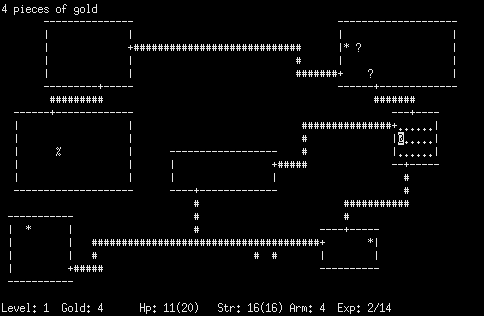

That is not a minor piece of trivia about a newsgroup name. The term roguelike, as a genre label, is traced by the encyclopaedic account of the genre to precisely this exchange, dating it to about 1993 and citing the reorganisation paperwork itself, and noting that it took three weeks of argument to arrive at. Usenet naming disputes were usually consequential only for Usenet. This one produced a word that is now printed on shop fronts.
The third RFD also settled the shape of the branch. The moderated information group, called .info in the first draft, became rec.games.roguelike.announce: a forum for FAQ lists, announcements of new patches and versions of existing games, postings of small official patches and announcements of new rogue-style games, with every posting cross-posted to the most appropriate other group in the branch and follow-ups directed there. Its charter named Aliza R. Panitz as initial moderator and gave the moderator one discretionary power, stated with unusual specificity — to change the subject line of a posting, especially to add the word [SPOILERS]. The branch had a spoiler policy before it had any groups.
The vote did not go as planned. The result, posted on 18 August 1993 on 337 votes, passed two groups and rejected three. rec.games.roguelike.announce carried 229 to 100 and rec.games.roguelike.misc 228 to 99; the proposed renames of the existing Moria, Hack and Rogue groups drew 212:115, 214:116 and 207:120 respectively, and all three failed both the two-thirds test and the requirement of a hundred more yes votes than no. The arithmetic of Big-Eight group creation, and the process that surrounded it, is described on the comp.* hierarchy page and not repeated here. The two surviving groups were created by control message on 24 August 1993.
So the branch began as a hierarchy with a catch-all, an announcement group and no games in it. Angband arrived next, by its own route: an RFD for rec.games.angband had been posted on 11 June 1993, three weeks before the reorganisation was proposed, and the two proponents agreed between them to run the reorganisation vote first. Its rationale was a traffic count rather than a principle — a sample of rec.games.moria reported in the later RFDs found 106 articles about Angband against 15 about other versions of Moria — and its third RFD, on 26 August 1993, opened with the question of whether the group should be called rec.games.angband or rec.games.roguelike.angband, given that the individual games were still sitting at the level of rec.games.moria. The vote passed 184 to 50 on 235 valid ballots on 27 September 1993, and the group was created as rec.games.roguelike.angband on 4 October.
Which left the hierarchy visibly lopsided, and the clean-up RFD of 1 April 1994 said so in one sentence: since the consensus had been to put the Angband group in the new hierarchy while the votes to move the existing groups failed, the network now had rec.games.moria alongside rec.games.roguelike.angband. The three renames were put again, unchanged except for a note that the Hack group had long been about NetHack rather than Hack and should be named accordingly. On 295 valid votes the result of 31 May 1994 passed all three — Moria 229:45, NetHack 230:60, Rogue 219:59 — and the groups were created on 6 June 1994. Nine and a half months after the branch's first two groups appeared, it finally looked like itself.
The proposal for a group of its own
Ancient Domains of Mystery spent its first two and a half public years in rec.games.roguelike.misc, the catch-all created in 1993 for rogue-style games that did not yet have groups. By the autumn of 1996 the catch-all had been comprehensively colonised. The Request for Discussion of 9 October 1996, posted to news.announce.newgroups, news.groups and rec.games.roguelike.misc, put the case in the flattest possible terms:
The newsgroup rec.games.roguelike.misc is intended for discussion of roguelike games which do not yet have their own group. For the past several months, virtually all traffic on the group has been people discussing the game ADOM. Although most people remember to put [ADOM] or the like in their subject header, it seems that there is both sufficient traffic and sufficient demand to justify the creation of rec.games.roguelike.adom.
Two further arguments followed, both of them characteristic of the period. The first was for the readers being displaced: someone interested in Larn rather than ADOM could go back to using the catch-all without spending most of their time deleting articles. The second was for discovery: a group with adom in its name would be easier to find for people who did not know what the rec.games.roguelike hierarchy was. The RFD carried two proponents. One was the poster, Dan Shiovitz; the other was the game's author, Thomas Biskup, listed with a personal address, which put the proposal in the slightly unusual position of being co-signed by the person the group would be talking about.
The Call for Votes went out on 31 January 1997, conducted by a neutral votetaker under the Usenet Volunteer Votetakers, with ballots mailed to an address at Helsinki University of Technology and counting closing at 23:59:59 UTC on 21 February 1997. The instructions are a small museum of the era: one account per person, one vote per person, no anonymous, forwarded or proxy votes, votes cast through web forms treated as anonymous and therefore void, and a warning that AOL and Delphi mail did not carry the voter's real name, so it had to be typed on a line of its own after the words Voter name.
The result was posted on 22 February 1997. There were 232 YES votes and 21 NO votes, a total of 253 valid votes, with one abstention and one invalid ballot — a single voter recorded under the heading Votes in error as having cast conflicting votes. The group passed on its first proposal, comfortably clear of both thresholds, and the votetaker published the full acknowledgement list, addresses and names included, in the way results were then published so that anyone could audit them.
After the mandatory five-day objection period the moderator of news.announce.newgroups issued the newgroup control message, dated 27 February 1997 at 15:30:11 GMT and carrying a PGP signature; it was re-sent at 21:30 the same evening and again on 6, 25 and 27 March, the routine repetition that kept slow or intermittent news servers in step. The message states the vote, then gives administrators the single line they actually needed:
For your newsgroups file:
rec.games.roguelike.adom The computer game ADOM.
That line is still there. The newsgroups file distributed today by the Internet Systems Consortium, which mirrors the Usenet administrative record, carries it verbatim, in a file of some forty-five thousand group descriptions.
The charter, and a reading convention written into it
Charters for single-game groups are usually perfunctory. This one is short but does four distinct jobs, and the control message reproduces it in full, culled from the vote result announcement:
This group is for the discussion of the game ADOM, by Thomas Biskup, an ASCII-character graphics adventure game in the style of Omega and Nethack. All things pertaining to ADOM are acceptable here, including requests for help locating and playing the game, announcements of new versions of the game (which should also be posted in rec.games.roguelike.announce), and so forth. When posting information about gameplay which is not mentioned in the manual and/or is not "common knowledge", it is customary to put a notice such as [SPOILERS] in the title of the post. Large binary files should not be posted to this group. If you have a large binary which is related to ADOM, please place it on an ftp or web site and post a message to this group saying what the file is and how to get it. Posts on other roguelike games such as Larn or BOSS should be directed to a more appropriate newsgroups such as rec.games.roguelike.misc. Commercial posts (advertisements, MAKE.MONEY.FAST, etc) are also not appropriate for this newsgroup.
The first job is definitional, and it is worth noticing how the charter defines its subject: not as a roguelike, a word the branch had coined three years earlier, but as an ASCII-character graphics adventure game in the style of Omega and NetHack. Omega was another free character-graphics game of the period, written by Laurence Brothers in the late 1980s and credited with bringing an overworld map to the genre before ADOM did; it had its own group in the alternative hierarchy, and alt.games.omega appears in the distribution list of every RFD in the branch's founding argument. Definition by exemplar was how the genre was described before anyone tried to define it by criteria, which nobody did formally until 2008.
The second job is routing. New-version announcements were to be posted here and in the branch's moderated announce group, which is the cross-posting discipline the 1993 charter had asked for, restated for a group created four years later. Other games went to the catch-all. Large binaries went on an FTP or web site with a pointer posted to the group — a rule that reflects both the cost of moving binaries over a store-and-forward network and the fact that the game already had a web site of its own to put them on.
The third job is the standard exclusion of advertising, with the era's most famous chain letter named specifically, and the fourth is the one that matters most. A convention about how to write subject lines is written into the group's constitution on the day it is founded. Most Usenet groups acquired their reading conventions by attrition, in arguments after the fact; this one was chartered with a spoiler policy already in place, inherited from the announce group's 1993 charter and now binding on the room where the spoilers would actually be posted. The related convention of scrambling spoiler text with rot13 is described on the recreation hierarchy page; what this branch did with it belongs below.
The game under discussion: a version chronology
The group's subject had a longer public life than the group did, and an unusually well-documented one, because the official site kept a version history and an archive of old releases. Development, according to that history, began on 12 July 1994. The archive page adds the prehistory in an aside: version 0.2.0 was the first version ever released, circulated to a small circle of friends for feedback and still downloadable years later, though by then unwinnable; 0.7.0 was the first publicly released version, and the author noted that he no longer had a copy of it and would like one; 0.7.1 was the first version to receive comments from the public.
What followed was the sort of release lineage that only a single-author project sustains. The archive lists 0.8.0, 0.8.4, 0.9.2, 0.9.4 Gamma 4, then 0.9.9 followed by a Gamma series running as far as Gamma 15 — a version number that stayed one hundredth short of 1.0 for years while the game was extensively rebuilt underneath it. Version 1.0.0 was completed on 6 August 2001, seven years after the first line of code. Version 1.1.0 followed on 3 November 2002 and 1.1.1 on 20 November 2002, and there core development stopped. The published change list for 1.1.1 is a fair portrait of what the last months looked like: trolls sacrificing rocks no longer crashed the game, the drakeling breath weapon no longer crashed the game, a bug in the drowning code was fixed, a credit in the manual giving the wrong version number was corrected, and two long-forgotten credits were added.
Ports tracked the era's hardware faithfully. The game appeared first for Linux in 1994; an Amiga release followed in 1995, and MS-DOS and Windows versions on 28 January 1996. The download archive shows the resulting matrix: DOS, Windows and OS/2 in one package; Linux in both ELF and a.out formats, with a Debian package for one release; AmigaOS builds in generic, 68020, 68040 and PowerPC flavours, each with its own readme; BeOS builds for two of the later releases; and, late on, native Windows betas. The version history's technical note is worth quoting for the picture it gives of the machine the game was built on:
ADOM is entirely written in C and developed under Linux using Emacs, GNU make and the GNU C compiler. Currently it takes about seven minutes to build the game from scratch on a non-SCSI Pentium-90 with 16 MB RAM and nothing else to do (it takes about thrice as long under DOS and more than one hour [!] with all optimizations turned on on an Amiga 3000).


The distribution terms were as characteristic as the build times. The game was postcard-ware: free to use, on condition that it be distributed only in the author's own unaltered packages, that no more than three dollars be charged for distributing it — a figure the licence dates to November 2001 — and that its copyright not be challenged. Anyone who enjoyed it was invited to send a postcard to a street address in Gelsenkirchen. The same document, published as The ADOM Fluff FAQ, signed May 1998 and revised for years afterwards, claims that every new version was downloaded by at least five thousand people, and that the game had been voted the most popular title of 1997 on a chart of free downloadable games. Those are the author's own figures, offered in a section pitching the game to commercial publishers, and are recorded here as claims rather than as measurements.
Then the hiatus. Core development ended with 1.1.1 in November 2002; beta-quality ports to Mac OS X of that version appeared in 2006. A next-generation successor was begun under the name JADE, later renamed Ancient Domains of Mystery II with Jade retained as the name of the underlying engine, and a further title, Ultimate ADOM, followed after the revival. The encyclopaedic account of the game records a nine-year gap in work on the original.
The revival was crowdfunded. An Indiegogo campaign launched in July 2012 reached its initial goal of $48,000 on 22 August, fifty-one days in, and closed at $90,169. The game entered Steam Greenlight in May 2014, and an HD re-release appeared on 16 November 2015 for Windows, OS X and Linux; releases from version 1.15.2.r60 onward were distributed publicly and through digital storefronts. The commercial edition is sold as Ancient Domains of Mystery Deluxe. The free line continued alongside it: the official site's downloads page today offers version 3.3.3, release 101, in a graphical build of some five hundred megabytes and a text-only build of about two, the latter still including an MS-DOS package and AmigaOS builds for three processor families. A game whose newsgroup was chartered in 1997 is still shipping a DOS binary.
What the spoiler literature was about
None of the group's documentary output makes sense without some idea of how much there was to know. A run begins with a choice from twelve races and twenty-two classes, in either gender, a combination that shapes everything after it, and an alignment — lawful, neutral or chaotic — which governs which quests are offered and how deities and other characters respond, and which shifts with the player's conduct, so that a chaotic character can work its way back towards law. Character development runs through experience levels, statistics and skills; version 1.1.0 added a talent system built on a hierarchy of prerequisites.
The setting is firmer than the genre's norm. Play takes place in the Drakalor Chain, a mountainous region of the world of Ancardia, where six thousand years of relative peace have been broken by reports of dangerous dungeons and frightening monsters; a sage named Khelavaster discovers an ancient prophecy of the Coming of Chaos and of a champion who will meet it in the Chain, and the player is one of the would-be champions who set out. Most dungeons are procedurally generated, but a level, once generated, stays generated and is the same when the player returns — a design choice inherited from the Hack line rather than the Moria line, and one with large consequences for what a spoiler file can usefully say.
Two mechanisms supplied most of the group's subject matter. The first is corruption. The forces of Chaos work on the landscape and on the character alike, producing mutations — antennae, a tail, alterations to existing features, magical abilities acquired whether or not they are wanted — some helpful, some crippling, many of them both. There are limited ways to mitigate or remove corruption, and taking too long to close the Chaos gate makes the rate climb sharply. A fully corrupted character becomes a writhing mass of primal chaos, and the game ends. Beyond the background rate, the most powerful chaotic artifacts corrupt merely by being carried; lesser ones only when wielded or invoked.
The second is that there is more than one way to win. The regular ending, and the one that existed first during development, is to find the Chaos gate and close it. Entering the gate instead opens the special endings, generally reckoned harder — becoming a demigod, or a heroic sacrifice that stops the invasion — and one of them requires the character to be almost fully corrupted, which is to say that the losing condition and a winning condition are separated by a narrow margin on the same scale. The official site today counts thirteen ways for a game to end, of which it reckons only seven can be considered wins.
Around those two sit systems that reward exactly the kind of collective note-taking a newsgroup is good at. Herbs growing on some levels propagate according to a slight modification of Conway's Game of Life, so that harvesting technique determines whether a patch survives. Items can be improved by smithing or magical enhancement, and can be damaged or destroyed; artifacts can be neither improved nor damaged, which presents a specialist smith with a real dilemma, since the time needed to raise ordinary equipment above artifact quality is time spent accumulating corruption. A monster memory records what the character — not the player — has learned about each creature, filling in hit points, experience value and speed with observed highs, lows and averages as more of them are killed, alongside fan-submitted descriptions of every monster in the game.
And death is final. The game saves and exits, holding one save file per character, and erases that file on loading. The author's published FAQ defends the arrangement at length, arguing that it makes every action count, and that players who rely on saved games take risks they are not prepared for and then complain about repetition. The official site's current feature list counts 431 monsters, 738 items with hundreds of thousands of variants, 100 talents, 47 spells, 41 skills and 35 corruptions. That is the corpus the group set out to document.
What makes a roguelike, and who says so
For most of this group's life the word in its parent branch's name had no agreed definition. It had exemplars — the charter's own definition is by comparison to two other games — and it had a rough working consensus that a roguelike meant permanent death, procedurally generated levels, turn-based play and a uniform grid of tiles, usually drawn in ASCII. What it did not have was a document.
It acquired one in 2008, at the International Roguelike Development Conference held in Berlin, where players and developers drew up what became known as the Berlin Interpretation. The Interpretation is a scorecard rather than a boundary, and its authors were explicit about that: it was designed to determine how roguelike a game is, and missing a factor does not disqualify a game, nor does possessing the factors qualify one. It set out nine high-value factors:
- random dungeon generation, to increase replayability, extending to the appearance of magical items varying between runs;
- permadeath — once a character dies the player begins a new run, and a saved game only suspends play rather than preserving a recoverable state;
- turn-based play, giving the player as much real time as needed to decide;
- a uniform grid of tiles;
- non-modality, in that every action should be available regardless of where the player is — the Interpretation notes that shops of the kind found in Angband break this;
- complexity enough that a goal can be reached in several ways, producing emergent play;
- resource management as a condition of survival;
- a hack-and-slash focus, in which the goal is to kill many monsters and peaceful alternatives do not exist;
- exploration, including the discovery of what unidentified items do, repeated every playthrough.
Behind them stood five low-value factors: control of a single character throughout a run; monsters that behave much as the player does, picking up items or casting spells; a tactical challenge that may take several runs to learn; dungeons made of rooms and interconnecting corridors; and a status display given in numbers. The nine and the five were derived from five games taken as canonical — ADOM, Angband, Linley's Dungeon Crawl, NetHack and Rogue. The group that is the subject of this page was eleven years old when its game was written into that list.
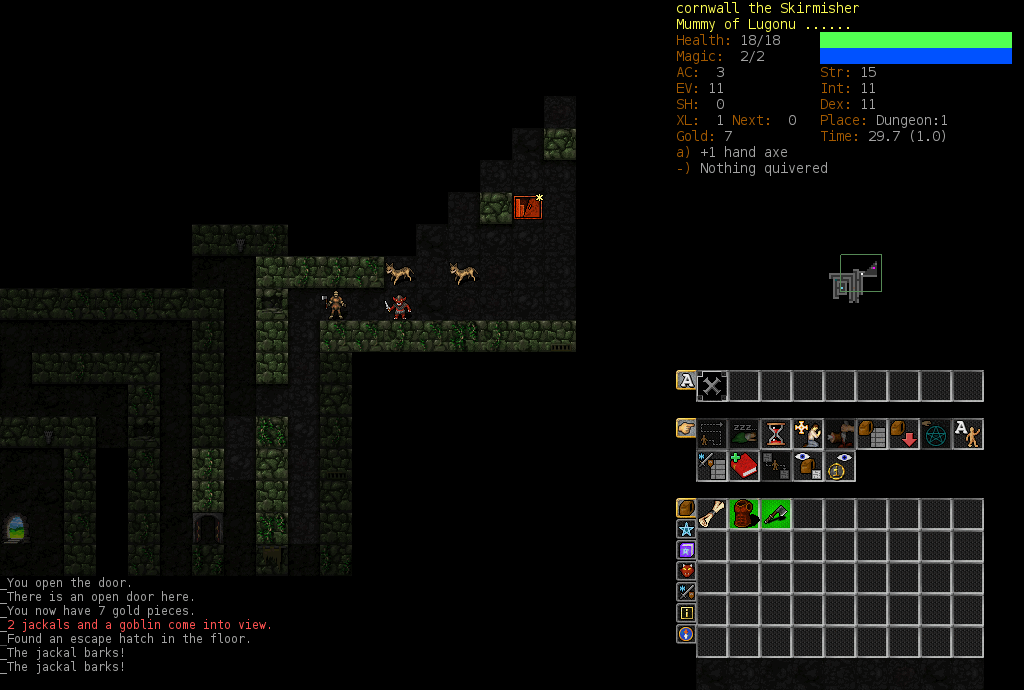

The scorecard was promptly used as one. A columnist for the games site Game Set Watch scored a range of titles against it in December 2009: Linley's Dungeon Crawl and NetHack came out highest, at 57.5 points from a possible 60, while Diablo and ToeJam & Earl, both routinely compared to roguelikes, took roughly half. That exercise is the clearest published illustration of what the Interpretation was for: not a border guard, but a way of saying how far from the centre a given game sits.
The term then broadened well past the document, and the disagreement about that is on the record. From the late 2000s a wave of independently developed games adopted procedural generation and permadeath while abandoning the grid, the turn or both — Spelunky, The Binding of Isaac, FTL: Faster Than Light, Crypt of the NecroDancer, Slay the Spire, Hades and a long tail after them — and were widely marketed and tagged as roguelikes. Alternative labels were proposed and partly adopted: rogue-lite and roguelike-like for games holding some but not all of the high-value factors, and procedural death labyrinth for the narrower case of permadeath plus random levels without the rest. Players attached to the older sense objected that the word had done useful work in the 1990s and 2000s precisely by marking off games that traded aesthetics for depth, and that the dilution cost them that. Publications from the Penny Arcade Report in 2013 to Rock Paper Shotgun in 2016 and PC Gamer in 2021 have returned to the question without settling it, and storefront tagging has settled it in practice by ignoring it.
There is a closing irony that belongs to this page rather than to the genre's. The game this group was chartered to discuss, one of the five the Berlin Interpretation took as canonical, now ships in several modes, among them a roguelike mode in which death ends the run and the saves are gone, and a story mode in which the player may save and load at will, even after dying. The canon moved too.
The rest of the branch
Eight groups made up rec.games.roguelike.*, and the one-line entries in the newsgroups file — the descriptions administrators actually saw — say plainly what each was for:
rec.games.roguelike.adom— The computer game ADOM.rec.games.roguelike.angband— The computer game Angband.rec.games.roguelike.announce— Major info about rogue-styled games. (Moderated)rec.games.roguelike.development— Design and programming of Roguelike games.rec.games.roguelike.misc— Rogue-style dungeon games without other groups.rec.games.roguelike.moria— The computer game Moria.rec.games.roguelike.nethack— The computer game Nethack.rec.games.roguelike.rogue— The computer game Rogue.
Their creation dates, taken from the control messages, run: announce and misc on 24 August 1993; angband on 4 October 1993; moria, nethack and rogue on 6 June 1994; adom on 27 February 1997; development on 25 May 1998. Five of the eight are named after a single game, which is the branch's distinguishing feature and the reason this page exists.
The games themselves have release histories long enough to explain why each earned a room. Rogue was written in 1980 by two students at the University of California, Santa Cruz, originally on a VAX-11/780; it shipped with BSD Unix from 1984 but without its source code, which was not released until BSD 4.3 in 1986, which is why the first generation of imitators had to reconstruct it from the outside. Moria (1983) was written at the University of Oklahoma, also on a VAX-11/780, by someone who could not get at the Rogue source at all; it added a persistent town level where equipment could be bought and sold, and its Pascal data structures allowed a more diverse bestiary. UMoria made it portable. Hack (1982) was written by four students at Lincoln-Sudbury Regional High School on a PDP-11/70 the school had acquired, again after being refused the Rogue source, and added persistent dungeon levels; it was superseded by NetHack in 1987, maintained thereafter by a standing DevTeam, which shipped version 3.6.0 on 7 December 2015, its first major release in over a decade. Angband (1990) was built from the UMoria code by two students at the University of Warwick, released to the public over Usenet, and has been maintained by a devteam ever since; at least sixty variants of it are known. Larn (1986) borrowed from both lines and aimed at a game completable in one sitting. Linley's Dungeon Crawl, programmed in 1995 and first released to the general public on 2 October 1997, arrived late enough to miss the branch's group-creation era and passed to the community as Dungeon Crawl Stone Soup in 2006. ADOM, begun in Germany in 1994 by a student at the Technical University of Dortmund, took its cues from NetHack and set out to keep the depth while imposing a single coherent setting and story.

.svg)
Two of the eight groups were not about a game at all, and both are instructive. rec.games.roguelike.announce was the branch's only moderated group, created with it in 1993 and carrying the moderator's subject-line power described above; the mechanism by which Usenet moderation worked — submissions mailed to a volunteer, articles propagated only when carrying an Approved header — is set out on the soc.* page, and the question of how the recreation hierarchy used moderation belongs to the branch rather than to this group, which was unmoderated from its first day to its last.
rec.games.roguelike.development came much later, and its RFD of 9 March 1998 explains the gap. The roguelike games, it observed, often used ideas or even code from each other, and with a large number of games and variants in existence there were occasional discussions of programming problems — dungeon-generation algorithms are the example it gives — that were of interest to the designers of several games at once, but which nobody saw because developers did not read all the play groups. The charter admitted crossposting to a game's own group but asked that single-game implementation detail stay there, and barred advertisements and binaries with one exception that dates the document precisely: binaries other than PGP signatures. It passed 175 to 19 on 194 valid votes, with seven abstentions and three invalid ballots, and the result was posted on 19 May 1998.
Variants, and one game that refused them
Variant development is the branch's defining shared practice, and the paperwork for the development group is the clearest evidence that everyone involved understood it as such. The lineage is visible in the group names themselves: Moria begets UMoria begets Angband, which in turn accumulated a large family of its own forks; Hack begets NetHack, whose DevTeam released the source but kept a small circle of committers precisely so that the vanilla game would not splinter as Hack had. Source availability was the mechanism. Games distributed with source could be modified, and modified versions could be redistributed, which is how a genre with perhaps a dozen ancestors ended up with hundreds of named descendants; the community-run RogueBasin wiki tracks hundreds of roguelikes and their development.
The game this group discussed was the conspicuous exception, and the exception was deliberate, documented and contested. The author's published FAQ records that the original plan had been to release the sources once version 1.0.0 was finished and the game could be considered even remotely complete, and then explains, at some length and with visible irritation, why that plan was abandoned: a number of people had argued that a game available without charge implied a right to do as they liked with the sources. The stated consequences are set out plainly — the good one being that the game would remain, in the document's own words, the most challenging and mysterious of all roguelike games, precisely because nobody could read the secrets out of a new release; the bad one being that nobody could make variants. On variants the same FAQ is a single line: there won't be any as far as I am concerned.
Two reasons are given. The first is proprietorial and is stated as such: the game is described as a breathing world rather than an exercise in creating a tactically interesting game, and the author says he would hate to see it turned into a munchkin-fest. The second is administrative. He records receiving three to four thousand e-mails a year about the game already, roughly ten a day, and declines to receive another three thousand about variants he knows nothing about. The encyclopaedic account of the game adds that the refusal to release the source drew death threats, and that on one occasion keen fans turned up at his house; that is recorded here because it is published and because it explains the tone of the documentation, not for any other reason. The same account notes that he remained open to licensing the source to capable developers as a commercial venture.
The refusal had a direct and traceable effect on what this newsgroup was for. In a branch where the standard route to understanding a game was to read its source, the readers of this group had no source to read, and so established the game's mechanics the hard way: by systematic experiment, by comparing many characters' outcomes, and by inspecting the running program, its memory and its binaries. That last method sat outside a line the author had drawn, and the collision between the two is the one documented quarrel in the group's own reference literature, described in the next section but one.
What a single-game newsgroup actually carried
Describing the traffic of a group whose archive is intact but whose external documentation is almost nil calls for care: the honest account is of classes of posting, not of individual threads. Four classes are attested by the group's own governing documents, by its own FAQ and by the official site that pointed at it.
Version announcements. The charter required them and required them to be cross-posted to the branch's moderated announce group, which had itself been created in 1993 largely for that purpose — the 1993 RFD noted that many people play a given game until they beat it and then stop until a new version appears, and that an announce group would let such people find out. With a release lineage running from 0.7.1 to 1.1.1 across eight years, this was not an occasional event.
Help and advice. This was official policy, not drift. The author's own FAQ, asked why requests for advice were not answered by e-mail, replies that he lacks the time and directs the reader to visit rec.games.roguelike.adom or one of the spoiler sites. The same document lists the group among the most important sources of information about the game, calls it the official ADOM newsgroup, and adds an instruction that will read as science fiction to anyone who came to the internet later: if your news server does not carry this group, make it known to your system administrator and ask him in a polite way to get the group.
The spoiler and strategy literature. The largest and most durable class, and the subject of its own section below.
Feature requests. The official site ran a request-for-enhancement database alongside a bug database, with open and closed lists for each; a capture of the open list from 2 December 2003 reports that 1,454 requests had not yet been tackled, and the page notes drily that further ones arrive by e-mail and never reach the database because neither party has time to enter them. The group's FAQ records that the author had asked for proposals to be posted on the newsgroup before submission, so that duplicates, features that would not fit the setting and things already implemented could be filtered by experienced players — a volunteer triage layer between a userbase and a single developer, conducted in public and on the record, which is a shape that commercial early-access communities arrived at a decade and a half later. The same FAQ carries a standing list of requests already rejected, from multi-player support to in-game note-taking.
It is as useful to say what the group did not carry. Bug reports had their own channel and were pointedly kept off it: the FAQ gives a dedicated e-mail address and, preferably, an automated web form which ensured the necessary fields were present, and specifies exactly what to include — the version, including the gamma release number read off the title screen, the operating system and version, the description, and the reporter's real name so that a genuine new bug could be credited in the game's credits section. It also specifies what not to send: binaries of any kind, binary patches, and flames. Large binaries were barred by the charter, advertising was barred by the charter, and other roguelikes belonged in the catch-all. Genuinely off-topic posts were tolerated on condition that they were marked [OT] in the subject line.
The author's own accounting of his time is the single best evidence for what the room was like from the front. In the heyday of activity, the FAQ says, he spent roughly an hour a day reading e-mail and news postings about the game, which he describes as more than he could realistically afford. That is a developer reading his players' public conversation daily, for years, in a room he had co-proposed. He has credited the community around the game as the main reason both of his games exist.
As to volume, one figure circulates and deserves to be labelled. The encyclopaedic article on the game states that the group carried two to three thousand messages a month during the years of active development, citing the group's own summary page at Google Groups; that figure has not been independently verified here and is repeated as an attributed claim rather than a measurement. What can be said without qualification is that the medium suited the material. A spoiler file is a reference document, and a system that quoted precisely, wrapped to a fixed column width, threaded replies to their parents and kept everything retrievable served reference documents better than most of what replaced it.
The spoiler apparatus
The group's real subject was knowledge and how to handle it. A game of this size could not be finished by one person working alone, yet a large part of its pleasure lay in not knowing; the community therefore managed the tension rather than resolving it, and did so with an etiquette elaborate enough to need its own document. The group's own FAQ — a separate paper from the game's FAQ, maintained in turn by Richard Fowler, Malte Helmert and others, and standing at version 4.4 in April 2008 — set it out at length.
A spoiler was defined there in functional terms: a piece of information that gives away a secret, something that is not obvious and is not in the manual, the knowledge of which bypasses the problem-solving process in some way. The border, the FAQ conceded, is fuzzy, and the worked examples are about the distinction between the existence of a thing and its properties — that the sheriff in Terinyo assigns quests is fair game, what the quests are and what they pay is not; that an artifact named Kinslayer exists is fair game, its powers and statistics and the place it is found are not. Posts carrying spoiler material took a tag in the subject line, [Spoily] in the ordinary case and something like [Major Spoilers] for a ground-breaking discovery, together with a warning in the body and roughly twenty lines of spoiler space before the content. The space was to be made of asterisks rather than empty lines, because some newsreaders — Google Groups among them — truncated runs of blank lines automatically; the reason for insisting on the space at all was that many readers moved from article to article without reading subject lines and always saw the first screenful. Scrambling the text with rot13 was proposed as an alternative and debated many times over the group's life. Spoiler space kept winning, by what the FAQ calls that dictatorship of the majority known as democracy.
Around this grew a set of abbreviations for the group's standing post genres, of the kind that any long-lived Usenet group develops and that make an archive almost unreadable to an outsider: YAVP for a victory post, with YAFVP for a first one; YASD for a stupid or sad death; YAFM for a game message, or more often a combination of messages, that somebody found funny enough to share; RFE and Pre-RFE for feature requests before and after they were formally submitted; and YAGBU, Yet Another Guidebook Update, for a finding to be folded into the community's reference work. That work, the ADOM Guidebook, maintained by Andy Williams, was described by the group's FAQ as the definitive source of information about the game, and newcomers were asked to search the Guidebook thoroughly and then the newsgroup archive before announcing a discovery — a norm that treats the group's own back catalogue as a database, which is one of the things the recreation hierarchy is credited with inventing.
There was a second reference tradition alongside it. The author's FAQ names a separate site as the primary spoiler site for the game, maintained by Richard Fowler, who also maintained the game's own FAQ and is thanked on the official archive page for the completeness of his records. A single-game community with two overlapping canonical reference works is not an unusual arrangement; a comparable pattern in a Usenet group devoted to a written work, where fans assemble and police a shared canon, is described on the page for rec.arts.sf.written.robert-jordan.
Not everything was amicable. The group's FAQ records a dispute over a rival document, the Improved Guidebook, which copied and altered the original without permission from its author and added material obtained by disassembling the game's executable — a practice the author had asked people not to engage in for any purpose, and one that follows directly from the decision to withhold the source. The FAQ listed the resulting argument among three taboo topics newcomers should approach carefully, alongside the question of whether the source code should be released and the question of what constituted proper use of the save feature. Those three subjects are a precise index of where a single-game community's fault lines lie: intellectual property, method, and cheating.
Where it went
The group's own FAQ registers the change of medium more clearly than any external account could. A question added in version 4.1 and headed What is a newsgroup anyway? Is it like a web forum? explains to arrivals from the web that Usenet is not the web, that messages take a while to propagate and to be answered, that context is not preserved for you and must be quoted, and that HTML posts will reach many readers as source — a document written for readers who already knew, being retrofitted for readers who did not.
The migration followed the general pattern with one local accelerant: the game's official site had been accumulating the functions a forum would later absorb since the late 1990s. It carried the news, the downloads, the archive of old versions, the licensing terms, the bug database and the request-for-enhancement database, each with a submission form, and it linked the newsgroup from its navigation bar as one destination among several rather than as the community's centre. A developer blog and a set of site forums were both running on the same domain by early 2008. The site today runs those forums still, with the blog, the downloads and the FAQ beside them, and the newsgroup is not in the menu.
Elsewhere the genre's institutional memory moved to wikis. RogueBasin, which tracks hundreds of roguelikes and their development, took over the cataloguing role that the branch's catch-all and announce groups had performed, and per-game wikis absorbed the spoiler literature that had previously been maintained as posted text files. The conference tradition that produced the Berlin Interpretation in 2008 continued as the Roguelike Celebration, first held in San Francisco in September 2016, again there in 2017, 2018 and 2019, and as a virtual event annually from 2020 to 2024. Development itself moved to crowdfunding in 2012 and to a storefront in 2015, as described above, and the paid and free lines of the game have run in parallel ever since.
The group itself was never removed. Its line stands in the current newsgroups file, its control message is in the archived record, and the eight groups of the branch are all still listed. What ended was the traffic, not the address.
What the record does not show
A great deal, and it is worth being specific about the shape of the gap. The administrative history of this group and its branch is unusually complete: every RFD, every Call for Votes, every result with its full tally, and every newgroup control message with its PGP signature survives in the mirrored Usenet administrative record, which is why this page can be precise about dates and vote counts. The editorial history is not comparable. There is no surviving external history of the group, no contemporary journalism about it, and no scholarly treatment; what is known about its internal conventions comes from its own FAQ, from the game's FAQ and from the official site that pointed at it.
Consequently this page names no threads, quotes no posts, counts no messages of its own and identifies no participants beyond those who signed a public document in the role described. Readership figures do not exist for it: the network-wide readership estimates that circulated in the early 1990s predate the group, and no equivalent survey covers 1997 onward. How much of the branch's traffic this group carried, how many people posted regularly, when the volume peaked and how quickly it fell away are all questions the surviving documents do not answer, and the archive would have to be counted to answer them.
Nor does the record show what most readers would most like to know: what the arguments were actually like. That a dispute over a rival guidebook existed is documented, and the group's FAQ says that supporters and opponents clashed many times; who took which side is not set out here. That the source-code question was contentious is documented in the author's own words; what the group said about it is in the archive and is not summarised here on the strength of secondary description. The prudent statement is the narrow one: the paperwork is excellent, the memoir is missing, and the archive is the only remedy.
Scope and limits
This page is about a newsgroup. Its subject is a game with a long and well-documented development history, and that history is given here in the detail needed to explain what the group was doing — version chronology because the group announced versions, game systems because the group documented them, the definition question because the branch coined the word — and no further. The game's design, its merits and its reception are covered in the encyclopaedic account linked above.
People are named here only where they signed a public document in the capacity described: the game's author, the two proponents of this group, the moderator named in the branch's 1993 charter, and the maintainers of the two reference works whose authorship is printed on them. Voters, posters and correspondents are not named, although the vote acknowledgement lists give several hundred names and addresses in full. Quotations are from published charters, control messages, RFDs, vote results and the game's and group's own published FAQs and version history, and are reproduced as written, including their spelling.
Topics belonging to other pages of this directory are pointed at rather than retold. The origin and naming conventions of the recreation hierarchy, its moderation practice and the conventions it gave the network are on the rec.* page; the Big-Eight group-creation process and the mirrored master files are on the comp.* page. Where a figure could not be verified this pass it is labelled as an attributed claim in the text, and where the group's own documentation is the only source for a convention, that is said.
Reading rec.games.roguelike.adom today
- Historical archive: Google Groups — rec.games.roguelike.adom (coverage varies by group and era).
- Open in a newsreader:
news:rec.games.roguelike.adom— the original site offered exactly this link, and it still works if your system has a newsreader registered for thenews:scheme. - Live access: point an NNTP newsreader at a modern server — see accessing Usenet today.
- The original news2mail e-mail subscription service ended in the mid-2000s and no longer operates.