microsoft.public.windows.mediacenter.hometheaterpc
Windows Media Center and the home-theater PC.
The mid-2000s HTPC wave — living-room PCs, TV tuners, remote controls, codec grief — had its Microsoft-side support room here, covering Media Center from the XP edition through Vista.
The group documents a hardware culture that streaming quietly retired; Dutch tech press coverage of that era still links this address.
On this page
- The paperwork, and what does not exist
- The home theatre PC as a project
- Six problems no ordinary PC had
- Tuners, drivers and the standards they had to speak
- Broadcast standards by region, and what Media Center actually supported
- CableCARD, and the North American conditional-access arrangement
- Recordings that would not travel
- The guide as infrastructure
- Extenders, and the second television
- Writing for the inside of the interface
- Two televisions, one address
- The appliance that replaced it
- What the room carried
- What the record does not show
- Scope and limits
The paperwork, and what does not exist
A Big-8 newsgroup arrives with a paper trail: a Request for Discussion, a Call for Votes, a published tally, a RESULT. This group has none of those, and never could have. microsoft.* was a vendor hierarchy — a namespace a company created on its own authority, on its own server, and removed the same way — so there was no proposal to argue over, no charter to negotiate, no electorate to convince and no votetaker to publish a count. The hierarchy itself, its naming conventions and its closure are described on the microsoft.public.* hierarchy page, and the shape of the namespace as counted data on the microsoft.public.* namespace page; what follows here is only what those pages do not carry, which is this particular room.
What does survive is the group's line in the newsgroups file, the tab-separated description list that circulates with Usenet's configuration data. It reads, in full, the group name followed by a tab and three words:
microsoft.public.windows.mediacenter.hometheaterpc Microsoft Windows newsgroup.
That is the entire documented statement of purpose, and it is not a statement about this group at all. The identical string stands against microsoft.public.windows.mediacenter and against microsoft.public.windows.mediacenter.digitalcable; it also stands against every other name in the branch, all seventy-two microsoft.public.windows.* groups in the current file carrying it without a single variation. One sentence was written once and copied down a subtree. A reader who wants to know what the room was for has to work it out from the name, which — home theatre PC — is at least unusually specific for a hierarchy in which most names are a product and a component.
The Media Center rooms that appear in the current namespace files are these ten:
- microsoft.public.windows.mediacenter — the parent
- microsoft.public.windows.mediacenter.digitalcable — the American conditional-access problem, given a room of its own
- microsoft.public.windows.mediacenter.hometheaterpc — this group
- microsoft.public.windows.developer.mediacenter — the programming side, kept out of the user tree
- microsoft.public.uk.windows.mediacenter
- microsoft.public.nl.windows.mediacenter
- microsoft.public.de.german.windows.mediacenter
- microsoft.public.fr.windows.mediacenter
- microsoft.public.it.windows.mediacenter
- microsoft.public.il.mediacenterpc — the one that broke the naming pattern
The Internet Systems Consortium mirrors the Usenet control archive, and there the record thins out in an instructive way. It holds no newgroup message for this group, none for its parent, and none for the digitalcable sibling. What it does hold, for the Media Center family, are seven other names: the British room, created by a control article sent from [email protected] on 18 March 2004; a portable-devices room on 30 August 2004; the Dutch room on 6 January 2005; the Korean room on 16 March 2005; the Taiwanese room on 24 March 2005; a Japanese room, present only in the record of its removal; and an Israeli room announced on 7 September 2007. The absence of the English-language core groups from that archive is not evidence they were created quietly — it is evidence that propagation of Microsoft's control messages was patchy, which is exactly the problem the archive's later entries were written to solve.
Those later entries were written by a third party. Microsoft did not issue signed control articles for its own hierarchy; a Usenet volunteer did, and INN's control.ctl records the arrangement in plain terms — control articles for that hierarchy are not issued by Microsoft itself but by a Usenet active participant in order to improve the quality of the propagation of Microsoft newsgroups. The contact address given is [email protected], the administrative group is microsoft.public.news.server, and the syncable server is named as msnews.microsoft.com. Both newgroup and rmgroup from any other sender are set to be dropped. The company owned the namespace; somebody else did the plumbing that kept it visible on the rest of the network. For readers unfamiliar with what a control message is, the short explanation of Usenet covers the protocol underneath all of this.
The end is documented better than the beginning. Microsoft's 2010 notice said that all public newsgroups would eventually be closed between 1 June and 1 October 2010, in a phased approach beginning with the least active groups and moving to the busier ones over the following six months — so there is no single shutdown date for the hierarchy, and none published for this group in particular. The msnews.microsoft.com server itself was reported, by an answer given in Microsoft's own forums early in 2011, to have been shut for good the previous October.
The home theatre PC as a project
The proposition was simple and the plumbing was not: a computer that sat under the television rather than on a desk, driven by a remote control from three metres away, doing the work of a video recorder, a DVD player, a music library and a photograph album at once. Everything difficult about it followed from the two halves of that sentence. It had to be a computer, so it had expansion slots, drivers, codecs and a file system; and it had to behave like an appliance, so it had to be quiet, always ready, operable without a keyboard, and connected to a device that expected a television signal rather than a video card.
The idea was older than the software. Fitting a home computer with broadcast video hardware goes back to the Amiga: NewTek's Video Toaster, demonstrated in the late 1980s and sold as a commercial product from December 1990, put video production onto an expansion card, and tuner cards followed the same route into other machines. Apple built the Macintosh TV into a Macintosh LC 520 chassis in late 1993 and withdrew it after about ten thousand units. In 1996 Gateway 2000 unveiled the Destination, a four-thousand-dollar machine with a tuner card and a video card that the press of the day called a PC-TV combo; by the end of that December the phrase home theatre PC had reached mainstream print, in a newspaper prediction that such a thing would be a combination entertainment and information appliance.
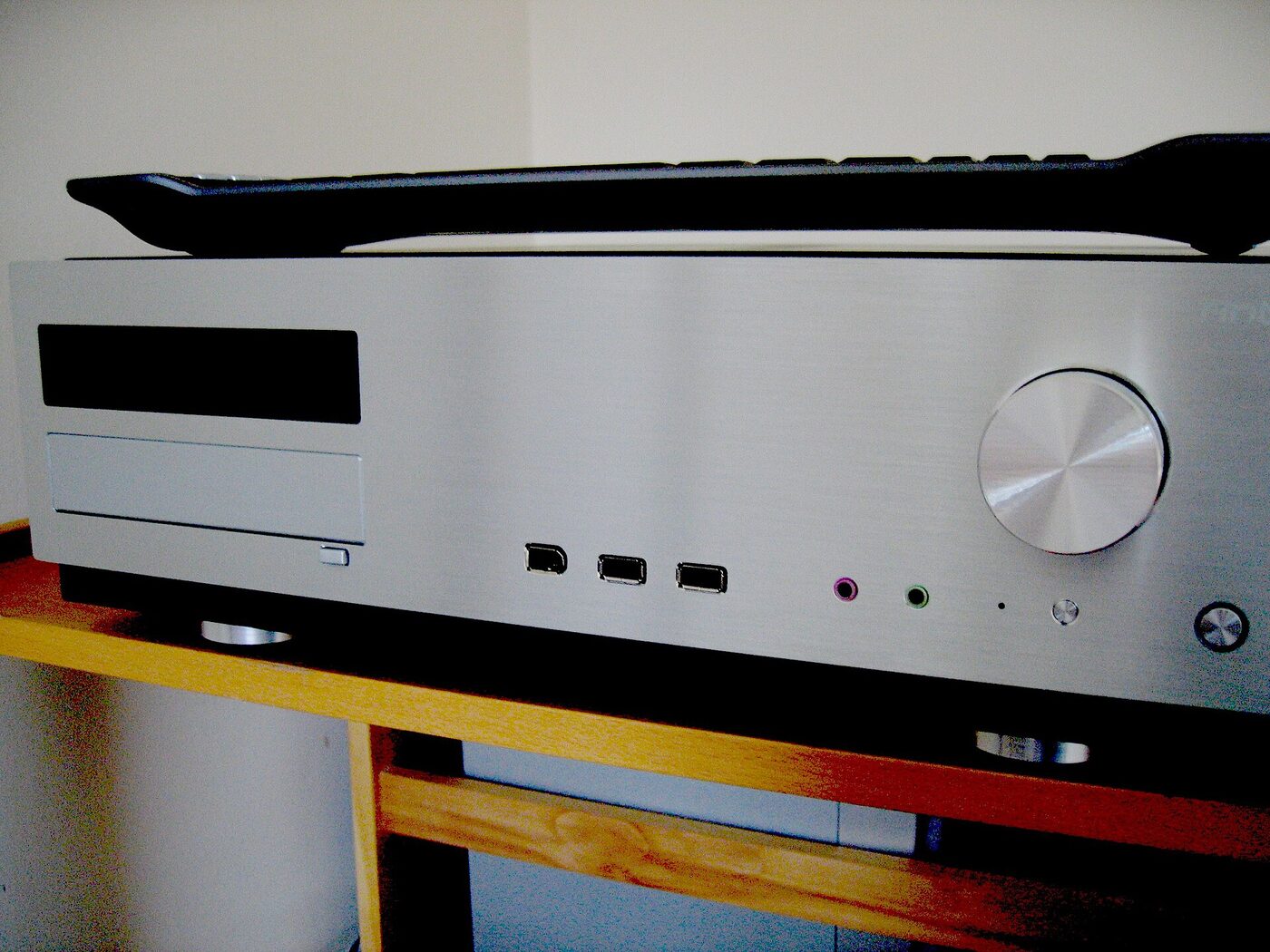

What made the category real around 2000 was a stack of unrelated developments arriving at once: DVD playback on a computer that could out-perform a cheap standalone player, particularly on progressive scan, where the difference between 480p and 480i was worth money; hard disks large enough to hold a video library; and the demonstration by TiVo and ReplayTV that a purpose-built computer could timeshift broadcast television without anyone thinking of it as a computer. Assembling that from parts was within reach of a hobbyist. The missing piece was software to manage and present the media from across a room. MythTV and XBMC — now Kodi, and at the outset a repurposed Xbox — both appeared in 2002; Apple shipped Front Row in 2005 and retired it with Mac OS X Lion in 2011.
Microsoft's answer, developed in a division called eHome and shown in preview at the Consumer Electronics Show in 2002, was an edition of Windows rather than an application. The release history is easy to misread, because each revision was named a year ahead of itself:
- Windows XP Media Center Edition, codenamed Freestyle, announced 16 July 2002, released to manufacturing on 3 September 2002 and generally available in North America on 29 October 2002, built on the Windows XP Service Pack 1 codebase.
- Media Center Edition 2004, codenamed Harmony, launched 30 September 2003, also on the Service Pack 1 codebase, and offered as an upgrade to owners of an original licence.
- Media Center Edition 2005, codenamed Symphony, launched 12 October 2004 on the Service Pack 2 codebase — the first edition available to system builders outside the largest tier, and the first with Media Center Extender support and CD and DVD burning.
- Media Center Edition 2005 Update Rollup 2, codenamed Emerald, released 14 October 2005: Xbox 360 extender support, DVB-T reception, support for two ATSC tuner cards, and Away Mode.
After that the software stopped being an edition of Windows and became a feature of one. A dedicated Longhorn Media Center Edition, codenamed Slalom, was planned and then dropped in favour of folding the component into ordinary editions; it shipped instead, under the codename Diamond, as Windows Media Center inside Windows Vista Home Premium and Ultimate, and then in every edition of Windows 7 except Starter and Home Basic. The group's working span sits almost exactly across the years when Media Center was still a reason to choose one machine over another.
The hardware demands were the reason it was sold the way it was. Microsoft judged the requirements strict enough that it would not offer Media Center as an independent retail product at all: it went to MSDN subscribers and to original equipment manufacturers in certain countries, and a buyer acquired it preinstalled on a computer, a set-top box or an embedded device. Media Center Edition 2005 wanted at least a 1.6 GHz processor, a DirectX 9 hardware-accelerated graphics part — an ATI Radeon 9 series or an nVidia GeForce FX or better — and 256 MB of system memory, with extenders, multiple tuners and high-definition playback all pushing those figures up. Retail availability of the XP edition ended, as planned, on 14 April 2009; support, originally due to stop on 13 April 2010, was extended twice — first to 12 July 2011, then to a final date of 8 April 2014.
All of which set the terms for anyone who wanted to build the machine rather than buy it, which is the population this group served. The parts list was constrained as tightly as the licence, and finding a supplier in the right country willing to sell the operating system alongside the components was itself a piece of research before a single screw was turned.
Six problems no ordinary PC had
Strip out the enthusiasm and a home theatre PC is a list of six engineering problems that a desk machine simply does not have. Almost everything the group discussed was one of them.
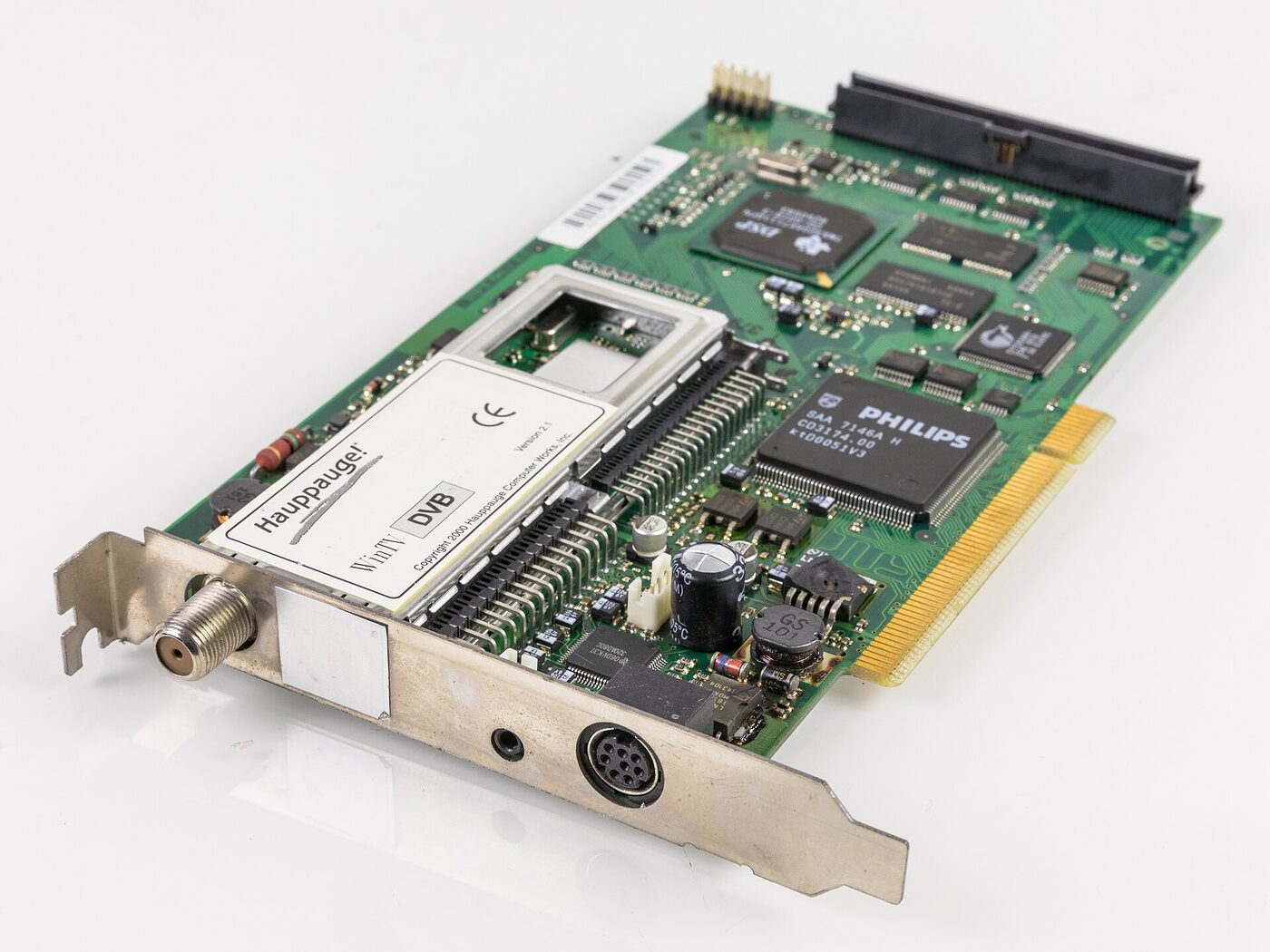
The tuner card. A desktop computer does not need to receive a broadcast; this one did, from an aerial, a dish or a cable, and in a format the software would accept. Tuner cards of the period commonly carried a hardware MPEG-2 encoder precisely so that recording did not consume the processor, and Media Center's early versions required one. The card also had to present a standardised driver interface and support closed captions, along with a number of other features. A tuner that worked perfectly in the windowed television application shipped by its own manufacturer could therefore be invisible to Media Center, which is a distinction that takes some explaining to a person who has just bought one.
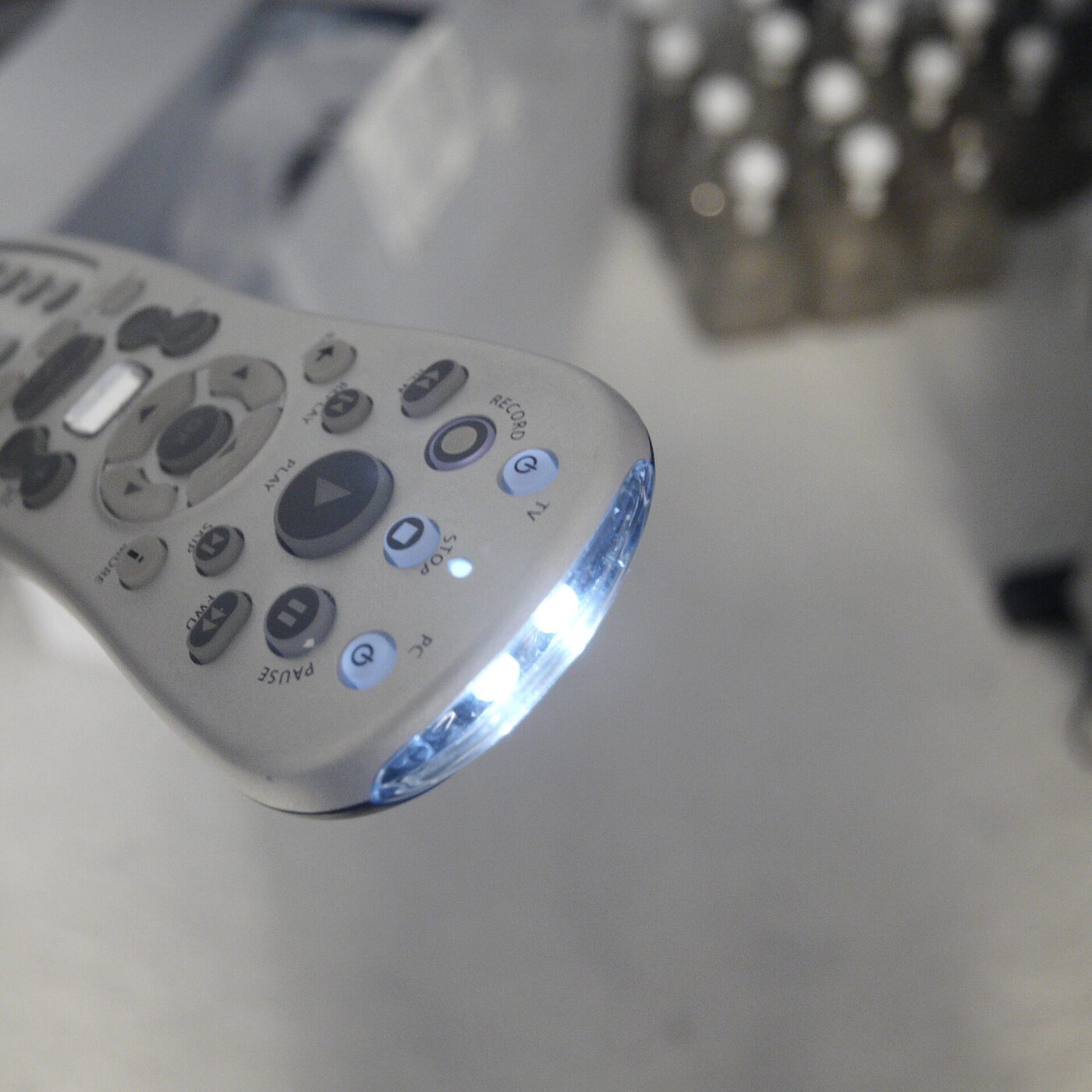
The remote and its receiver. An appliance is operated from an armchair, and a Media Center PC needed a sensor before it could be. Most systems used an infrared receiver on a USB lead, plus — where the signal came from a cable or satellite box rather than from the PC's own tuner — an infrared blaster: a small emitter taped over the sensor window of that box, through which the computer changed the box's channel on the recording schedule's behalf. This is a genuinely fragile arrangement. The blaster fires blind, with no confirmation that the box received anything, and a firmware update at the operator's end can change the timing or the codes underneath it. Microsoft shipped its own remote, receiver and blaster with Media Center Edition 2005 and a matching wireless keyboard in September of that year, and required remotes advertising Media Center support to carry particular buttons — the green Media Center Start button, navigation, playback, volume, power and channel keys — so that the interface could assume they existed.

Video out to something that is not a monitor. Televisions and projectors of the period took HDMI, DVI, component video, VGA on some sets, S-Video or composite, and each of those imposed its own assumptions about resolution, refresh and the edges of the picture. A set expecting broadcast timings is not simply a large monitor. On top of that sat content protection: the American broadcast-flag rule, described below, was written in terms of protected outputs — DVI and HDMI carrying HDCP encryption — with everything else degraded to enhanced-definition resolution or worse, and Windows Vista introduced the Protected Media Path, with its Protected Video Path and Protected User Mode Audio subsets, to enforce such rules inside the operating system. A cable that worked was not necessarily a cable that was allowed to work.
Noise, and therefore the case. A computer built for maximum performance is tuned to move heat, and the fans that do it are audible in a quiet scene. A machine that plays films has to be inaudible from the sofa while doing far less work than its cooling was designed for, so the standard remedies were passive cooling, low-noise fans, and elastic mounts to keep fan and disk vibration out of the chassis. The market answered with hi-fi-shaped cases in component widths, often with a vacuum-fluorescent display on the front, so that the thing would sit on a rack without announcing itself as a PC.
The ten-foot interface. Text sized for a desk at half a metre is unreadable at three, so the whole presentation layer had to be rebuilt around large type, large targets and directional navigation from a remote rather than a pointer. Media Center's menus were designed on that principle throughout, and the constraint propagated outward: any application that wanted to live inside it had to be written to the same rules.
Always-on power. A recorder that is asleep at nine o'clock does not record the nine o'clock programme, and a machine left running to be sure of that is a machine humming in the living room all night and drawing power for the privilege. Update Rollup 2 addressed the first half of that with Away Mode, which let the machine appear to be off — screen dark, no obvious activity — while it stayed awake to perform background work such as a scheduled recording. It did not address the second half. The scale of the problem is visible in the extender hardware that came later: an Xbox 360 pressed into service as a second screen draws somewhere between seventy and two hundred watts depending on model and activity, where a purpose-built extender such as the Ceton Echo claimed under five. There is also the storage question hanging off all of it: recorded television is bulky, internal bays were scarce in a slim case, and network-attached storage or a separate file server became the usual answer.
Tuners, drivers and the standards they had to speak
Television support in Windows did not begin with Media Center. Tuner hardware was brought into the operating system with the Broadcast Driver Architecture in Windows 98, and that framework grew over the following decade to take in digital and high-definition reception and successive terrestrial, cable and satellite standards. What Media Center added, from Windows XP Media Center Edition onward, was the recorder: the scheduling, the guide and the disk.
It added them on strict terms. Media Center was, by a wide margin, more restricted in the hardware it would accept than most other DVR software of the period. Tuners needed the standardised driver interface, the hardware MPEG-2 encoder, closed-caption support and a number of other features besides. That rule loosened rather than lifted: manufacturers wrote drivers to bring existing products inside the fence, and ATI's All-In-Wonder and HDTV Wonder boards were supported under the 2005 edition. But the boundary stayed where Microsoft had drawn it, and a card's presence in a slot never guaranteed its presence in the interface.
How many tuners the software would drive at once was a property of the software, not of the case. Update Rollup 2 added support for two ATSC tuner cards. The Vista version supported two dual-tuner cards, and the TV Pack of 2008 raised the ceiling again. Windows 7 allowed four tuners of each type — clear QAM, ATSC, CableCARD, NTSC — with all of them sharing a single set of guide data, which could be edited to add channels the listings did not carry. Media Center handled analogue and digital tuners alike, took composite and S-Video inputs as well, and would drive analogue FM radio if the tuner supported it. While live television was playing it kept a buffer, which is what made pausing and rewinding a broadcast possible, and what made skipping past advertisements a matter of holding a button.
The later answer to all of this was to take the tuner out of the computer altogether. A network tuner, or television gateway — SiliconDust's HDHomeRun is the best-known example — sits between the aerial or dish and the local network and converts the broadcast to IP, so that several devices can be served from one set of tuners and the machine under the television no longer needs the slot, the aerial lead or the heat. That is a tidy solution and it arrived, in the mainstream, rather later than the period in which such groups were most used years.
Broadcast standards by region, and what Media Center actually supported
Nothing about a television signal is universal, and a room devoted to building television receivers therefore had to be several rooms at once. Three families of digital broadcast standard divided the world between them, and a card bought for one was of no use for another.
ATSC. The Advanced Television Systems Committee standards came out of the Grand Alliance, the consortium the Federal Communications Commission convened in 1993 to pool the competing American digital television proposals. Standard A/53 was published in 1995 and adopted by the Commission in 1996; the modulation is 8VSB, the channel is the 6 MHz slot the American system had always used, the two principal high-definition formats are 1080i and 720p, the audio is Dolby Digital AC-3 — standardised by the committee as A/52 — and captions follow EIA-708. A single channel can carry one high-definition service or several standard-definition sub-channels instead. ATSC is used chiefly in the United States, Canada, Mexico, South Korea and Trinidad and Tobago; the analogue switch-offs came on 12 June 2009 in the United States, 31 August 2011 in Canada, 31 December 2012 in South Korea and 31 December 2015 in Mexico. Cable in the same territories used QAM, and unencrypted cable channels — clear QAM — could be received by an ordinary QAM tuner without any conditional-access hardware at all.
DVB. The European family is maintained by the DVB Project and published by a Joint Technical Committee of ETSI, CENELEC and the European Broadcasting Union, and it divides by delivery rather than by region: DVB-S for satellite, DVB-C for cable, DVB-T for terrestrial, each with its own modulation and error correction. DVB-T was first published in 1997 and first broadcast in Singapore in February 1998; the standard is EN 300 744, the modulation is coded orthogonal frequency-division multiplexing, and most adopters use 7 MHz VHF and 8 MHz UHF channels, though Taiwan, Colombia, Panama and Trinidad and Tobago use 6 MHz. Within a single variant, frequencies, multiplexes, channel line-ups and listings were arranged nationally rather than continentally — the United Kingdom's D-book, Italy's DGTVi, the ETSI E-Book and NorDig for the Nordic countries and Ireland are all separate implementation books — so a working set-up carried across a border did not simply resume.

ISDB. The Japanese family, maintained by ARIB, covers satellite, terrestrial and cable in ISDB-S, ISDB-T and ISDB-C. Terrestrial digital broadcasting using ISDB-T began in Japan in December 2003. An adapted version was chosen by Brazil, which called it SBTVD and which the Japanese DiBEG group then folded back into the standard as ISDB-T International, and it spread across most of South America and to the Philippines, Botswana and elsewhere. ISDB brought with it a conditional-access arrangement of a kind the other families did not impose: in Japan the signal is scrambled under the B-CAS system even when the programme is free to air, which makes an unencrypted Japanese broadcast something close to a contradiction in terms.
Against that map, Media Center's coverage was narrow and arrived late. Standard- and high-definition unencrypted video were supported through DVB-T and ATSC. DVB-T reception did not appear at all until Update Rollup 2 in October 2005, which meant European posters spent the software's first three years either on analogue capture or waiting. The gap was closed by the Windows Media Center TV Pack 2008, codenamed Fiji — released on 16 July 2008, its existence confirmed only obliquely through an article in Microsoft's support database, and announced publicly at the IFA in Berlin on 28 August 2008. It added direct DVB-S satellite support, though not DVB-S2; improved DVB-T; ISDB-T and clear QAM; digital sub-channels; a higher limit on the number of tuners of each type; and the new WTV recording format, with DVR-MS superseded but still readable. High-definition television carried as H.264 was still not supported: beta builds handled it and the feature was removed before release.
One item in that list is disputed and is set out here rather than resolved silently. The English-language encyclopaedic account of the pack lists MHEG — the interactive-television middleware used on British digital terrestrial services — among its additions, and an earlier revision of this page repeated that. The German-language account, which is the more detailed of the two and itemises the release feature by feature, does not mention MHEG at all. The claim is therefore recorded as contested: one reputable source asserts it, another that covers the same release in more depth omits it, and no primary Microsoft document consulted for this revision settles the point.
The pack's distribution is the detail that mattered most to the people in this group. It went only to OEMs building complete machines. An owner of a working Vista Media Center installation could not license it, could not download it legally, and would not receive it by buying or installing a fresh copy of Vista Service Pack 1. The choice was a new computer or Windows 7, whose Media Center folded in most of what the pack had added and went further, driving DVB-S2 tuners and playing H.264 — which together made high-definition satellite reception possible for the first time. DVB-C, the cable variant used across Europe, was never directly supported at all; reaching it meant buying third-party software or a card whose maker had solved the problem in its own driver.
Microsoft's own summary of the broadcast standards involved appears in the post announcing that Media Center would leave the box in Windows 8, published on the Building Windows 8 blog on 3 May 2012 and authored by Bernardo Caldas of the Windows Business Group with Linda Averett of the Developer Experience team. Acquiring either pack, it said,
gives you Media Center, including DVD playback (in Media Center, not in Media Player), broadcast TV recording and playback (DBV-T/S, ISDB-S/T, DMBH, and ATSC), and VOB file playback.
The typo is Microsoft's; DVB-T and DVB-S are meant. It is as close to an official list as the record offers, and worth noting for what it includes — the Japanese satellite and terrestrial standards, and the handheld DMB-H — and for what it does not.
CableCARD, and the North American conditional-access arrangement
American readers had a further ordeal, and it had a statutory origin. Section 629 of the Telecommunications Act of 1996 instructed the Federal Communications Commission to assure the commercial availability to consumers of converter boxes and related equipment from manufacturers and retailers not affiliated with any multichannel video programming distributor — a deliberate echo of the Carterfone principle that had opened telephone networks to third-party handsets. On 11 June 1998 the Commission ordered cable operators to supply a separable security device, called in the regulations a Point of Deployment module, by 1 July 2000. After repeated requests for delay from the cable industry, the first devices from third-party manufacturers reached the market in August 2004.
The card that resulted, trademarked CableCARD by CableLabs and specified in standards including SCTE 28, SCTE 41 and CEA-679, is a PC Card that performs a conditional-access function and nothing else. The tuner, the QAM demodulator and the MPEG decoder all stay in the host device; the card identifies and authorises the subscriber, decrypts, hands back an MPEG-2 transport stream, and forwards messages sent down the operator's out-of-band signalling channel. Two kinds existed: a single-stream card, which decodes one channel at a time, and a multi-stream card, which decodes several — the difference between a receiver that can record one programme and one that can record while you watch something else.
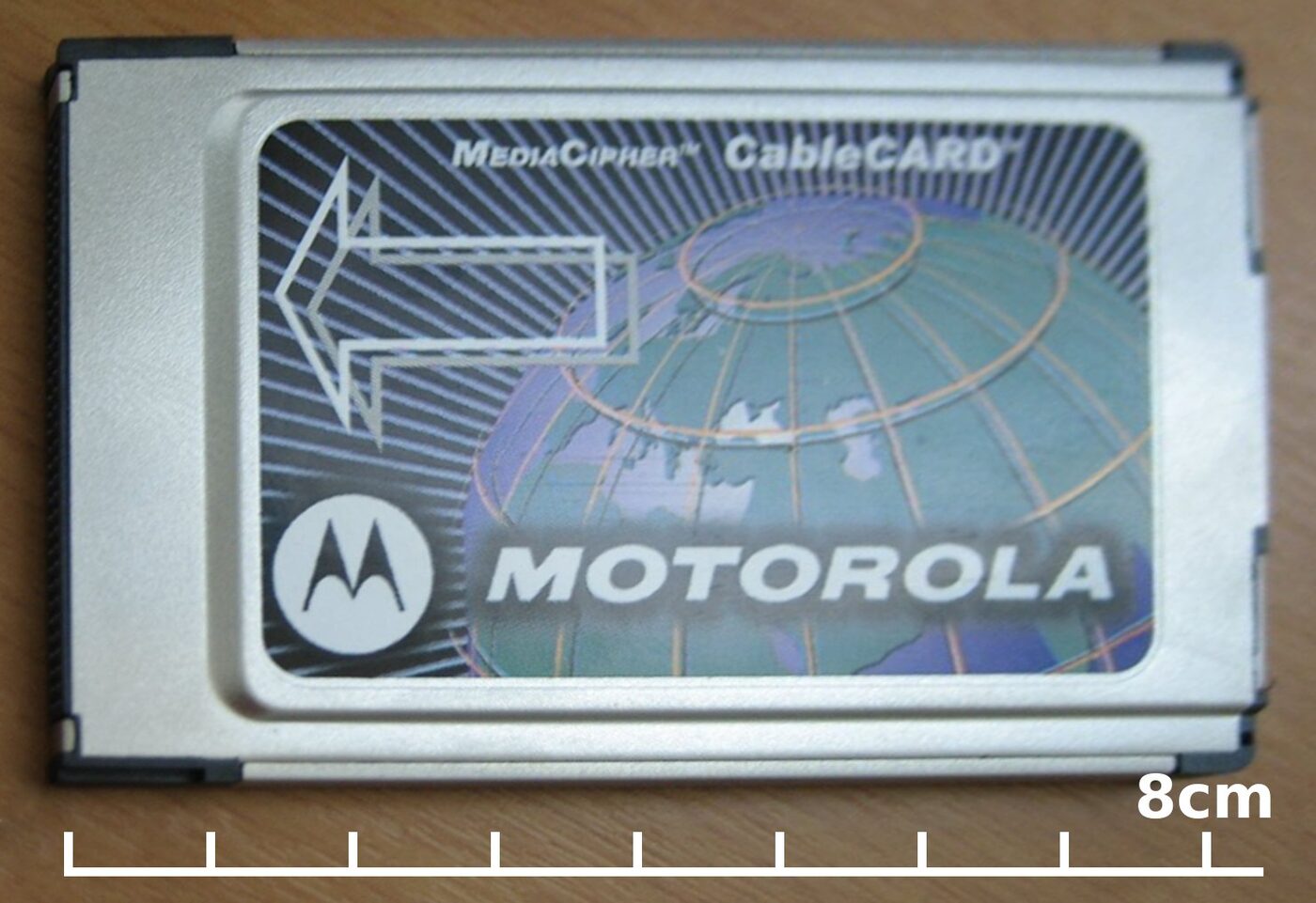

The rest of the arrangement was regulatory scaffolding. To stop operators from supplying themselves better equipment than they supplied their competitors, the Commission imposed an integration ban, requiring operators to use the same separable security in their own boxes; directed for 1 January 2005, deferred twice, it took effect on 1 July 2007 and ended in December 2015. Devices using the cards were called hosts, had to be certified as compliant by CableLabs, and were tested in batches on a quarterly cycle — a schedule that sets an outer bound on how quickly a new tuner could reach the market.
Windows Vista introduced CableCARD support, and made it conditional in a way that mattered enormously to a self-builder: it worked only on complete OEM systems that had been certified by CableLabs. Buying the parts and assembling them yourself was not a path to premium digital cable, whatever the parts were. The OEM restrictions were officially lifted in September 2009, and the Windows 7 version allowed a CableCARD to be added to existing hardware that met certain requirements, with a Digital Cable Advisor tool shipped shortly after release to tell an owner whether a given machine qualified. That is the single change most responsible for the late flowering of American Media Center building.
Even then a Media Center PC was a one-way receiver. Unidirectional hosts had no return path to the head end, so video on demand, pay-per-view and, initially, switched-video channels were simply out of reach; a Tuning Resolver Interface Specification was later added to give one-way devices enough of a back channel to request switched services. The interactive half of the specification depended on the host running the OpenCable Application Platform, a Java-based layer the consumer-electronics industry objected to at length as an expensive answer to a question it had not asked — its argument being that Java is inefficient on consumer-electronics hardware and that the cable industry was passing on the cost of a software platform the manufacturers had never wanted.
The adoption figures record how the experiment went. There were 141,000 cards in retail devices by February 2006. By June 2009 the ten largest incumbent operators had deployed more than fourteen million operator-supplied set-tops containing CableCARDs against 437,800 modules for use in retail equipment. In April 2016 the National Cable Television Association counted 621,400 retail cards against fifty-five million operator boxes among the nine largest operators. Outside the United States the technology was adopted only in South Korea. The Commission issued a notice of inquiry in 2010 for a successor system called AllVid, which came to nothing; and on 4 September 2020 it removed the requirement that operators supply the cards at all, leaving in place only a general obligation to provide consumer access by way of separable security.
Europe had an equivalent in principle and no equivalent in practice for these machines. DVB's conditional-access work defines a Common Scrambling Algorithm and a physical Common Interface into which a conditional-access module is inserted, with each operator's proprietary system built to those specifications — structurally the same idea as separable security, arrived at by a different route, and capable of carrying several conditional-access systems on one scrambled stream at once. Media Center's documented support for encrypted channels, however, was CableCARD and CableCARD only. For a European builder, encrypted cable and encrypted satellite were, as far as this software was concerned, someone else's problem; free-to-air reception was the part of the map the documentation covered. That the sibling group microsoft.public.windows.mediacenter.digitalcable existed at all — a whole room for one country's conditional-access scheme — is the clearest single indication of how much support load the arrangement generated.
Recordings that would not travel
A recording made by this software was not a file in a neutral format, and the group's most durable frustration came from discovering that after the fact rather than before.
Under Windows XP and Vista, recorded television was written as DVR-MS: audio and video streams wrapped in Microsoft's Advanced Systems Format container, video encoded as MPEG-2, audio as MPEG-1 Audio Layer II or Dolby Digital AC-3, with both standards extended to carry metadata and rights management. The files came from the Stream Buffer Engine, a DirectShow component introduced in Windows XP Service Pack 1 — which is why an unprotected recording would open on any Windows machine from that service pack onward, on Windows XP RTM with a specific hotfix that added the format to DirectShow, on Windows Mobile 6, and elsewhere only through a player that had implemented the format. The DirectShow lineage is covered on the DirectX group's page; the codecs and containers themselves, and the wider story of Microsoft's media formats, belong to microsoft.public.windowsmedia and are not retold here.
The broadcast side is this page's subject, and the broadcast side is where the difficulty came from. If a broadcast arrived marked as copy protected, the resulting DVR-MS file could be played back only on the device that had recorded it. Not on the laptop, not from the archive disc, not after a motherboard replacement. Everything else in the format worked as a file format should; the flag did not care.
The American regulatory instrument behind that is the broadcast flag, formally the Digital Broadcast Television Redistribution Control rule, codified at 47 CFR 73.9002(b). Its demodulator compliance requirements obliged every high-definition demodulator either to listen for the flag or to assume it present, and to send flagged content only to protected outputs — DVI or HDMI carrying HDCP encryption — or in degraded form through analogue outputs or digital outputs limited to 720 by 480 pixels. Flagged content could be recorded only by authorised methods, which the rule permitted to include tethering a recording to a single device. Separate robustness requirements obliged hardware to resist user modification, a condition open-source drivers cannot meet by design. Receivers were to comply by 1 July 2005.
They never had to. In American Library Association v. Federal Communications Commission, 406 F.3d 689, docket 04-1037, the United States Court of Appeals for the District of Columbia Circuit decided on 6 May 2005 that the Commission had exceeded its authority: it could not forbid the manufacture of computer or video hardware lacking copy-protection technology, because its authority ran to transmissions rather than to the devices that receive them. Attempts to restore the rule by statute followed — a version was inserted into a communications bill on 1 May 2006, an amendment to strike it failed in committee on 22 June, and the bill itself died when the 109th Congress adjourned that December. The Commission formally removed the regulations from the books on 22 August 2011.
The rule being vacated did not make the flag disappear from the signal or from the software. On 18 May 2008 it was reported that Microsoft had confirmed that shipping versions of Windows Media Center adhered to the broadcast flag, following reports that users had been prevented from recording particular NBC broadcasts — chiefly episodes of American Gladiators and Medium; a company spokesperson said that Media Center adhered to the rules set forth by the FCC. That is the crux of the matter as this group experienced it. A regulation that no longer bound anybody was still being honoured by the receiver, because honouring it was a term of doing business with the people who supplied the content.
Other signalling did similar work by other means. CGMS-A, the analogue copy-generation system, has existed since 1995 and consists of a waveform inserted into the vertical blanking interval, of which two bits carry the copy-generation state; it is standardised through the IEC, the CEA, EIA-J and ETSI, with a different line and bit assignment for each video format. A compliant recorder that sees it may refuse or restrict the recording, though no blanket legal requirement obliges any recorder to look for it. Where the source is digital, the equivalent Copy Control Information travels as metadata in the transport or program stream, and a compliant player re-encodes it into the analogue output it generates itself. From 15 April 2008, pay-per-view films on American cable and satellite were flagged so that a recording expired twenty-four hours after the order.
Europe and Japan arranged this differently. No equivalent flag was in general use in DVB transmissions; the DVB Project's answer, DVB-CPCM, was standardised by ETSI as the multi-part TS 102 825 between 2008 and 2013 and was deprecated by the DVB Steering Board in February 2019 without ever having displaced the situation it was written for. The BBC introduced content-protection restrictions on free-to-air Freeview HD from 2010 by licensing the data needed to read the service information, while stating that the strongest protection applied would permit one copy. ISDB, by contrast, built rights management in from the start: content carries one of three modes — copy free, copy once, copy never — where a copy-once programme may be stored on a recorder and moved to another protected medium exactly once, after which it is marked to prevent any further copying, and a copy-never programme may be timeshifted but not kept.
From the TV Pack 2008 onward the container changed. WTV kept MPEG-2 and AC-3 but no longer used ASF underneath, and Microsoft did not publish a general DirectShow filter to let third-party players open it on Windows Vista or on Windows XP Media Center Edition; an update added playback to Windows Media Player 11 on Vista, and that was the extent of the accommodation. Windows 7 shipped a conversion in the other direction, turning WTV recordings that were not copy protected back into DVR-MS. The qualification carried the whole difficulty of the subject: what could be moved could be moved, and what could not stayed on the disc that had written it.
The guide as infrastructure
The point most easily missed about a recording appliance is that the tuner is the cheap half. A machine that can receive and store a broadcast but does not know what is on is a video recorder with a clock, and everything that makes a DVR pleasant to use — recording a series, following a programme that has moved, searching by title — is a function of programme data rather than of hardware.
Media Center's guide was one of its strongest arguments. Unlike the commercial DVR products it competed with, Microsoft charged no monthly subscription for the Media Center television guide service. For a buyer comparing a Media Center PC against a set-top recorder with a monthly fee attached, that was the argument. It was also, though nobody framed it that way at the time, a dependency: the machine's most valuable function was being provided free by a company that had not promised to provide it forever.
Where listings come from is itself regional. DVB transports carry Service Information — standardised as ETSI EN 300 468 — which links the elementary streams into coherent programmes and provides human-readable descriptions specifically so that a receiver can build an electronic programme guide and support searching and filtering. A European receiver can therefore assemble a guide out of the air, within the limits of what the broadcaster chooses to send. North American practice leaned instead on a listings business: a company that compiles schedules for the whole country, licenses them, and bills for the licence.
What happens when such a company changes its mind is a matter of record, and the clearest example is not Microsoft's. Tribune Media Services, whose listings data underpinned a great deal of the American guide ecosystem, shut down its free Data Direct programme-listing service with effect from 1 September 2007. Developers from MythTV, XMLTV and GB-PVR responded by founding Schedules Direct, a non-profit that contracts with the same data business — now trading as Gracenote — for a licence to redistribute the listings to members using approved open-source and freeware applications, for thirty-five dollars a year. An entire class of home-built recorders lost its schedule on one date, and got it back only because volunteers set up an organisation to buy it.
Microsoft's own feed changed hands late in the product's life. In early July 2015 the company announced that the guide would be updated on 7 July with new video data packages; the update moved the service from Zap2It to Rovi, and it was followed by a long run of complaints about incorrect channel line-ups, outdated and incorrect programme data, and failures to download the data through Microsoft's servers at all.
The service ended on 14 January 2020 — the same day support for Windows 7 ended, which is unlikely to be a coincidence, and which applied to every version of Media Center including those running on XP and Vista. In practice the data kept arriving after the announced end, continuing to update until the first week of April 2020. Substitutes exist and are the reason working Media Center installations survive: epg123, which feeds the software from other sources; EPG Collector, which harvests over-the-air data; WebGrab+Plus; and Schedules Direct itself.
The general lesson the archive of this kind of group preserves is worth stating plainly, because it applies far beyond television. The tuner is a physical object and keeps working. The disk keeps working. The schedule is a service, and a service is a contract, and a contract ends. A device whose principal function depends on a data feed has a life expectancy set by somebody else's business plan, and the owner will usually not learn what it is until the feed stops.
Extenders, and the second television
One machine under one television solves one room. Microsoft's answer for the rest of the house was the Media Center Extender, officially Extender for Windows Media Center and codenamed Bobsled: a device on the network that presents the host PC's Media Center interface on another screen, so that the tuners, the disk and the licence stay in one place. Media Center Edition 2005 introduced the capability and would serve up to five extenders per household.
The mechanism is neater than it sounds. The interface itself is streamed to the extender over the Remote Desktop Protocol, so all the processing — including any add-in applications — happens on the host, and an extender can render a plug-in it has never heard of. Each extender is paired with the host by an identifying number it generates, creates its own account there, named MCX1, MCX2 and so on, and a version of Fast User Switching lets the host and the extenders be in use simultaneously; this is why the ability to join a Windows domain was disabled in the 2005 edition, and why users promptly found a registry edit that put it back. Media, unlike the interface, travels by a different route, which means the codec has to exist on the extender or the host has to transcode on the fly — a chore Windows 7 finally made standard.
First-generation extenders ran Windows CE and included the HP x5400, the Linksys WMCE54AG and an add-on kit that turned the original Xbox into one. They supported Media Center only up to Media Center Edition 2005 Update Rollup 2 and could not be made to work with the Vista version, which left a population of owners stranded by an upgrade they had not asked for. Second-generation devices could use other embedded operating systems, handled newer video formats including DivX, Xvid, Windows Media Video HD and H.264, streamed high definition over HDMI, could carry protected content, and often shipped with draft 802.11n wireless. The list of them is short and mostly forgotten: the D-Link DSM-750, the Linksys DMA2100 and DMA2200, HP's MediaSmart Connect and MediaSmart televisions, a Samsung media extender, the Niveus Edge — an Xbox 360 rebuilt into another case — and, last of the line, the Ceton Echo.
The device that made the category briefly ordinary was a games console. Update Rollup 2, on 14 October 2005, added Xbox 360 extender support to Media Center Edition 2005; the console itself went on sale in the United States and Canada on 22 November 2005, in Europe on 2 December and in Japan on 10 December, with the function built in. For a great many households the second Media Center screen was a machine bought for something else entirely, and the Xbox 360 was for a long stretch the only second-generation extender that worked with Vista and Windows 7 alike. Microsoft announced extenders from Linksys, D-Link and Niveus Media on 5 September 2007; by 2020 none of the category was commercially available.
Writing for the inside of the interface
Media Center was a programmable platform as well as a product, which is why a separate room, microsoft.public.windows.developer.mediacenter, existed for the people writing against it and why this one could stay on hardware. The relationship matters here in one direction only: the extender architecture meant an add-in ran on the host and was drawn on the screen, and a builder with a second television inherited the developer's constraints whether or not any code was ever written in the house.
Three kinds of application could extend it. Presentation Layer applications were managed code packaged as assemblies, with full access to the .NET Framework and to a managed object model covering media playback, live television, recording and the presentation system itself; their interfaces were written in an XML dialect called Media Center Markup Language, which handled animation, text input, navigation, data binding and local storage from the markup, with code-behind assemblies in any CLI language for anything the markup could not express. Because the Presentation Layer streamed over the same Remote Desktop connection as the rest of the interface, these ran on extenders unmodified. Second came XAML Browser Applications, rendered with the vector-based Windows Presentation Foundation, supported for streaming to extenders only in a limited way and declared deprecated in version 5.3 of the Media Center software development kit. Third, and simplest, Media Center could host Internet Explorer inside its own interface and run web applications written against a JavaScript subset of the same API.
The first two existed only in the Windows Vista version. An application could register itself as a top-level menu entry, as an item in a sub-menu, as an autoplay handler, in the Program Library, or as a background task with no interface at all that ran for as long as a Media Center session did. Downloaded rather than installed code was untrusted and confined to the classes marked safe for internet-originating code. None of this is a large body of software by any modern measure, and almost none of it survives; but it is the reason a plug-in on the host machine appeared on the television in the next room, which is a thing the group's members noticed and asked about.
The synchronisation side had a room of its own too, microsoft.public.windows.mediacenter.portable, created on 30 August 2004 and removed in the December 2009 sweep. Media Center would copy recordings to Windows Mobile Pocket PCs, smartphones, Portable Media Centers and other players that synchronised with Windows Media Player, re-encoding television to Windows Media Video at a lower quality on the way out to suit the storage and processing available at the far end, and optionally re-encoding music smaller as well. Microsoft's own Zune could not use the synchronisation function, though it would play a Media Center recording copied into a folder it watched — a small, exact illustration of how little the pieces of one company's product line necessarily know about each other.
Two televisions, one address
Because television is a national institution before it is a technology, this group was really two conversations sharing an address. North American posters worked with NTSC and ATSC, with QAM cable, with a rented set-top box in the signal path and an infrared blaster taped to its front. European posters worked with analogue systems giving way to DVB-T, with DVB-S satellite, and with a software feature set that reached them years late. Answering a question therefore began by establishing where the asker lived, because the correct answer to a tuner question in Ohio was wrong in Oxfordshire and the reverse.
Microsoft's own namespace shows the company reaching the same conclusion and solving it by subdivision. The control archive dates the localised Media Center rooms precisely: the British group was announced on 18 March 2004, the Dutch group on 6 January 2005, the Korean group on 16 March 2005 and the Taiwanese group on 24 March 2005, each by a control article sent from the pssolops address at Microsoft, timestamped in Pacific time. A portable-devices room followed on 30 August 2004. An Israeli room, microsoft.public.il.mediacenterpc, was announced on 7 September 2007 — by then not by Microsoft at all, but by Julien Élie, the volunteer who signed the hierarchy's control messages, whose article said in as many words that the group had recently been created on Microsoft news servers and that the signed article was being sent to improve its propagation. German, French, Italian and Japanese rooms existed too.
The contractions are dated as well, and they run ahead of the hierarchy's own closure. The Taiwanese room was removed on 21 June 2007. In December 2009 Microsoft removed 535 obsolete newsgroups from its own servers at once, and the signed rmgroup articles that followed — dated 15 December 2009 and sent out at a rate of 107 a day over five days, so that news servers elsewhere would not choke on them — swept away the Japanese room, the Korean room and the portable-devices room together, roughly half a year before the general shutdown began. This group and its digitalcable sibling were not touched by that sweep and remain in the newsgroups file that circulates today, long after the server that hosted them stopped answering — a namespace outliving its machine, which is a condition several pages of this directory record.
The national variation went further down than language. Media Center's availability itself varied by country, since it shipped through OEMs and system builders under agreements that were not global. Guide coverage varied by country. Channel line-ups varied by region within a country. The tuner standards varied, the conditional-access schemes varied, and the legal instruments governing what a recording could do varied most of all. It is difficult to think of another category of consumer software of the period in which the same version, correctly installed, did such different things depending on which side of an ocean it was switched on.
The appliance that replaced it
The enthusiasm ran from roughly 2003 to 2008, and the retreat can be read almost entirely off dates and price lists. Microsoft disbanded the Media Center development team shortly after Windows 7 shipped in 2009, and the interface consequently did not change again: Windows 8 and 8.1 users were looking at the Windows 7 version, and on Windows 8 it could not even run at startup or above other windows, for reasons the company attributed to new operating-system requirements and behaviours.
The reasoning was set out at unusual length in the post announcing that Media Center would not be in the box in Windows 8, published on 3 May 2012 on the Building Windows 8 blog. It is worth quoting because it is the company's own account of why the category died, and because it is candid about money:
Our telemetry data and user research shows us that the vast majority of video consumption on the PC and other mobile devices is coming from online sources such as YouTube, Hulu, Netflix, or any of the other myriad of online and downloadable video services available. … These traditional media playback scenarios, optical media and broadcast TV, require a specialized set of decoders (and hardware) that cost a significant amount in royalties.
What followed was a sequence of prices. Media Center was in no edition of Windows 8. It returned as the Windows 8 Media Center Pack, obtainable only through the Add Features to Windows control panel — the renamed Windows Anytime Upgrade — and only for a machine already running Windows 8 Pro; owners of the base edition needed the Windows 8 Pro Pack, priced at 69.99 US dollars, which carried Media Center with it. Both offers ran from 26 October 2012 to 31 January 2013, with the Media Center Pack free during that window and limited to one product key per e-mail address. After the promotion the pack cost 9.99 US dollars. It was discontinued on 30 October 2015, the day before the Add Features to Windows service itself stopped, and Microsoft's support note recording that the packs were no longer available to buy is dated 27 October 2015 — three dates within a week of each other for one withdrawal, which is about as much precision as the record supports.
The end was confirmed at the 2015 Build developers' conference, where a Microsoft executive said that Media Center, with its television reception and recording functions, would not be updated for or included with Windows 10, and that upgrading would remove it; the announcement was made in May 2015. Those upgrading from an edition that had included Media Center were given the paid Windows DVD Player application free, to preserve DVD playback and nothing else. Two petitions were organised on change.org and thousands of requests were sent through the Windows Feedback application; the decision did not move, and what support the software still has is maintained by its remaining users.
What took the machine's place was deliberately smaller and deliberately less capable. A digital media player is a compact set-top box or a stick in an HDMI socket, driven by a remote through a ten-foot interface, and it characteristically has no tuner for terrestrial television and no disc drive; smart televisions fold the same software into the set, with several manufacturers licensing a player platform as middleware. Roku released its first box in 2008, having begun as a Netflix hardware project that Netflix decided to spin out rather than ship; Google's Chromecast line ran from its announcement in July 2013 to its discontinuation in August 2024; Amazon's Fire TV line began on 12 April 2014.
Said plainly, this is what stopped working and when:
- First-generation extenders: unsupported from the Windows Vista version onward, stranding devices bought in 2005.
- The TV Pack 2008, and with it DVB-S and ISDB-T reception: never made available to any existing installation, at any price, from 16 July 2008.
- Media Center as part of Windows: absent from every Windows 8 edition, October 2012.
- The paid packs: withdrawn at the end of October 2015.
- Media Center at all on a current Windows: announced May 2015, removed on upgrade to Windows 10.
- The guide service, and with it series recording and scheduling by title: announced for 14 January 2020, in practice trailing off in April of that year.
- CableCARD as a mandatory arrangement: the FCC requirement on operators to supply the cards eliminated on 4 September 2020.
- The newsgroup itself: closed in Microsoft's phased shutdown between 1 June and 1 October 2010, a decade before the software's guide finally stopped.
Read against the convergence journalism of the period, which treated the merging of the monitor and the television set as an inevitability, the archive is a corrective rather than a refutation. Convergence did arrive. It arrived inside the television and inside a stick costing a few tens of pounds, not inside the living-room PC, and it arrived by dropping the functions this group spent its years on — the tuner, the guide, the scheduled recording, and the file left on a disc afterwards.
What the room carried
No archive of this group has been read for this page, and nothing below is a count, a quotation or a summary of any particular exchange. What can be said honestly is what kinds of question the subject and the software guaranteed would recur, because each of them follows from a documented property of the system rather than from a guess about the people using it.
- Build advice. Which case, which cooling, which board, which power supply, whether the thing would be audible from the sofa, and whether a given combination would fit in a rack beside an amplifier. This is the one class of traffic that a purely software support group would not have generated, and it is the reason the room existed separately from the parent Media Center group.
- Tuner compatibility. Whether a particular card would appear in Media Center at all, given the driver-interface, hardware-encoder and caption requirements; how many of them the installed version would drive; and whether a card sold for one broadcast standard could be made to do anything useful in a country that used another.
- Codec and playback problems. Files that would not play, files that played without sound, files that played on the host and not on the extender, and the general question of what had to be installed where. The extender architecture guaranteed a steady supply of these, since the codec had to exist on the rendering device and not merely on the machine holding the file.
- Protected content. Recordings that would not move, would not convert, would not burn or would not open on a second machine; channels that would not record at all; and the recurring discovery that the obstacle was not a bug and could not be fixed by anyone in the conversation.
Those are categories, not observations. Anyone wanting the actual threads will find them, if anywhere, in the general Usenet archives; this page does not pretend to have counted them.
What the record does not show
The gaps here are large and worth listing, because a reader who assumes the silence means something is likely to assume the wrong thing.
- No creation date. The Internet Systems Consortium's control archive holds no newgroup message for this group, for its parent, or for the digitalcable sibling. The group's own birthday is therefore not in the public record, and this page will not estimate one from the dates of the localised rooms.
- No charter. The three-word newsgroups-file description is shared with the whole branch. There is no statement of scope written for this group, because a vendor hierarchy owed none.
- No counts. No subscriber figure, no article count, no traffic profile and no measure of how the room compared with its parent survives in any source consulted for this page. The only published figures for the hierarchy as a whole are Microsoft's own, and they are set out on the hierarchy page rather than here.
- No named participants. Whether Most Valuable Professionals answered questions in this particular room, and who they were, is not established by anything found here; the award programme itself is described on the microsoft.public.* hierarchy page. No poster, moderator or contributor is named on this page, and none should be inferred.
- No closure date for this group. Microsoft promised individual closure dates group by group during the 2010 phase-out. The specific date for this name, if it was announced, would be in the group's own final articles.
- One contested feature. Whether the TV Pack 2008 added MHEG support is asserted by one reputable account and omitted by another that covers the same release in more detail. It is recorded above as unresolved rather than decided.
Scope and limits
This page is about a newsgroup and about the technical world it existed to discuss. Facts about that world — standards, statutes, court decisions, product dates, prices — have been checked against published sources for this revision: the Usenet control archive and configuration files mirrored by the Internet Systems Consortium for the newsgroup material; encyclopaedic summaries and the standards bodies' own descriptions for ATSC, DVB and ISDB; the Federal Communications Commission's rules, and the federal appellate docket, for the broadcast flag and for CableCARD; and Microsoft's own contemporaneous web pages, captured at the time, for the Windows 8 pricing and for the company's statement of why the product ended. Where two reputable accounts disagree — over MHEG in the TV Pack, over the exact day the Windows 8 packs were withdrawn — the disagreement is printed rather than tidied away.
Several neighbouring subjects are deliberately not covered. The microsoft.* hierarchy, how its names were built, the MVP programme and the 2010 retirement belong to the microsoft.public.* hierarchy page linked above; the namespace as counted data belongs to the namespace page linked with it. Windows Media formats, the player, the codecs, the format wars and the digital-rights-management story are the subject of the microsoft.public.windowsmedia page linked above, which treats them at length; where this page touches them it states a broadcast-side fact and stops. DirectX and its managed interfaces are covered on their own page in this directory.
Finally, a note on register. The rights and standards questions described above were argued fiercely at the time, in this group among many other places, and the arguments are part of the history. This page reports the instruments, the decisions and the dates, and attributes positions to those who held them. It does not take a side on any of them, and nothing here is advice about how to obtain, convert or play any recording.
Reading microsoft.public.windows.mediacenter.hometheaterpc today
- Historical archive: Google Groups — microsoft.public.windows.mediacenter.hometheaterpc (coverage varies by group and era).
- Open in a newsreader:
news:microsoft.public.windows.mediacenter.hometheaterpc— the original site offered exactly this link, and it still works if your system has a newsreader registered for thenews:scheme. - Live access: point an NNTP newsreader at a modern server — see accessing Usenet today.
- The original news2mail e-mail subscription service ended in the mid-2000s and no longer operates.