alt.fan.godzilla
King of the Monsters!
The fan group for Godzilla and the wider kaiju genre, covering the Toho films from the 1954 original onward, the American productions, and the long-running arguments about continuity, suit design and which era of the series was best.
The group’s one-line description in the Usenet namespace is simply “King of the Monsters!”, which is the sort of charter the alt.* hierarchy produced when a subject needed no explaining.
On this page
- One message, two days, four words
- The rest of the namespace: what else was there to read
- 1954: the film everything else is measured against
- The bomb, the boat, and what the scholarship says
- The American re-edit, and where four words came from
- The eras, dated
- Suitmation, miniatures and a double bass
- The practical tradition, and the year it collided with something else
- What a fan group was for, part one: filmography and continuity
- What a fan group was for, part two: the same film under four names
- What a fan group was for, part three: what you could legally watch
- May 1998: the month the group was created
- A sibling group, and the shape of alt.fan.*
- What the record does not show
- Where it stands now
- Scope and limits of this page
One message, two days, four words
The entire administrative record of this newsgroup is a single Usenet article. The Internet Systems Consortium mirrors the network's control traffic, and its archive holds one file for alt.fan.godzilla; that file contains exactly one message. It is a newgroup control message posted to alt.config at 12:28:59 GMT on 9 May 1998, carrying an Approved header and an Organization line reading First Online Church of “Bob”, from a poster using the name Modemac. There is no second message in the file. No rmgroup, no corrective checkgroups entry, no later notice of any kind — the group was created once and never administratively touched again.
At the very top of the message body sit the two lines that a newgroup control message has to carry if it is to be accepted at all: a line reading exactly For your newsgroups file:, with no leading whitespace, and immediately below it the group name, a tab, and the description.
alt.fan.godzilla King of the Monsters!Those two lines are not a flourish. ISC's published group-creation policy requires that a newgroup control message contain a valid newsgroup description, given on the line immediately following a line reading exactly For your newsgroups file:, with no leading whitespace; and it states that the descriptions carried in the master newsgroups file are taken from the most recent control message for that group. In the alt.* and free.* hierarchies, ISC adds, all properly formatted newgroups are executed automatically and all rmgroups are ignored. The consequence is a small piece of provenance worth stating plainly: the description that still appears against this group's name in the reference newsgroups list is not an archivist's summary or a directory editor's gloss. It is the string a fan typed into a control message one Saturday in May 1998, propagated across the network, and never amended.
The body of the message is the proposer's case, and it is unusually candid about its own timing. The support for the group, it concedes, “is, of course, fueled by the hype for the new Hollywood ‘Godzilla’ movie” — but, it goes on, “Godzilla fandom has existed since long before this Hollywood movie, and it will continue to be discussed after the movie disappears from theaters.” It also explains the name. The proposer chose alt.fan.godzilla over alt.movies.godzilla, he wrote, “because a Godzilla discussion occasionally occurs on alt.movies.monster”, and because the new group was for “all Godzilla-Gojira topics, in addition to the movies”. That is a taxonomic argument of the kind Usenet conducted about itself constantly, and it is the only surviving statement of what the group's founder thought the group was for.
What the file does not contain is equally informative. There is no Request for Discussion, no Call for Votes, no vote tally, no neutral votetaker's result posting and no mandatory waiting period, because alt.* has never operated a formal ballot. What it had instead was argument in alt.config, and the message gestures at exactly that: the group was proposed on Thursday 7 May 1998, it says, and in the short time since there had been “a considerable show of support”. No record of that discussion survives in the control archive, which preserves only the message that did the work. The formal apparatus that governed a Big-Eight group — thirty days of argument in news.groups, a supervised ballot, a published count — is described on the soc.* hub; the reasons alt.* deliberately dispensed with it, and the mechanics by which a control message is only ever a request to several thousand independent administrators, are set out on the alt.* hierarchy page. The practical difference is measurable here. Proposed on a Thursday, created on the Saturday: two days, start to finish, for a namespace entry that has now outlasted the film that prompted it by nearly three decades.
One small irony sits in the headers. The control message carries X-No-Archive: yes, a request that news servers not retain it. It survives because ISC preserves control traffic as an administrative record rather than as discussion, which is why the founding document of a group that left almost no other trace is the one document that can be read in full today.
The rest of the namespace: what else was there to read
alt.fan.godzilla was not the first address on Usenet for people who liked large monsters, and the proposer knew it. The group it names, alt.movies.monster, had been created on 10 February 1994 by way of a control message issued from news.duke.edu — Duke being, as it happens, one of the two North Carolina universities at which Usenet was established in 1980. Its description is the most cheerfully unhelpful line in the monster corner of the namespace, and it is still carried verbatim in the current newsgroups file: Godzilla! The Wolfman! The Thing! Aiiieee!! A general monster-movie group with Godzilla named first in its own description is exactly the situation that produces a dedicated group four years later, and the 1998 proposal says so.
Elsewhere in alt.* the kaiju presence is thinner than a modern reader might expect, and the control archive shows why. At 17:26 GMT on 25 July 1995 someone created alt.gamera.is.friend.to.all.children — a joke-name group in the long-winded alt.* tradition, its description reading Gamera, Friend to All Children, the tagline attached to Daiei's rival giant turtle. The same archive records an rmgroup for it at 23:50 GMT the same evening, from an entirely different address. The name does not appear in the current newsgroups file. It is a compact illustration of the hierarchy's economics: creation costs one message, deletion costs one message, and what survives is whatever a few thousand administrators independently decided to keep.
The other names in the neighbourhood are binaries groups and generalists. alt.binaries.monster-movies was newgrouped and rmgrouped on the same day in April 2004, and is nonetheless still listed — alt rmgroups being ignored by the reference archive — with the description Movies about monsters of any sort. For discussion rather than files, readers spread across rec.arts.sf.movies, rec.arts.movies.past-films and the rest of the rec.arts.movies.* family, none of which was kaiju-specific.
The genuinely specialist groups were in the Japanese hierarchies, and they were not in English. fj.rec.tokusatsu carries the description Topics of visual works with Special Effects., and japan.tokusatsu, more explicitly, Talk about SFX, “tokusatsu”(Japanese SFX) in particular. Tokusatsu — written with characters meaning, literally, “special filming” — is the Japanese term for live-action production built on practical effects, and kaiju cinema is one of its subgenres. So the subject was addressed in two languages across three hierarchies: in Japanese in fj.* and japan.*, in English in alt.*. That division of the namespace is one reason the translation and title-mapping work described further down was worth doing at all in the English-language group.
What is not in the namespace is also worth recording. There is no alt.fan.gamera, no alt.fan.mothra, no alt.fan.ultraman and no alt.kaiju in the reference list. Whatever the wider fandom's interests, only one monster got a group of its own here, and it got it in the fortnight before an American studio opened a film with his name on it.
1954: the film everything else is measured against
Gojira — released internationally as Godzilla — was made by Toho, a company that had come to film-making sideways. Toho was founded on 12 August 1932 by Ichizō Kobayashi, the founder of the Hankyu railway, as the Tokyo-Takarazuka Theatre Company; it was a theatre operator before it was a studio, and by the 1950s it was the home of Akira Kurosawa as well as of Japan's most capable special-effects department. The monster picture exists because another one did not: a planned Japanese-Indonesian co-production, In the Shadow of Glory, collapsed when political pressure in Indonesia led the government to deny visas to Toho's film-makers, and producer Tomoyuki Tanaka conceived a giant-monster film on the flight home from Jakarta. He had two commercial precedents in view — the profitable 1952 reissue of King Kong and the 1953 American film The Beast from 20,000 Fathoms, generally considered the first live-action picture to feature a giant creature unleashed by an atomic bomb.
Tanaka pitched the outline to executive producer Iwao Mori, who approved it in mid-April 1954 once special-effects director Eiji Tsuburaya had agreed to do the effects and confirmed that the film was financially feasible; Mori also saw the project as a vehicle for Tsuburaya and a test of the storyboarding system he had recently instituted. Ishirō Honda (7 May 1911 – 28 February 1993) directed and co-wrote, from a screenplay by Takeo Murata and Honda based on a story by Shigeru Kayama. Tsuburaya (7 July 1901 – 25 January 1970) directed the special effects. Akira Ifukube (31 May 1914 – 8 February 2006) wrote the score. The cast was led by Akira Takarada, Momoko Kōchi, Akihiko Hirata and Takashi Shimura — Shimura, in the same year, was also one of the Seven Samurai, which gives some sense of the seriousness with which Toho was staffing a picture its own sceptics expected to flop.
The dates and figures are firm and worth having in one place, because they are among the most frequently garbled facts in the whole subject. Principal photography ran 51 days; special-effects photography ran 71. The production budget was approximately ¥62.9 million — roughly $900,000 at the time — with prints and advertising bringing the total to around ¥100 million, or roughly $1.5 million. The film premiered in Nagoya on 27 October 1954 and went into general Japanese release on 3 November. It sold 9.69 million tickets and took ¥183 million in distributor rentals, making it the eighth best-attended film in Japan that year. Japanese reviews at the time were mixed, and some critics accused the film of exploiting the devastation the country had suffered in the war. It was nominated for two Japanese Movie Association awards, best picture and best special effects; it won the second and lost the first to Kurosawa's Seven Samurai. The reappraisal came much later.
The name is a portmanteau: gorira, gorilla, and kujira, whale. Tsuburaya's own first proposal had been a giant octopus; the dinosaur-like design that replaced it was worked up by Teizō Toshimitsu and Akira Watanabe under his supervision, combining features of a tyrannosaur, an iguanodon and the dorsal plates of a stegosaur. Sequels followed almost immediately, and the run has since been recognised by Guinness World Records as the longest continuously running film series, in production since 1954 with several hiatuses of varying length.
The bomb, the boat, and what the scholarship says
The 1954 film's relationship to nuclear weapons is not a modern reading imposed on it; it is stated by the people who made it. Tanaka is on record saying that “the theme of the film, from the beginning, was the terror of the bomb”, and that mankind having created the bomb, nature was now going to take revenge on mankind. Honda, who shot the Tokyo sequence to mirror the atomic bombings of Hiroshima and Nagasaki, put the design logic in engineering terms: a dinosaur could be killed with a single cannonball, so the creature had to be given the characteristics of an atomic bomb instead, at which point nobody would know what to do about it. On the first day of filming Honda addressed a crew of thirty, told them to read the script, and told them to leave the project if they were not convinced by it.
The specific event in the film's background is documented independently of the film. On 1 March 1954 the Japanese tuna boat Daigo Fukuryū Maru — Lucky Dragon No. 5 — with a crew of twenty-three, was showered with fallout from the United States Castle Bravo thermonuclear test at Bikini Atoll. The crew developed acute radiation syndrome; the boat's chief radio operator, Kuboyama Aikichi, died on 23 September 1954 and is generally counted the first fatality of the hydrogen bomb. The catch was contaminated, a panic about the safety of eating fish followed, and the incident is credited with launching a mass anti-nuclear movement in Japan that had gathered thirty million signatures on a petition by August 1955 and was eventually institutionalised as the Japan Council against Atomic and Hydrogen Bombs. Filming began a few months after the incident; the film's opening scene, in which a Japanese vessel is destroyed at sea, is a direct reference to it, and it landed hard on Japanese audiences for whom the event was still fresh. The boat itself has been preserved since 1976 and is on display in Tokyo.
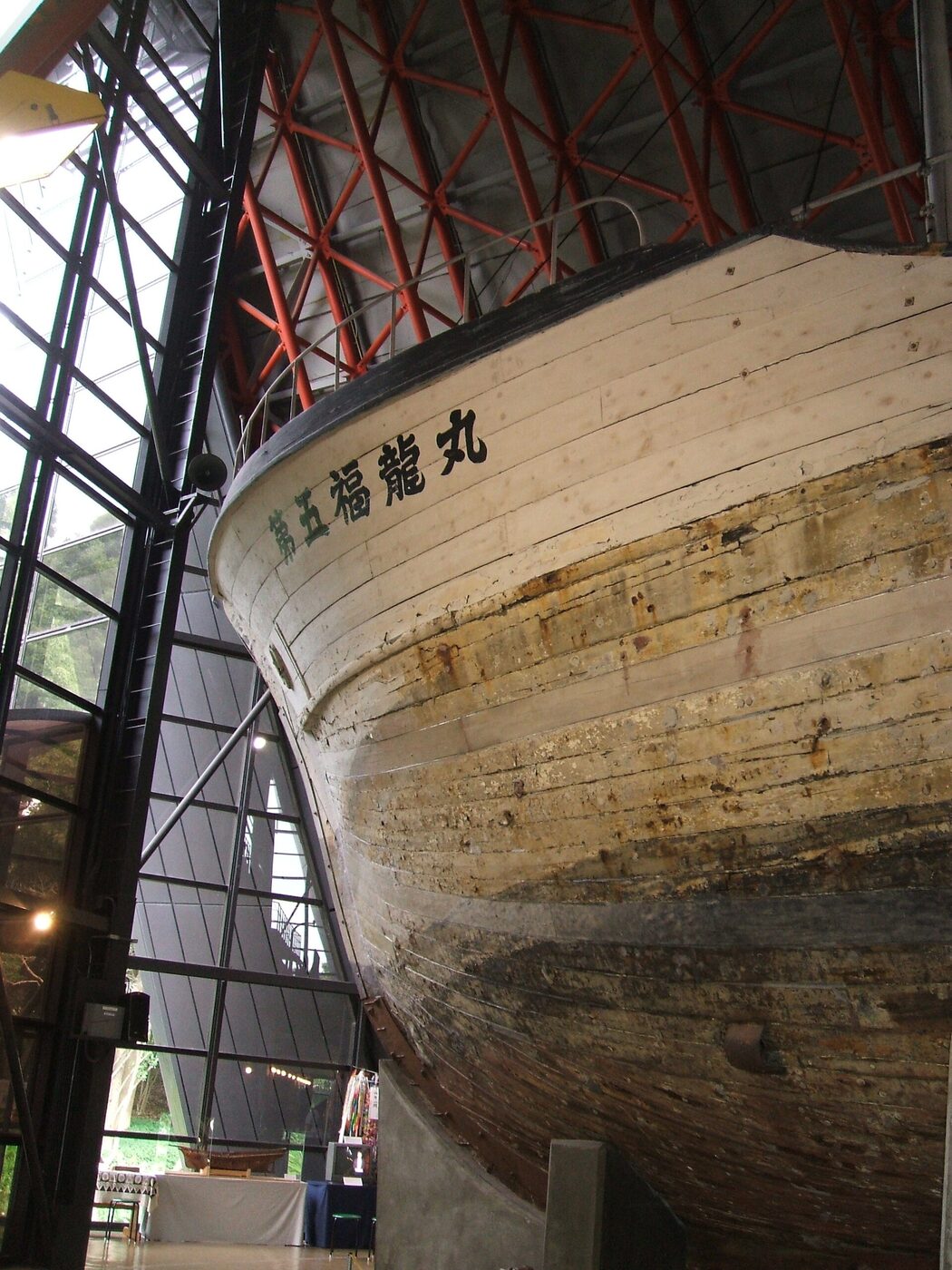

Beyond the film-makers' own statements, the academic literature is broadly agreed on the outline and divided on the emphasis, and it is worth attributing rather than summarising into a single verdict. Anne Allison, Thomas Schnellbächer and Steve Ryfle have argued that the film carries political and cultural undertones traceable to the Japanese wartime experience, that Japanese audiences connected emotionally to the monster as a fellow victim, and that — since the tests that woke it were American — the film can be read as assigning responsibility for Japan's postwar difficulties; they have also suggested it functioned as a means of collective coping. A separate reading, which gained prominence in Japan in the 1990s, treats Godzilla spiritually as the unquiet souls of soldiers killed in the Pacific War: the folklorist Norio Akasaka is credited with proposing it around 1992 and the critic Saburo Kawamoto with popularising it in a 1994 book, citing the creature's apparent refusal to attack the Imperial Palace. Ifukube himself endorsed that interpretation. Popular criticism has tended to the blunter formulation — the film as “an obvious gigantic, unsubtle, grimly purposeful metaphor for the atomic bomb” and as “extraordinarily solemn, full of earnest discussions”, in Terrence Rafferty's phrases in The New York Times — while noting how far the 1954 picture stands from the series it founded.
None of this was settled or uncontested reading in 1998, and a fan group is precisely where the general reader of the period would have encountered it. That is worth saying because the version of the film most English-speaking readers had seen was not the one the scholarship was describing.
The American re-edit, and where four words came from
In 1955 Edmund Goldman, a co-founder of Manson International, approached Toho's Los Angeles subsidiary about the film and offered $25,000 for the American theatrical and television rights. The contract, signed on 27 September 1955, provided that the film would be “narrated, dubbed in English and completed by the revisions, additions, and deletions”, with final approval resting with Toho. Goldman brought in Harold Ross and Richard Kay of Jewell Enterprises; Joseph E. Levine then paid $100,000 for half the rights, and Edward Barison set up Trans World Releasing Corp. to distribute. Terry Turner was hired to develop the promotional campaign, at a reported cost of $400,000 — sixteen times what the rights themselves had cost. A working title of Godzilla, the Sea Beast was considered before the released one was settled on.
The re-edit was directed by Terry O. Morse, who watched the Japanese cut with a translated script to find places where an American character could be inserted. Rather than dub the whole picture, Morse kept much of the Japanese dialogue and had a character translate it — inaccurately — on screen, alternating with narration. Raymond Burr, playing the reporter Steve Martin, was filmed with body doubles shot over the shoulder to hide their faces, on mock-up sets built to resemble the Japanese originals; accounts of how long his own shooting took differ, the new footage being recorded as three days on a rented soundstage while Burr's own recollection of a single day conflicts with a production record of six. He was paid $10,000, the same as Morse. The dubbing of the remaining roles was recorded in under five hours by two actors, James Hong and Sammee Tong, locked in a room and reading every part between them — seven younger characters for Hong, six older ones for Tong, thirteen in all — each line at several speeds so that the best take could be matched to the footage. They never saw the film while recording it.
What came out was 80 minutes long against the original's 96, with new American footage cut into a substantially shortened Japanese film. The cuts were not random. Overt references to the atomic bomb and the hydrogen bomb — the bombing of Nagasaki, the Bikini tests, the radioactive contamination of tuna — were removed, along with much of the Diet-chamber argument about whether to tell the public. Richard Kay was unembarrassed about it afterwards: “We weren't interested in politics, believe me. We only wanted to make a movie we could sell.” A West German release of the Japanese version on 10 April 1956 performed comparable surgery from the other direction, cutting that version to 84 minutes and removing the Diet argument, the description of Godzilla as a child of the H-bomb, and the references to Hiroshima and Nagasaki.
Godzilla, King of the Monsters! opened at Loew's State Theater in New York on 4 April 1956 and went into general American release later that month. It took more than $2 million — nearly four times what the original had made in Japan — returning about $200,000 in profit to its producers, and it became the first Japanese feature to be a commercial success in the United States and, at the time, only the fourth foreign film to pass $1 million at the American box office. The television rights went to RKO and it was first broadcast in 1959, on a Los Angeles station. Its success then made it, rather than the Japanese cut, the version the rest of the world saw: Trans World renegotiated with Toho to license the American edit to foreign markets, and it played across the Western world.
The Japanese release of the American version followed on 29 May 1957, as Kaijū Ō Gojira — Monster King Godzilla — cropped to a widescreen ratio the film had not been shot for, with the English dialogue subtitled in Japanese. Honda did not know the picture had been re-edited until Toho put that version out at home.
And this is the point at which the paperwork closes a loop. “King of the Monsters” was not Toho's phrase. It was an American selling line attached to the 1956 release, and Toho adopted it afterwards as an epithet for the character, where it has remained in marketing and promotional material ever since. Forty-two years later a fan typed it into a control message as the whole description of a newsgroup, and it entered the Usenet namespace — where it still sits. A four-word charter with a documented provenance is a rarer thing in alt.* than a long one.
The eras, dated
The series is conventionally divided into four eras. Three of them borrow the name of a Japanese imperial era and one is named for the turn of the millennium, and in every case the label is a production scheme rather than a calendar: the boundaries are drawn where Toho restarted its continuity, not where a reign began. Fan and critical usage has been consistent enough that the divisions can be stated exactly, with the films that bracket them.
- Shōwa era, 1954–1975. Fifteen films, from Godzilla (1954) to Terror of Mechagodzilla (1975), named for the reign of Emperor Shōwa, which does contain all of them. The tone travels an enormous distance across the run: from the 1954 picture to Ghidorah, the Three-Headed Monster (1964), from which Godzilla begins turning into an anti-hero, and on to films aimed squarely at children such as Son of Godzilla (1967) and All Monsters Attack (1969).
- Heisei era, 1984–1995. Seven films, from The Return of Godzilla (1984) to Godzilla vs. Destoroyah (1995), running in one continuous timeline. The 1984 film is a direct sequel to the 1954 original that discards everything in between. It is filed under Heisei despite predating the Heisei reign by five years, on the grounds that it leads directly into Godzilla vs. Biollante (1989), which did not.
- Millennium era, 1999–2004. Six films, from Godzilla 2000: Millennium (1999) to Godzilla: Final Wars (2004). These were all made during the Heisei reign too; the label exists to mark a different house style and a different structure — an anthology in which each film is a standalone story taking only the 1954 film as given, with two exceptions that share continuity with one another and with Mothra (1961) and The War of the Gargantuas (1966), and one, Final Wars, that sets aside 1954 as well.
- Reiwa era, 2016 onward. Beginning with Shin Godzilla (2016) and continuing through an animated trilogy and Godzilla Minus One (2023). Toho counts Shin Godzilla and the anime trilogy as Reiwa although Japan's Reiwa era did not begin until 1 May 2019. A sixth Reiwa entry, Godzilla Minus Zero, is scheduled for Japanese release on 3 November 2026, after a world premiere at the New York Film Festival in September.
The craft credits move in blocks along the same boundaries, which is part of why the divisions hold. Tsuburaya directed the effects for the first six Shōwa films; his protege Sadamasa Arikawa took the next three with Tsuburaya supervising, and Teruyoshi Nakano the last six. In the Heisei films the effects were Kōichi Kawakita's, with Nakano handling the 1984 entry; the Millennium films had a different effects director almost every time. The suit performers do the same. Haruo Nakajima played Godzilla in twelve consecutive films from 1954 to Godzilla vs. Gigan (1972), with Katsumi Tezuka sharing the 1954 work and a rotation of substitutes covering the last Shōwa years; Kenpachiro Satsuma played all seven Heisei Godzillas; Tsutomu Kitagawa played most of the Millennium ones.
Two things follow for anyone trying to catalogue the series, and both were live problems for readers in the 1990s. First, the era scheme is retrospective: nobody in 1971 was making a “Shōwa-era film”. Second, the numbering is genuinely ambiguous, because the American productions sit inside the franchise but outside Toho's own count — which is why a reference work can accurately describe Godzilla 2000: Millennium as the twenty-fourth film in the franchise and Toho's twenty-third in the same sentence. Arguments about which number a film is are not pedantry; they are a consequence of two studios releasing under one name.
Suitmation, miniatures and a double bass
Tsuburaya's first instinct for the 1954 film was stop motion, in the manner of King Kong. He worked out that Toho's staff and infrastructure would take seven years to finish the picture that way, and abandoned it. What he settled on instead — a performer in a monster suit moving through scaled-down sets — became the defining technique of the genre and acquired a name, suitmation, a portmanteau of “suit animation”. The technique is not merely a costume. The performer is filmed at a higher frame rate so that playback slows the movement; the performance is deliberately heavy and unhurried; the camera is placed low to sell the scale; and the sets are built to a scale chosen against the suit rather than against reality. Stop motion did not vanish entirely from the 1954 film — a shot of Godzilla's tail destroying the Nichigeki theatre building was done that way — but it survived as a garnish.
The miniature work was industrial. Kintaro Makino, the chief of miniature construction, was given blueprints by Akira Watanabe and assigned thirty to forty workers from the carpentry department, who took a month to build the scaled-down Ginza. Most miniatures were built at 1:25; the Diet Building was made at 1:33 so that it would read as smaller than the monster. Frameworks were thin wooden board reinforced with a plaster-and-chalk mixture, with explosives set inside the buildings destined to be destroyed, some sprayed with fuel to burn more readily and others deliberately cracked so they would crumble. The glow of the dorsal fins was optical animation, drawn frame by frame across hundreds of cels. Footprints on the beach were painted onto glass and composited into the live-action plate. Typhoon waves were stagehands upending barrels of water into a tank. Around four hundred staff were taken on for the optical work, half of them part-timers with little or no experience.
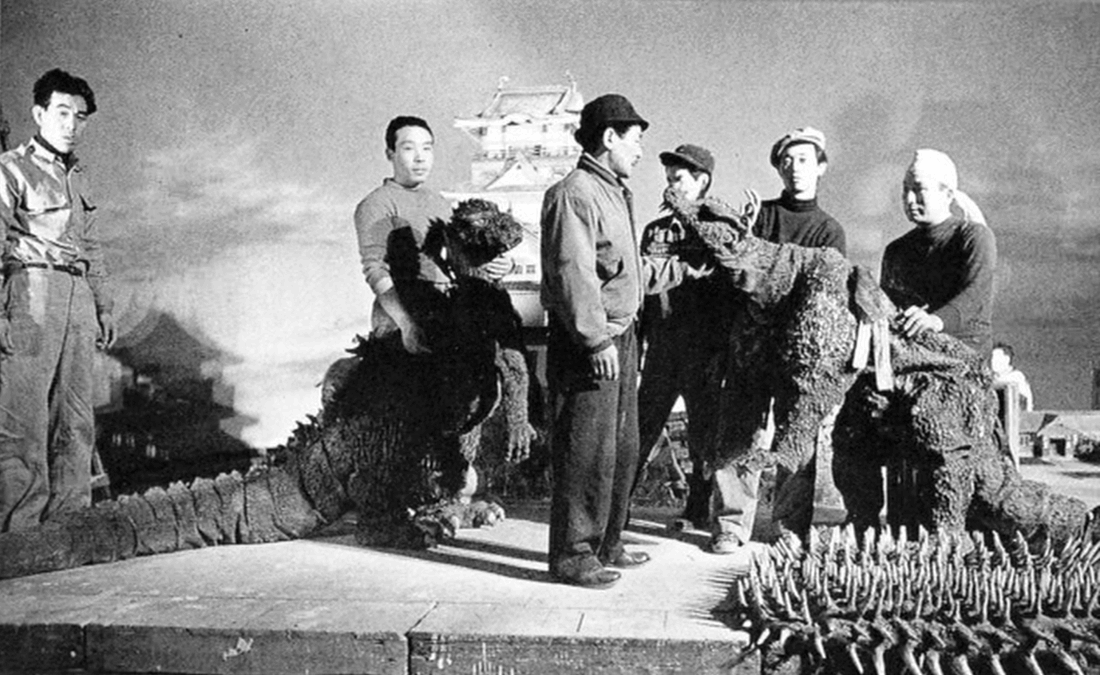
_Behind_the_scenes.gif)
The suit itself was punishing. Nakajima said the first one weighed 100 kilograms and needed two men to help him into it; even in the lighter second suit built for full-body shots he could last about three minutes before heat and exhaustion overcame him, and the Yagi brothers dried out the cotton lining every morning. Before shooting he spent a week at Ueno Zoo watching elephants and bears — he threw a piece of bread at the bears to see how they moved to catch it, and noted that elephants never show the soles of their feet. That he was in the suit at all was kept quiet: Mori barred reporters from the set, and Nakajima's performance was not publicly acknowledged until the 1960s. He went on to teach the performers who followed him, retired from the role after Godzilla vs. Gigan in 1972 when Toho cycled him out of its contract-actor system, and was reportedly moved to a job at the studio's bowling alley. He died on 7 August 2017, aged 88; the asteroid 110408 Nakajima was named after him the following year.
Satsuma's Heisei tenure was no gentler. He regularly passed out on set for lack of oxygen inside the heavy, poorly ventilated suits, and the problem was at its worst on Godzilla vs. Destoroyah, where the steam pouring off the creature during its nuclear meltdown was produced with pure carbon dioxide. He had also played Hedorah in 1971 and Gigan twice, and — a footnote of exactly the kind fan cataloguers collected — the title creature of Pulgasari, the North Korean monster film made by the abducted South Korean director Shin Sang-ok, which reference sources date variously to 1985 and 1986.
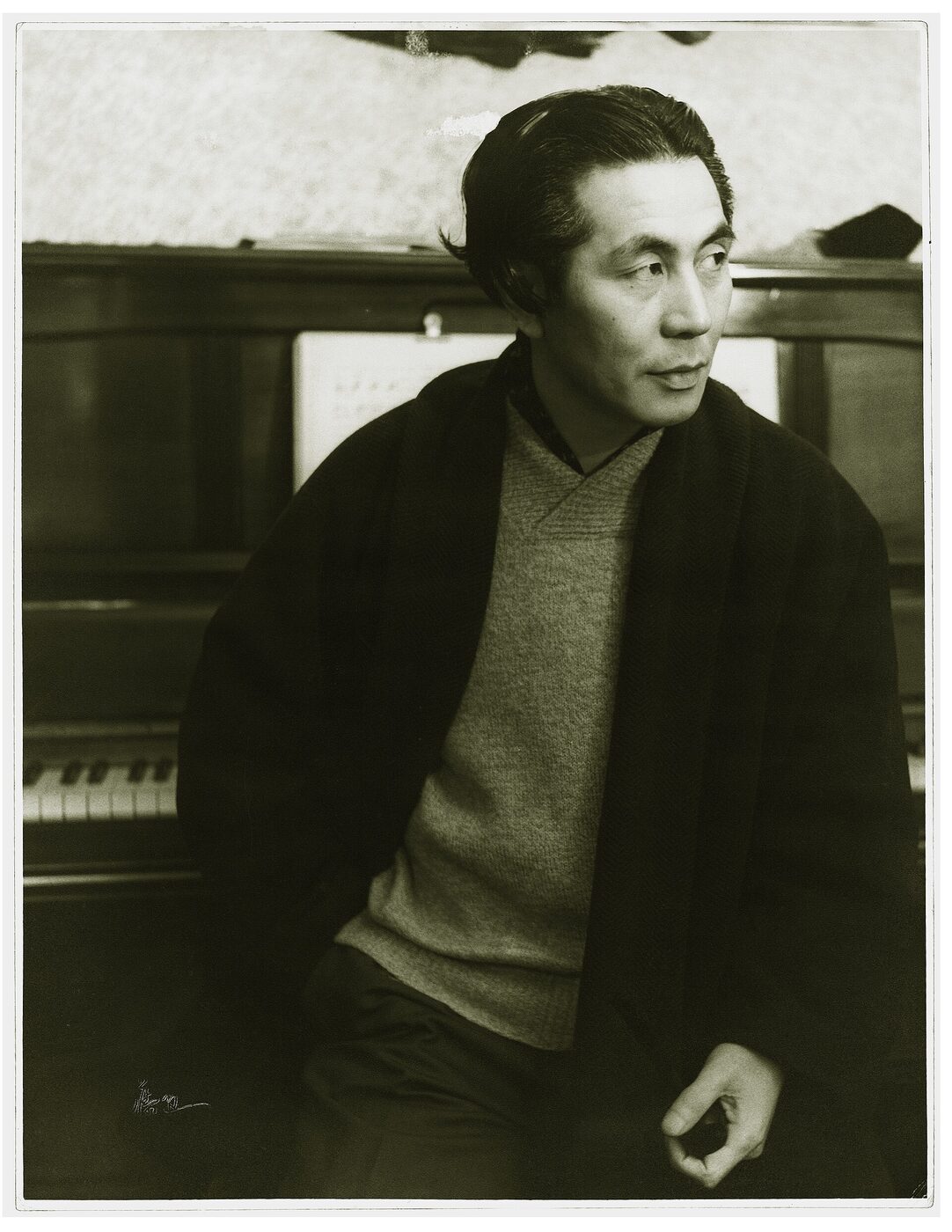

The sound was invented as deliberately as the picture. Ifukube had roughly a week, no finished footage and only a model of the creature and the screenplay to work from; he used low brass and strings to suggest something enormous. The roar came out of the same improvisation. Recordings of zoo animals played back at altered speeds were tried and rejected; Ifukube then borrowed a double bass from a university music department, loosened the strings, rubbed them with a leather glove and had the result recorded and played back slowed. Toho adopted the method as its standard way of building monster voices thereafter. Ifukube's themes outlived him and continued to be used in the series after his death in 2006.
The practical tradition, and the year it collided with something else
What makes the craft above a subject rather than a nostalgia item is how long Toho kept doing it. The studio was still building suits and blowing up miniatures into the 2000s, decades after the international industry had moved to optical compositing and then to computer-generated imagery. The Millennium films were still made with a performer in a suit and with miniatures. The break came at the end of them: after Godzilla: Final Wars in 2004, which marked the series' fiftieth anniversary, Toho put it on hiatus and demolished the water stage on its lot that had served the Godzilla, kaiju and tokusatsu productions.
The 1998 American production went the other way from the start, and the contrast was the substance of a great deal of argument. Rather than adapt the Toho design, the production began again: Emmerich hired Patrick Tatopoulos, whose account is that the only specific instruction he was given was that the creature had to be able to run incredibly fast. Tatopoulos replaced an upright, plantigrade sea monster with a lean, digitigrade, iguana-like animal carrying its back and tail parallel to the ground, coloured to blend into the urban environment. The creature was computer-generated. Motion capture from a human performer was considered and dropped — because, the production found, it ended up looking too much like a man in a suit.
That is a sentence with forty-four years of history compressed into it, and it is the honest hinge between the two halves of this article's subject. The technique that had been invented as the best available illusion of a giant animal had, by 1998, become a defect to be engineered out. The Japanese series returned to suits when it resumed the following year and kept them for another five years; the practical tradition ended not with the American film but with the water stage. When Toho later moved decisively to digital effects, it did so on its own terms and with results the industry noticed: Godzilla Minus One (2023), written and directed by Takashi Yamazaki, who also handled its visual effects, won Best Visual Effects at the 96th Academy Awards — the first Academy Award of any kind for a Godzilla film.
What a fan group was for, part one: filmography and continuity
It is worth being precise about the kind of work a group like this did, because the temptation to romanticise it is strong and the evidence for any particular thread is nil. What can be described honestly is the class of problem the subject presented in the late 1990s, and it was a large one.
Start with continuity, which in this series is not a fandom obsession but a genuine bibliographic difficulty. Three of the four eras begin by discarding most of what came before. The Heisei films ignore everything between 1954 and 1984. The Millennium films mostly ignore everything except 1954, except for the two that connect to each other — and those two also connect outward to Mothra (1961) and The War of the Gargantuas (1966), which are not Godzilla films at all. Final Wars sets aside 1954 as well. Meanwhile the Shōwa run absorbed monsters from outside its own series — Rodan, Varan and Mothra each arrived from solo films of their own, and Anguirus, Manda, Baragon, Gorosaurus and Kumonga from elsewhere in Toho's catalogue — so that the Godzilla filmography is not a closed set and never has been. A reader who wanted to know which films they had to see, in what order, and whether a given monster's earlier appearance “counted”, was asking a question with no answer printed on any box.
Add the numbering problem described above, and the fact that Toho itself re-released shortened cuts of Shōwa titles as part of its Toho Champion Festival children's programme, so that some films exist in more than one running time under the same name in the same country. Add the American, Italian and German re-edits, which are effectively separate films made from the same negatives. What the fandom produced in response was list-making: filmographies with dates, studios, directors, effects directors, suit performers, monster rosters and running times, maintained collaboratively and corrected in public. Usenet was a good medium for that work and a bad one for preserving it — the corrections lived in threads and the compiled result usually lived on somebody's web page or in a periodically posted FAQ. The general culture of Usenet fan scholarship, and what the FAQ meant as an institution, is discussed on the rec.arts.sf.written.robert-jordan page and not repeated here.
What a fan group was for, part two: the same film under four names
The title problem deserves its own section because it is the single most concrete, most checkable illustration of why an English-language kaiju group had work to do. The following are all documented release facts, and every one of them was a live source of confusion in the 1990s.
- The 1954 film is Gojira in Japan. In the United States it has been released as Godzilla, King of the Monsters! (1956, re-edited), as Godzilla (2004, Rialto, the Japanese cut, uncut and subtitled), as Gojira (2006, on disc) and as Godzilla: The Japanese Original (2014, subtitled that way specifically to avoid confusion with a different American film released that year).
- Godzilla Raids Again (1955) was to have been cannibalised into an entirely new American film called The Volcano Monsters, using the Japanese effects footage around a new story with American characters. The financing collapsed. The film was instead re-cut, dubbed and released by Warner Bros. on 2 June 1959 as Gigantis, the Fire Monster — the monster renamed outright.
- Mothra vs. Godzilla (1964) was released theatrically in the United States by American International Pictures on 26 August 1964 as Godzilla vs. the Thing, the second monster deliberately withheld from the title and from the poster. Paramount Home Video issued it on tape in 1989 as Godzilla vs. Mothra. In 1998 Simitar reissued it on tape and disc still called Godzilla vs. Mothra — except that the widescreen side of the disc carried the original American print, titled Godzilla vs. The Thing. One film, three titles, two of them on the same object.
- Meanwhile the 1992 film Godzilla vs. Mothra — a different picture, twenty-eight years later, with a different Mothra — was released on American home video on 28 April 1998 as Godzilla and Mothra: The Battle for Earth. For part of 1998, therefore, two distinct films were on American shelves under names that swapped between them.
- King Kong vs. Godzilla (1962) was reworked for America with new footage of a United Nations reporter and the head of a New York natural history museum explaining the plot, and Ifukube's score largely replaced with library music recycled from other pictures, including Creature from the Black Lagoon.
- The Return of Godzilla (1984) reached America in 1985 as Godzilla 1985, again re-edited with new footage, and again with Raymond Burr — reprising the same reporter he had played in 1956, twenty-nine years on.
- In Italy, Luigi Cozzi licensed a negative of the American 1956 version, colourised it frame by frame by a gel process, cut in stock footage of destruction and wartime newsreel, redubbed it in Italian and released it to Italian cinemas in 1977 at a running time of about 105 minutes. “Spectrorama 70”, often quoted as the name of the process, was a term Cozzi coined for the advertising. Fans, and Cozzi himself, call the film Cozzilla; by Cozzi's account Toho also licensed the colourised version to Turkey.
Mapping that lot — Japanese title to international title to American release title to home-video title, with running times and which negative each was cut from — is exactly the sort of collaborative reference work a newsgroup is good at, because it can be corrected by whoever owns the tape. It also required people who could read Japanese, or at least read a Japanese poster, since the Japanese theatrical materials themselves sometimes carried an English title different from the one used abroad: the 1964 film's own Japanese poster gives its English title as Godzilla Against Mothra, which matches neither the American release nor the modern English name.
What a fan group was for, part three: what you could legally watch
The third genre of work follows from the second. In 1998 a large part of this filmography was difficult or impossible to see legally outside Japan, and tracking what had been licensed, by whom, in what form and under what title was a standing service the fandom performed for itself.
The headline fact is stark: the original 1954 Japanese version remained officially unavailable in the United States until 2004. For fifty years the version American critics and scholars had access to was the 1956 re-edit. There were exceptions at the margins — the film played in cinemas serving Japanese-American neighbourhoods from 1955 into the 1960s, and an English-subtitled print was shown at film festivals and art-house cinemas in New York, Chicago and other American cities in the summer of 1982 — but those were events, not availability. The 2004 remedy was itself modest: a coast-to-coast travelling limited release by Rialto Pictures from 7 May to 19 December 2004, never on more than six screens at once, reaching roughly sixty theatres in total. The British Film Institute released the Japanese version theatrically in the United Kingdom in October 2005 and on disc the same year.
What was on the shelves in the group's own year makes the point better than any general statement. In 1998 Simitar Entertainment issued the American 1956 version on tape and disc. The Heisei films were arriving in North America not in cinemas but straight to video, and mostly through Columbia TriStar, the corporate sibling of the studio then making the American film: Godzilla vs. King Ghidorah (1991) and Godzilla vs. Mothra (1992) both landed in 1998, the two also sharing a single-disc double feature — full frame at 1.33:1, English audio only, no subtitles, a trailer for each as the extras. Godzilla vs. Destoroyah (1995) followed in 1999. Godzilla vs. Biollante (1989) had reached America in November 1992 on HBO Video, two years late, after Toho sued a would-be distributor over a broken-off deal.
Everything a modern reader would consider basic access arrived afterwards, and it is worth listing so that the 1998 position is not read backwards through it: the British Film Institute's 2005 disc of the Japanese version, with commentaries by film historians and a documentary about the Daigo Fukuryū Maru; the Classic Media two-disc release of both the Japanese and American cuts in 2006, with commentaries by Steve Ryfle and Ed Godziszewski and two short making-of documentaries; the Criterion Collection's high-definition restoration in 2012; streaming of both cuts from 2017; and, in October 2019, Criterion's box set of all fifteen Shōwa films, sixty-five years after that run began. Every one of those is a fact about the years after the group was created. In May 1998 the honest summary is that an English-speaking enthusiast could see a good deal of the series legally, but mostly dubbed, mostly cropped, and often under the wrong titles.
May 1998: the month the group was created
The timing recorded in the control message is not incidental, and the surrounding facts are all documented. TriStar Pictures had announced plans in October 1992 for a trilogy of Godzilla films, having acquired the rights from Toho earlier that year. Jan de Bont was announced as director in July 1994 and left that December over budget disputes; Roland Emmerich and Dean Devlin replaced him in 1996. Toho, for its part, had killed the character off: Godzilla vs. Destoroyah, released in Japan on 9 December 1995, was publicised in advance on exactly that basis, with placards reading “Godzilla dies”, and Toho representatives said afterwards that while the death was not permanent they did not plan a revival until the twenty-first century, because of TriStar's plans. So from December 1995 to May 1998 there was no Japanese Godzilla film in production at all, and the only one in the world was American.
The American production kept its creature secret. Emmerich insisted that no full-body image appear in the marketing, and some three hundred companies signed agreements not to show the whole creature before release. The teaser, budgeted at $600,000 and shot before principal photography, showed a foot crushing a Tyrannosaurus skeleton in a museum and nothing else. A campaign built on withholding the design, running in the first years of a mass consumer internet, produced precisely the conditions in which a newsgroup gets created eleven days before opening night, and the proposer said as much: the support was fuelled by the hype.
The reception is on the record and does not need editorialising. Godzilla premiered at Madison Square Garden on 18 May 1998 — a day the Mayor of New York proclaimed Godzilla Day in the city — and opened in the United States and Canada on 20 May in a record 3,310 theatres. Sony had expected $100 million over the Memorial Day weekend; it took $44 million over the weekend and $74.3 million in six days, and finished with $136.3 million domestically and $379 million worldwide against a production budget put at $125–150 million. Reviews were generally negative, with aggregate scores settling around a fifth of critics positive; audiences polled by CinemaScore gave it a B minus; and at the 19th Golden Raspberry Awards it won Worst Supporting Actress and shared Worst Remake or Sequel in the only three-way tie in that show's history. Two planned sequels were cancelled; an animated series was made instead; TriStar let the licence lapse in 2003.
Reaction from within the series is documented too, and is more interesting than the reviews. Nakajima, who had worn the suit for eighteen years, said of the new creature that “its face looks like an iguana and its body and limbs look like a frog”. Satsuma walked out of a screening at the G-Con '98 convention in Chicago, saying “it's not Godzilla, it doesn't have his spirit”. The Toho publicist Yosuke Ogura later called the design a disaster. Shusuke Kaneko, who would direct a Godzilla film himself in 2001, offered the sharpest reading: “It is interesting [that] the US version of Godzilla runs about trying to escape missiles... Americans seem unable to accept a creature that cannot be put down by their arms.” And the fandom coined a term of art — GINO, Godzilla In Name Only — attributed to the critic and fan Richard Pusateri, to name the creature without conceding the name. Toho eventually made the distinction official: when the 1998 design reappeared in Godzilla: Final Wars in 2004, it was called Zilla, and it has been used and trademarked under that name since.
The commercially decisive consequence, from the perspective of anyone reading a kaiju group in 1998, was quick and in the opposite direction from what the studios had planned. Development on a new Toho film began two months after the American one opened. Godzilla 2000: Millennium premiered at the Tokyo International Film Festival on 6 November 1999 and opened in Japan on 11 December; TriStar distributed it in North America on 18 August 2000, dubbed and eight minutes shorter than the Japanese cut. The group had been created in the gap between two studios' Godzillas, and the gap closed within a year and a half.
A sibling group, and the shape of alt.fan.*
alt.fan.* worked on one principle: a group per object of enthusiasm, created the moment somebody cared enough to format a message. This directory preserves several of them, including alt.fan.starwars.jar-jar-binks.die, whose name performs the other thing the family was for. The comparison is instructive rather than flattering to either: in a namespace where creation is free, the group that catalogues a fifty-year filmography and the group that exists to voice an opinion about one character sit on the same shelf with the same standing, and the only thing that distinguishes them is what people did afterwards.
Which is the honest frame for alt.fan.godzilla. Its founding document argues that the subject predates the marketing wave that prompted the group and would outlast it. The namespace record shows that the name did outlast it, by a considerable margin. What it does not show is what was posted there.
What the record does not show
This page has been assembled from documents that survive: one control message, the reference newsgroups and active files, the archived control traffic of neighbouring groups, and the published history of the films. Several things a reader might reasonably want are not available and have not been guessed at.
- Traffic and readership. There is no surviving measurement of how many people read or posted to this group, at any point in its life. alt.* groups were not polled, and the article counters in a distributed reference active file record the state of that file rather than the network's.
- Threads, regulars and running jokes. No specific discussion is described here because none has been verified. A group founded eleven days before a major release almost certainly discussed that release; saying more than that would be invention.
- A FAQ. Fan groups of this period commonly maintained one; no periodic posting for this group has been located, and its absence from the record is not evidence that none existed.
- The founder. The control message is signed with a handle and an organisation, both of which are quoted above exactly as the archive records them. Nothing further about the person is asserted.
- An end date. alt.* groups do not usually get closed; they get carried less. There is no rmgroup for this group and therefore no date on which it stopped existing.
This is the normal condition for an alt.* fan group and not a defect peculiar to this one. The hierarchy that made creation cost one message also made documentation cost nothing to skip.
Where it stands now
The group is still in the namespace. It appears in the reference active file as a carried, unmoderated group, and in the reference newsgroups file with the same description it was born with — which, given that ISC executes every properly formatted alt.* newgroup automatically and ignores every rmgroup, is what one would expect: alt.* accumulates names rather than shedding them, and nothing has ever been sent that would change this one. Whether any particular news server still carries it, and whether anything has been posted to it recently, are separate questions that no central record can answer, because in alt.* there is no central record to consult. Usenet's wider decline through the 2000s is described on the soc.* hub.
The subject, meanwhile, went in the other direction. The series that was dormant when this group was created has since run through a fourth era, taken an Academy Award for visual effects, and has a further film scheduled. The 1954 film that could not be seen legally in America when the group was founded is now available in restored form on several continents, with commentary tracks by the historians whose books the fandom of the 1990s was reading. Almost everything a kaiju enthusiast in May 1998 was waiting for eventually arrived.
What did not survive is the thing the group itself made: the pooled, corrected, argued-over reference work of readers who owned different tapes, read different languages and had seen different cuts. Some of it migrated to the web and some of it went into the commercial reference books. The rest of it went where most Usenet went. The four words remain, which is more than most groups leave.
Scope and limits of this page
This is an article about a newsgroup and the world it belonged to, not a review, a ranking or a viewing guide, and it takes no position on the arguments the group existed to have. Where the scholarship on the 1954 film is quoted it is attributed to the people who published it; where accounts conflict — as they do over how many days Raymond Burr worked, over which American release date is the right one to cite, and over whether Pulgasari is a 1985 or a 1986 film — the conflict is stated rather than resolved. Film titles, years, studios, directors, effects directors and performers have been checked individually against reference sources rather than copied from a list, because this filmography is miscopied more often than almost any other in popular cinema, and because Japanese and international release names differ in ways that make a plausible-looking list easy to assemble and wrong.
The group's own paperwork is quoted from the Internet Systems Consortium's mirror of Usenet control traffic, which is the primary source for it. Everything attributed to that message can be read there in full. Everything else about what happened inside the group is, so far as this page is concerned, unknown.
Reading alt.fan.godzilla today
- Historical archive: Google Groups — alt.fan.godzilla (coverage varies by group and era).
- Open in a newsreader:
news:alt.fan.godzilla— the original site offered exactly this link, and it still works if your system has a newsreader registered for thenews:scheme. - Live access: point an NNTP newsreader at a modern server — see accessing Usenet today.
- The original news2mail e-mail subscription service ended in the mid-2000s and no longer operates.