The adobe.* groups
A vendor branch for Adobe product discussion, carried by the gateway alongside Usenet’s own hierarchies. Only the group the gateway served is described here.
On this page
- What the hierarchy record actually contains
- How a vendor hierarchy was administered
- microsoft.public.*, the fully documented case
- Other vendors in the same ledger
- Where Adobe's software was discussed in Usenet's own hierarchies
- The company whose products the group was named for
- Acrobat and PDF, in dates
- 1 July 2008: the format leaves the vendor
- From news servers to web forums
- What would settle the question
What the hierarchy record actually contains
The question a directory page owes its reader is a simple one: did an adobe.* hierarchy exist as a managed hierarchy, and if so, who ran it? The canonical place to look is the pair of files the Internet Systems Consortium has distributed for decades — the master newsgroups list, which names every group in every hierarchy it knows of, and control.ctl, the access-control file that tells a news server whose newgroup and rmgroup messages to honour. Checked while this page was being written, the newsgroups file carries just over 45,000 group names spread across 479 distinct top-level hierarchies. Not one of them begins with adobe.
That absence is worth something, because the archive states its own ambition. Its README says of the two files that the intention is for the active and newsgroups files here to be complete for all publicly available hierarchies, and asks anyone who knows of a public hierarchy missing from control.ctl to write in. The control file is equally retentive about the past: it carries twelve entries flagged *DEFUNCT* — hierarchies no longer in use, kept in place so that a server meeting a stray control message still knows what it is looking at. Ball State University's and Stanford University's long-dead branches are both still there, as are mod.*, the original moderated hierarchy, and the German zer.* and Japanese tnn.*. There is no ADOBE entry among the living or the dead.
The same data is published as a browsable hierarchy database, and a query there for ADOBE returns one line: That hierarchy is unknown. Please tell us if it really exists.
The honest reading of that is narrow. These files record hierarchies whose administration was declared and whose group lists someone maintained. A branch carried on a single company's own news server, and picked up by whichever peers chose to take a feed from it, need never have issued a control message and so need never have entered the record at all. This directory's own listing is evidence that the gateway received adobe.acrobat from somewhere between 2000 and 2004; it is not evidence of a managed hierarchy behind it. What follows is therefore the documented pattern into which such a group fits, and the documented history of the products it was named for — not a reconstruction of an adobe.* hierarchy, for which the surviving record is very slight indeed.
How a vendor hierarchy was administered
Usenet's own hierarchies were governed by discussion and, in the Big Eight, by a formal proposal and voting process. A vendor hierarchy was governed by whoever owned the products. The published guidance on hierarchy administration puts the range plainly: maintenance practice varies from the complete anarchy of alt.* to the highly formal system used by comp.*, or simply by fiat of the organization running the hierarchy as with microsoft.*. The mechanism, in every case, was the control message — a specially formatted article telling servers to create a group, remove one, or reconcile their list against a canonical checkgroups.
A hierarchy therefore needed an administrator: someone responsible for following whatever procedure had been agreed and then publishing the result. Publication mattered because control messages alone were never enough. Many servers ignored them, either from policy or from a well-founded fear of forgeries, so a hierarchy that wanted to be carried accurately also published its group list by other means. control.ctl records that second channel as a syncable server: a hostname from which another administrator could pull the canonical list directly.
The default disposition of anything unrecognised is set at the top of the file — all:*:*:drop, with the comment that unknown control messages are dropped to allow people to experiment without inadvertently mailbombing news admins, while unrecognised newgroup and rmgroup messages are merely mailed to the administrator for a human decision. The practical consequence is the one that matters for a page like this. A vendor hierarchy nobody had configured did not propagate by default. Carriage was a decision taken server by server, which is exactly why a small gateway's list of the groups it actually served is a historical document in its own right.
microsoft.public.*, the fully documented case
The vendor pattern is best documented at Microsoft, and the documentation survives in the same files. The current newsgroups list carries 1,770 microsoft.* groups, every one of them under the second-level public, a convention Netscape's hierarchy shared. The ISC hierarchy notes, a file last modified in 2010, describe how the list was kept: Microsoft does not maintain their hierarchy via Usenet control messages. I receive a list of changes to make every week directly from Microsoft via e-mail.
control.ctl records the later arrangement, in which the control messages were signed by a volunteer rather than by the company: Control articles for that hierarchy are not issued by Microsoft itself but by a Usenet active participant in order to improve the quality of the propagation of Microsoft newsgroups. The entry drops newgroup and rmgroup messages from everyone else, names microsoft.public.news.server as the administrative group, and gives the syncable server as msnews.microsoft.com — the company's own public NNTP host, from which other sites synchronised. The microsoft.public.* groups the gateway carried are listed on their own hub here.
The end of that arrangement is dated: Wikipedia's account of Usenet records that Microsoft closed its news server in June 2010 and moved product support to web forums. The group names outlived the server. They are still in the ISC list today, which is a useful caution about what such a list proves: it is a register of names that someone maintains, not a guarantee that any server still carries the traffic.
Other vendors in the same ledger
Microsoft was not alone, and the surviving entries show how varied the arrangements were. Each of these is a hierarchy with a declared administrator, a group list and, in most cases, a company-run server to synchronise from:
netscape.*— 93 groups, all undernetscape.public, withnetscape.public.adminas the administrative group and the hierarchy's published URL pointing at the Mozilla community page.opera.*— 39 groups for Opera Software of Oslo, syncable fromnews.opera.com; the list runs fromopera.announce, described as official announcements from the company and moderated, to per-platform and per-language groups such asopera.amigaandopera.afrikaans.staroffice.*— 26 groups for Sun Microsystems' StarOffice suite, administered fromstaroffice.adminand syncable fromstarnews.sun.com, with separate branches for chat, feature requests and customer-support announcements.codewarrior.*— 12 groups for the CodeWarrior development tools, whose control messages were issued not from the vendor's own address but from one atsupernews.net.openwatcom.*— 5 groups for the Open Watcom compilers, syncable fromnews.openwatcom.org.
Sybase's entry is the most instructive of all, because it describes a hierarchy that was deliberately not distributed. Its note in control.ctl reads:
For use through Sybase's news server only. Configure your news reader to use forums.sybase.com as an NNTP server, or access the groups via support.sybase.com/newsgroups/.
Two things are visible in that one instruction. The first is that a vendor branch could be a private service reachable by NNTP rather than a hierarchy in circulation — the reason a group can be real, and readable, and still leave no trace in the propagation record. The second is the hostname: forums.sybase.com, serving newsgroups. The vocabulary of the web forum had arrived before the transport changed. A single sybase.* group name survives in today's list; the rest has gone.
This is the shape an adobe.* branch would have taken had it been administered the same way, and it is the comparison a reader of this hub should hold in mind. For Adobe, none of these artefacts — no contact address, no administrative group, no syncable server, no group list — appears anywhere in the record.
Where Adobe's software was discussed in Usenet's own hierarchies
What the record does contain, in quantity, is Adobe discussion under hierarchies that were not Adobe's. The descriptions below are the ones carried in the master newsgroups file, quoted as they stand:
comp.text.pdf— Adobe Acrobat and Portable Document Format technology.comp.lang.postscript— The PostScript Page Description Language.comp.graphics.apps.photoshop— Adobe Photoshop techniques & help.alt.comp.apps.adobe— Adobe products discussion, multi-lingualalt.graphics.illustrator— Discussion of Adobe Illustrator graphic software program.de.comp.text.pdf— Mehr als Acrobat.it.comp.grafica.photoshopandfree.it.software.adobe.premiere— Italian-language groups for Photoshop and Premiere.fj.comp.lang.postscriptandjapan.comp.lang.postscript— PostScript in the two Japanese hierarchies.fido7.su.adobeandfido7.ru.adobe.photoshop— Russian-language FidoNet echoes, gatewayed into Usenet.
That distribution is the structural fact about Adobe on Usenet, and it is a different one from Microsoft's. Microsoft's customers were addressed in a branch the company itself maintained and fed from its own host; Adobe's were spread across the Big Eight, across alt.*, and across the German, Italian, Japanese and Russian-language hierarchies, where the groups were created and governed by those communities rather than by the vendor. A vendor group named adobe.acrobat sat alongside that traffic rather than replacing it.
The company whose products the group was named for
Adobe was founded in December 1982 by John Warnock and Charles Geschke, and its first product was PostScript, a page description language sold to printer manufacturers rather than to the public. The commercial breakthrough came with the printer that carried it: the Apple LaserWriter, announced at Apple's annual shareholder meeting on 23 January 1985 — the same day Aldus announced PageMaker — and shipping from that March, with a PostScript interpreter built in.


That founding fact shapes the discussion that followed. Adobe's earliest constituency on the network was reached through the language rather than through an application: PostScript has a group of its own in comp.* and another in each of the two Japanese hierarchies. The consumer applications came later — Illustrator for the Macintosh in the mid-1980s, Premiere in 1991, PageMaker and After Effects arriving with the acquisition of Aldus in 1994, and the Macromedia line in 2005 — and each of them, on Usenet, found a home in an existing hierarchy rather than a vendor branch of its own: Illustrator in alt.graphics.illustrator, Photoshop in comp.graphics.apps.photoshop, the Macromedia titles in alt.macromedia.director and alt.macromedia.flash.
Acrobat and PDF, in dates
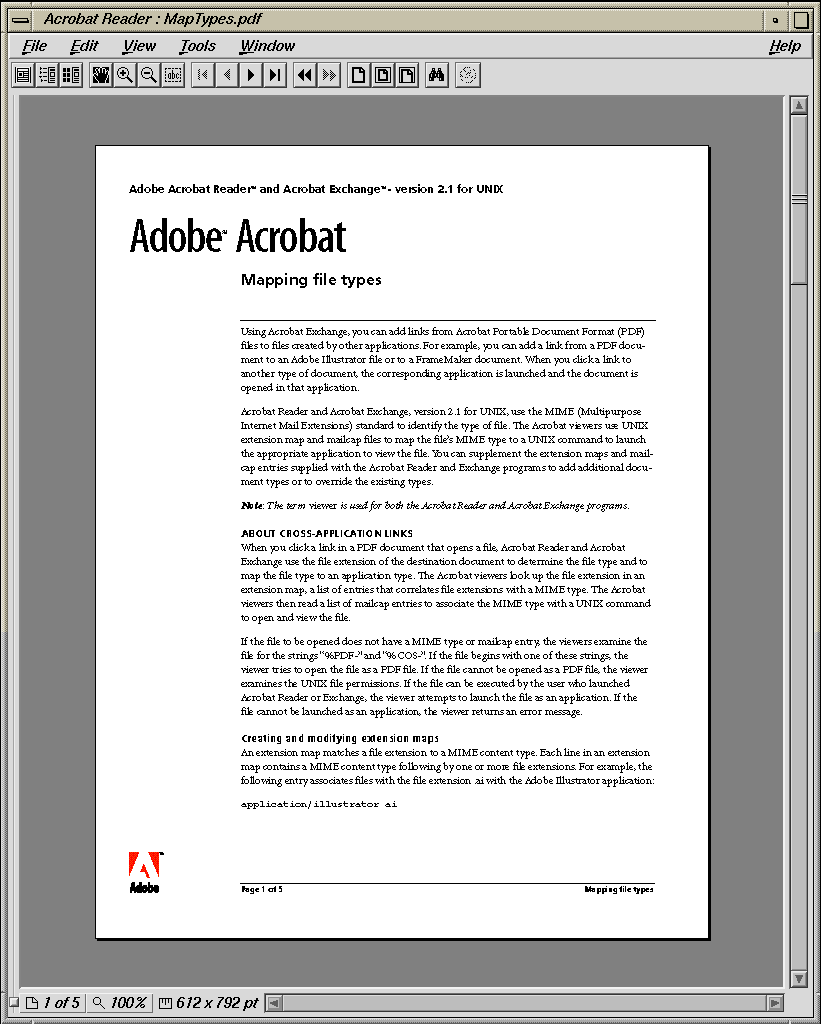
The group this hub sits above was named for Acrobat, and the milestones are firm. Development of the format began in 1991, when Warnock wrote a paper for a project then code-named Camelot, proposing a simplified version of PostScript. Adobe Acrobat was launched on 15 June 1993, and Adobe made the PDF specification available free of charge in the same year.
The original release was three products rather than one: Acrobat Reader, Acrobat Exchange and Acrobat Distiller, the last of these converting PostScript output into PDF. Over time Exchange became simply Acrobat and Acrobat Reader became Reader, the component distributed as freeware. In 1999 the Acrobat.com service came into being, introducing several web services alongside the desktop applications. The product history proper belongs to the group's own page, adobe.acrobat, rather than to this hub.

1 July 2008: the format leaves the vendor
PDF was a proprietary format controlled by Adobe until it was released as an open standard on 1 July 2008 and published by the International Organization for Standardization as ISO 32000-1:2008. In the same year Adobe published a public patent licence to ISO 32000-1, granting royalty-free rights to all patents it held that were necessary to make, use, sell and distribute conforming implementations; anyone may write software that reads and writes PDF without paying royalties to Adobe.
Standardisation continued after that. PDF/UA, the accessibility conformance level, was first published as ISO 14289-1 in 2012. ISO published PDF 2.0 as ISO 32000-2 in 2017, with a second edition of that standard following in December 2020.
For a directory of newsgroups the significance is structural rather than technical. A vendor support group exists because the vendor defines the thing being discussed; once the definition of PDF passed to a standards committee, the questions that had been vendor questions — does this file conform, will this renderer accept it, which version of the specification governs — became questions with a published answer that was not Adobe's to change alone. The two changes — the format leaving the vendor, and the vendor news servers closing — fell close together in time.
From news servers to web forums
The migration that ended vendor newsgroups is well dated at its edges. Access was withdrawn first by the carriers: AOL discontinued Usenet access in 2005; AT&T announced on 8 June 2009 that it would stop providing the service; Verizon announced in August 2009 that access would end on 30 September that year; Duke University decommissioned its own news server in May 2010. Microsoft closed its news server the following month and moved support to web forums, and the Sybase note quoted above shows a vendor offering NNTP and a support website as two doors into the same content well before that.
The archives outlasted the servers. Web archiving of Usenet had begun in March 1995 at Deja News, whose searchable database was acquired by Google in February 2001; that archive is where surviving traffic from the gateway's own period is generally looked for, although coverage varies by group and by era. Newsgroups themselves have not ended: the transport still works, and accessing Usenet today is a matter of pointing a newsreader at a server that carries what you want.
Where Adobe itself stood in that transition is precisely what this page cannot document. No source consulted for this article establishes when — or whether — the company ran a public NNTP service of its own, when any such service closed, or what relationship it had to the group this hub sits above. That gap is stated here rather than filled.
What would settle the question
Four kinds of evidence would turn this page from a description of a pattern into a history of a hierarchy, and each of them is the sort of thing a reader may well hold:
- A
checkgroups, newgroup or rmgroup control message foradobe.*, which would name whoever administered it. - An archived
activeornewsgroupsfile from a server that carried the branch, showing which groups it contained and when. - An archived Adobe support page naming an NNTP host, which would establish whether the company served the groups itself in the manner of Microsoft, Opera or Sybase.
- An article header from the period — the
NewsgroupsandPathlines of a single saved post would show the group's name as it propagated and the route it took.
None of these was obtainable while this page was written; the Internet Archive's Wayback service, the obvious place to look for the third, was returning a service-unavailable notice throughout. Corrections and documents are welcome. Until they arrive, this hub records what is verifiable: that the gateway carried a group called adobe.acrobat, that vendor hierarchies of that kind were a real and well-documented feature of the period, and that the canonical hierarchy record contains no entry for Adobe's.